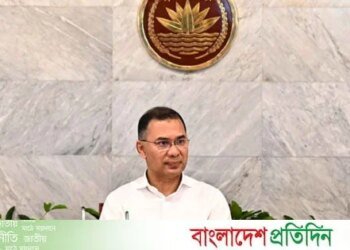
Prime Minister Tariq Rahman is going to Malaysia today for his first foreign visit. He will leave for Kuala Lumpur this afternoon on a two-day official visit at the invitation of the country’s Prime Minister Anwar Ibrahim. Later on Monday evening, Tariq Rahman will leave Malaysia for a four-day visit to China. During his visit, he will hold bilateral meetings with Malaysian Prime Minister Anwar Ibrahim and Chinese President Xi Jinping. At least 20 MoUs can be signed in these meetings besides discussing issues related to bilateral and regional interests. International relations analysts believe that the prime minister’s first pair of foreign visits will create a new equation in geopolitics. In a press conference at the Ministry of Foreign Affairs yesterday morning on the occasion of the Prime Minister’s visit, Foreign Secretary Asad Alam Siam said that Prime Minister Tariq Rahman is going to Malaysia on Sunday for a two-day official visit. He will then visit China on June 23-26.
Through this visit, the existing economic and diplomatic relations with Bangladesh, Malaysia and China will be deepened and expanded. The accompanying delegation is kept relatively small, with members limited to 27 to 28 members. The high-level delegation includes Foreign Minister Khalilur Rahman, Prime Minister’s Foreign Affairs Adviser Humayun Kabir, Expatriate Welfare and Foreign Employment Minister Ariful Haque Chowdhury, Information and Broadcasting Minister Zahir Uddin Swapan and others.
He said that Tariq Rahman will have a private meeting with Prime Minister Anwar Ibrahim tomorrow during his visit to Malaysia. Later, a bilateral meeting will be held between the high-level delegation led by the heads of government of the two countries. Discussions will focus on trade, investment expansion, energy cooperation, halal economy, semiconductor industry and agriculture, education and public relations. In these cases, more cooperation between the two countries will be discussed. Besides, Bangladesh will seek Malaysia’s support in taking new Bangladeshi workers in various sectors of Malaysia, joining Bangladesh in ASEAN, and repatriating Rohingyas. Apart from this, two documents on cultural exchange and free trade agreement with Malaysia are likely to be signed during the Prime Minister’s visit.
Regarding the visit to China, the foreign secretary said, it is expected that 15 to 17 memorandums of understanding (MOU) or agreements can be signed between the two countries during Prime Minister Tariq Rahman’s visit to China. Among them, 13 MoUs, two agreements, an action plan and a protocol are likely to be signed. Apart from this, there is going to be a detailed discussion on the Teesta Master Plan.
Regarding the schedule of the Prime Minister’s visit to China, he said that the Prime Minister will arrive in China’s port city of Dalian tomorrow Monday evening after his visit to Malaysia. Tariq Rahman is scheduled to meet with the President and Chief Executive Officer (CEO) of the World Economic Forum (WEF) on Tuesday. Tariq Rahman is scheduled to hold a bilateral meeting with the heads of government of countries like Kazakhstan, Mongolia, South Korea participating in the WEF Annual Meeting Summer Davos.
The Foreign Secretary also said that on the afternoon of the first day of his visit to China, Prime Minister Tariq Rahman will address a session titled ‘Climate Leadership in Shifting Global Landscape’ as the main speaker at the WEF conference. In the evening, the Prime Minister will attend a welcome dinner hosted by Chinese Premier Li Qiang. On Wednesday morning, Prime Minister Samar will attend the main opening ceremony of the 13th annual Davos meeting. In the afternoon, the Prime Minister will go to Beijing by train. He will stay at the State Guest House in Beijing. On Thursday morning, the Prime Minister will hold a separate meeting with the Minister of the International Department of the Central Committee of the Communist Party of China (CPC) and the Chairman of Exim Bank of China. Prime Minister will address the investment conference titled ‘Bangladesh Investment Forum’ organized by Bangladesh Investment Development Authority (BIDA) in Beijing in the afternoon. There, he will highlight the investment environment and potential of Bangladesh in front of Chinese businessmen and call for investment in Bangladesh. Tariq Rahman will attend a bilateral meeting with Prime Minister Li Qiang at the Great Hall of China in the afternoon. There will be a detailed discussion on all the issues related to the interests of Bangladesh and how to further this relationship in the future. After the meeting, several MoUs will be signed between Bangladesh and China in the presence of the Prime Ministers of the two countries. After that, Tariq Rahman will participate in a state banquet organized by the Prime Minister of China.
On the last day of the visit, the Prime Minister will meet Chairman of the Standing Committee of the Chinese National People’s Congress Zhou Leji. After that, Tariq Rahman will hold a bilateral meeting with Chinese President Xi Jinping. In the meeting, bilateral, regional and global issues will be discussed in detail. After the meeting, the Prime Minister will pay tribute to the memory of the brave warriors in Beijing’s Tiananmen Square. Later in the afternoon, the Prime Minister will leave for Dhaka from Beijing.
Regarding the Malaysian labor market during the Prime Minister’s visit, the former Joint Secretary General of Bangladesh Association of International Recruiting Agencies (BAIRA) Mohammad Fakhrul Islam told Bangladesh Pratidin that the syndicate of irregularities of the former government cannot continue during the democratic government. Malaysian labor market syndicates should be broken and transparency should be brought. These irregularities are questioning the status of the country. As workers are taken from 14 countries including Nepal, Bangladesh also has to follow the same rules. In this case, the country should be prioritized instead of individuals.
Former professor of International Relations Department of Dhaka University. M Shahiduzzaman told Bangladesh Pratidin that the Prime Minister’s visit will bring a real change in the geopolitics of South Asia. Long-standing Indian influence over Bangladesh will diminish. Apart from military assistance to Bangladesh, China will also increase its presence in the Bay of Bengal. And the US will not object to the change in Indo-Pacific strategy. As a result, there is going to be a big change in the regional geopolitics during this visit of the Prime Minister.