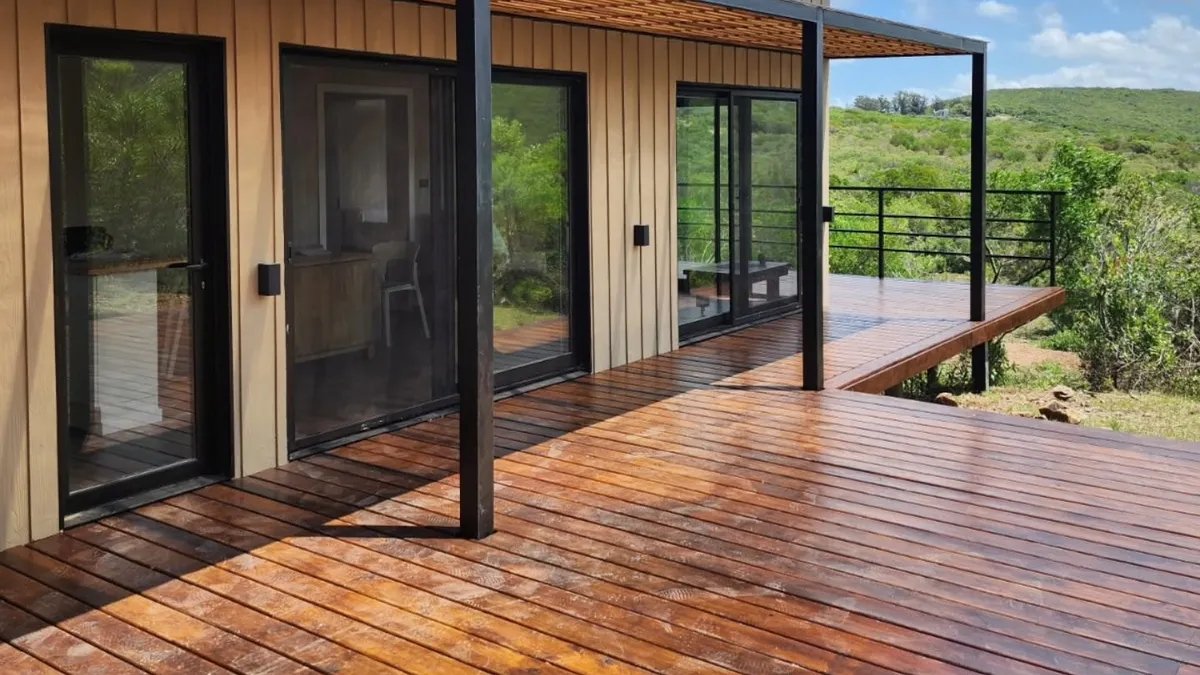
They grow in Maldonado, in La Barra, in José Ignacio, in Pueblo Edén and in Ciudad de la Costa. Modular houses are increasingly seen in Uruguay with a careful and modern aesthetic that, behind them, hides a revolution in their construction method. and, in some cases, also in the prioritization of natural materials such as wood.
Tiny House was the first company to focus on small moveable houses in the country in 2016. Its founder, Joaquín Rodiño, worked in traditional construction and found in this model a way to present excellent results with greater efficiency.
For the same price “we prefer to deliver a smaller house, but more complete and comfortable, than a larger house in which there are a lot of things left undone or the quality lowered,” says Rodiño.

Furthermore, since it is built in a plant, and not on site, companies can work on several houses simultaneously with the same construction manager, for example.
In Tiny Houses they are based on wood and The most requested are houses of 35 or 40 square meters with one bedroom as a weekend home or rental. Its price? Around US$2,000 per square meter for turnkey houses installed on the land.
In this sense, the founder of the company affirms that this value is variable and that, where appropriate, they place special emphasis on the use of quality materials that dialogue with the environment, which leads to differences in price with other companies that may not have the same criteria in terms of quality and sustainability.
“We avoid Chinese as much as possible. If it is not national manufacturing, we look for it to be Latin American and we only use wood that is either certified national or certified reforestation wood,” says Rodiño, who capped the amount of house manufacturing per year at 12 units to adapt to the local market and make it compatible with other brands he manages.
“We try to ensure that the houses breathe, we do not use panels, we do not use containers. We avoid concrete and iron, which are the materials that have the greatest impact on the environment related to construction,” stressed the businessman who has his main markets for Tiny Houses in the mountains, in the farm area of Pueblo Edén and also in La Barra and José Ignacio.
From your perspective, Traditional construction “is the past.” “In many countries this is the traditional construction system,” he maintains and affirms that when measuring the air quality of their houses compared to those of concrete construction, the difference “is tremendous.” “Living in those houses should be prohibited,” he believes.
Micro spaces and modular houses
Germán Lombardi started micro spaces with Gofi in 2023. Like Tiny Houses, this project boomed after the pandemic. In your case, It began with the creation of small office or consulting spaces—starting at nine square meters—to attach to the original house with a total cost of approximately US$12,000.
New lines of business emerged from this, such as commercial premises that materialized in small autonomous markets in private neighborhoods. Later, they expanded the offer to Gofi Residences, premium modular construction homes.

“We have no limitations on the typology of the modules, so we can make any type of design,” says Lombardi and points out that The house can be transported in up to four modules and assembled on site. In the case of a single module, each house is 100% assembled, moved to the site and deposited on the land.

At Gofi they work mainly on projects aimed at people who have land and want to make it profitable. placing modules to make, for example, Airbnb rentals. Although they also have projects of 120 square meters for those who want their summer home. Its main markets today are Maldonado, Colonia and Paysandú.
But is it cheaper than traditional construction? For Lombardi, “at the same level of quality, it ends up being more economical because there is an issue of industrialization in construction, delivery times, all of this directly impacts the amount of labor wages.”
Gofi uses recycled materials for its construction, on an iron structure on which the isopanel or steel framing structure and layers of insulation are mounted. “We put a lot of focus on thermal and acoustic insulation with premium quality openings with double glass always,” emphasizes Lombardi and highlights that at Gofi they work so that, in each of their lines, there is an “experience of excellence” from the first contact to delivery.
“In Uruguay now there is a furor, but if you see in the United States construction is (traditionally) modular,” he emphasizes. Lombardi and points out that in a country that does not have major meteorological events, such as hurricanes or tornadoes, not making use of this modality is absurd.