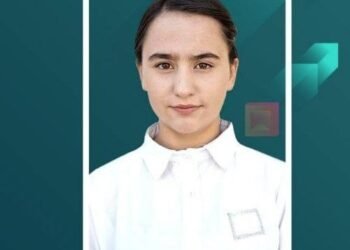
She — restorer, artist and jeweler who turns history into art and metal — into poetry. VIPzone looked into Farah Orifi’s workshop just to look at the work process – and it immediately became clear: behind her calmness there is a lot of work, patience and an honest love for the craft.
Farah Orifi has a rare combination: she is a restorer, an artist and a jeweler who is equally comfortable working with artifacts that are thousands of years old and with silver that requires almost surgical precision. Fragile in appearance, but incredibly focused in her work, she creates jewelry, paints paintings and brings ancient finds back to life.
Where it all started
Farah is 25 years old, she was born into a family where no one was associated with creativity – there were scientists and lawyers – people of strict professions.
But one person changed her choice: Aunt Anisa, who always sewed, decorated, created something. “I always watched her. Whatever he does is beautiful. It was probably then that I developed a taste for creativity.”
Thus, the first brushes, paints, threads, doll dresses and endless children’s crafts appeared in Farah’s hands.

The long road to art
In high school, Farah began to take painting seriously. The famous miniature artist Olim Kamalov became her mentor, a man who later prepared her for admission to one of the best art universities in Russia.
She entered the famous Academy. Stroganov – by the way, not everyone can withstand the huge competition there.
“I knew it was a once-in-a-lifetime opportunity, so I tried really hard.”
The first years of study were not easy. Most of her classmates entered the university after graduating from art schools and colleges, and she – after a regular school.
“I honestly admit: I was among the worst. But I studied day and night until I caught up with everyone, and even surpassed them somewhere.”

Six years at the academy flew by in a flash. Studying became a solid foundation for the girl: from chemistry (“where my humanitarian brain wanted to escape”) to complex restoration techniques.
Dialogue with the past
Farah recalls how in their fourth year they began practical work: paintings, frescoes, icons of the 15th–19th centuries, summer seasons in the Tula Kremlin, copying paintings in the Tretyakov Gallery. Later, an interesting job awaited her at the Interregional Scientific and Restoration Art Directorate (MNRKhU), where Farah was tasked with restoring the frescoes of the Novodevichy Convent.
Today she is a junior researcher at the National Museum of Antiquities of Tajikistan. This is where artifacts found at excavations throughout the country come.
“When you hold an object that was used a thousand years ago… This feeling cannot be explained in words. It’s like you’re living the life of an ancient man again.”

She works with ancient metal, jewelry, coins, ceramics, and wall paintings. Makes archaeological drawings and participates in excavations.
This spring, Farah underwent advanced training in the restoration laboratories of the Hermitage – she worked with paintings from ancient Penjikent.
Another Universe
During the coronavirus pandemic, Farah was unable to return to study in Moscow. The decision that came suddenly became fateful.
“I realized: if not now, then never. And I decided to master another dream of mine – jewelry craft.”
Her teacher was the famous Tajik jeweler Dilmurod Sharipov.
“My mentor became not only a mentor for me, but also a reliable support and support, always pushing me to learn new things and find my own style.”
In the beginning, Farah worked with copper, making candlesticks, coasters, and molds. Then she switched to jewelry, where her first mistakes awaited her, but over time, success. The moment came when the mentor gave the go-ahead to switch to making silver products.

“As a child, for some reason I often lost earrings. I even had a box where I kept single earrings and other broken jewelry. And when I learned jewelry making, I melted it all down myself and made a delicate ring with opal. The stone was removed from one such earring. It was very symbolic.”
The birth of beauty
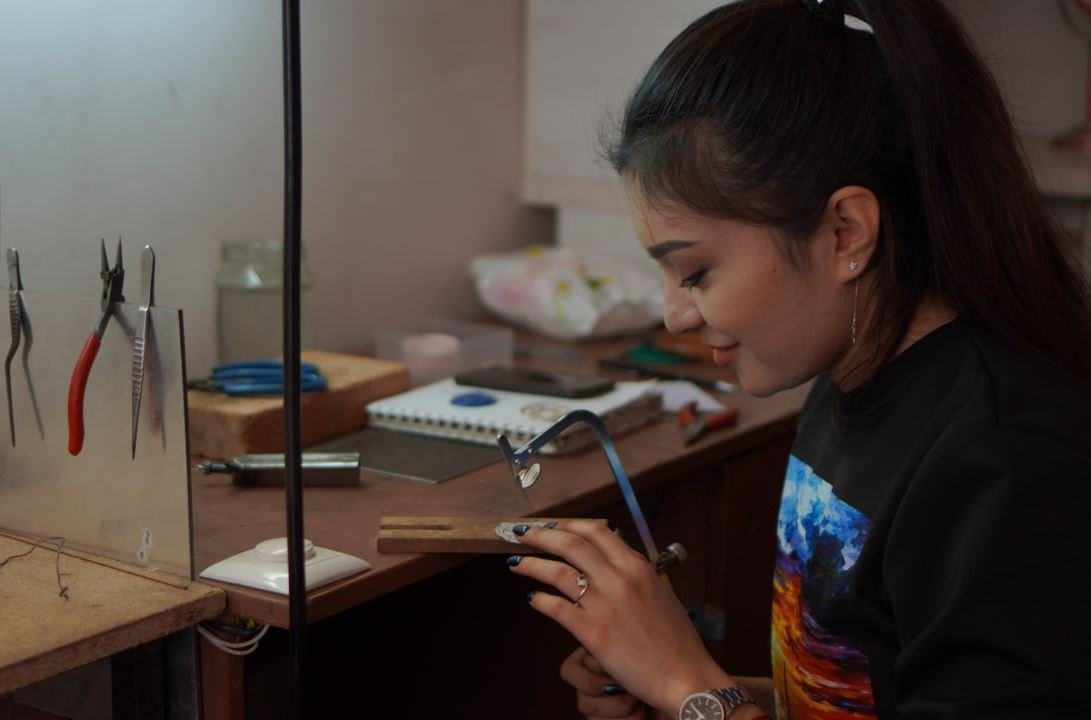
In the workshop, Farah showed exactly how a piece of jewelry is created. And it became clear: behind the external lightness there is a complex craft that requires special equipment and jewelry engineering.
Each product goes through a long journey: sketching, metal preparation, molding, soldering, grinding, waxing and finishing.
Farah works primarily with silver. Rarely does she add copper and natural stones – the wealth of Tajik soil. Sometimes you have to work at the millimeter level – filing, adjusting, joining so that everything fits perfectly and at the same time maintaining the thinness of the line.
“Jewelry making is like restoration. The main thing is accuracy and attentiveness. There’s no rush here.”
The tools in her workshop are like extensions of her hands: needle files, gravers, a jigsaw, flanges, a drill, a torch, polishing wheels. And there is a part that she considers the most difficult – solder.
Farah makes the alloy that connects the pieces of the jewelry herself: she selects the proportions of the metals, achieves the desired melting temperature, and then the required ductility. Then the alloy is poured into a mold, rolled and drawn to the thinnest wire.
“It’s physically hard work. With such a load, the gym is no longer needed.”

Nature inspired
We asked Farah to describe the girls who buy her jewelry.
“My slogan is just that: Nature inspired, which means inspired by nature, that is, natural style. It is important for me to emphasize the individuality of each person who purchases a product from me, because each of us is unique.”