Flights to Khorog and Murghab are among the most difficult in Central Asia. The number of pilots capable of landing a plane at these high-altitude airfields can be counted on one hand. In 2016, Asia-Plus journalist Liliya Gaisina spent one day with the crew performing these unique flights.
Regular air service between Dushanbe and Khorog was interrupted in October 2017 after the last An-28 aircraft failed. For almost seven years, it was possible to get to the administrative center of GBAO only along the Pamir Highway, a road that often becomes impassable due to weather conditions.
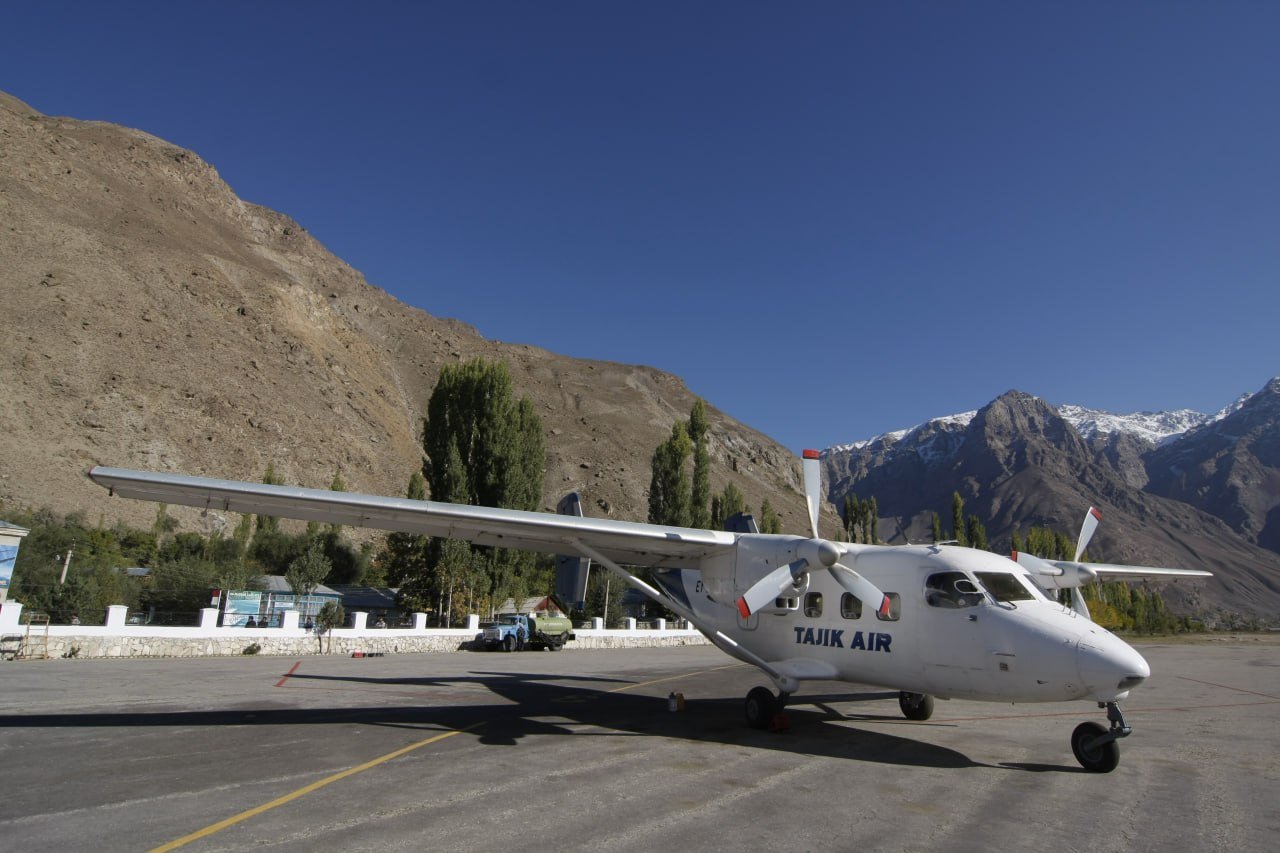
In October 2024, flights to Khorog resumed: the first flight after a long break was successfully completed by an An-28, designed for 17 passengers. However, their schedule, as before, is entirely dependent on weather conditions.
Not the most famous, but one of the most difficult
To be honest, neither Murghab nor Khorog airfields are included in various ratings of the most difficult airports in the world compiled by the media. As a rule, the leader in them is Paro Airport in Bhutan, which is also located in a high mountainous, inaccessible area, or Kennedy Airport in New York, located within a huge metropolis. These ratings also include the highest airport in the world – Qamdo Bamda in Tibet, at an altitude of 4,334 meters.
Not a word about the Murghab airfield – 3657 meters above sea level. They talk about it and the Khorog airfield only at specialized aviation forums.
“I wonder if any of them have been to mountain, or rather high-mountain, airfields in Tajikistan? I think that after Khorog – at an altitude of 2070 meters, with a runway length of 1829 meters, in the canyon of the Pyanj River with a one-way approach course – or Murghab (3657 meters, with a runway length of 2500 m), the approach to Paro would seem like an easy walk to them,” writes an old-timer of the forumavia.ru forum.
“Yes, the Khorog airfield is something: if you don’t hit the Rushan Gate, you’re lost,” notes another participant.
“They don’t write about these airfields because no one flies there,” concludes a third.
One can argue with the last remark: flights to Murghab and Khorog are now carried out regularly. For this purpose, special crews from Novosibirsk and Moscow arrive in Tajikistan every year on aircraft of the Russian Federal Security Service.
These flights are carried out to assist the border structures of Tajikistan by the Russian intelligence service and are carried out in accordance with the Agreement on Cooperation on Border Issues signed by Tajikistan and Russia.
During the entire period of Tajikistan’s independence, Russian FSB aviation pilots were the only ones who landed planes in Murghab.

Heading towards Murghab – to where the engines are not turned off
Planes and then helicopters began flying to Murghab in 1979. The first pilot to land the Yak-40 here was Major General Nikolai Rokhlov.
At that time, this airfield was located at the very extreme point of the border of the huge USSR and was the highest mountain in the Soviet Union.
That flight was successful, gradually Soviet pilots began to master the skills of flying to Murghab, and those who coped with this task received special qualifications.
There were few such professionals in the Soviet Union; now there are only a few left. “No more than twenty people,” crew members from Novosibirsk, who annually carry out scheduled flights from Dushanbe to Murghab and Khorog, explain to us. Together with this crew we go to dangerous airfields.
The AN-26 aircraft on which the flights will be made is being prepared by the crew independently at the Dushanbe airfield. In the morning, cargo is delivered to this vehicle, which is intended for Tajik border guards serving in the Eastern Pamirs.
Food or bed linen will be delivered to Murghab in an hour; If you get there by car, the journey will take three days with interruptions. The same planes take Tajik military personnel to the farthest border post and back. For example, today we will pick up demobilized conscripts from Murghab and Khorog to Dushanbe.
Boarding the plane, got ready, took off. The first minutes of the flight Dushanbe – Murghab looks like a completely normal flight. It all starts a little later, when the plane reaches the Pamirs.
Despite the flight altitude of 6400 meters, the peaks of the Pamir Mountains are clearly visible from the window, so it seems that the plane is still taking off. The Pamirs are the highest mountainous area in Tajikistan, and a height gain of 6 thousand meters here is a mere trifle.

We fly past Lake Sarez (3263 meters above sea level) – now, by the way, ice drift has begun there; a little further on the left side the Somoni Peak (7495 meters) appears, soon the plane begins to descend, and a sharp decline, because it is impossible to achieve a smooth descent in the Pamirs, among the tall peaks.
At the Murghab airfield, cargo and demobilized soldiers are already waiting for us in full readiness, who, after two years in service, are noticeably in a hurry to go home. Everyone needs to hurry. The fact is that planes here never turn off their engines. The air is so thin that if you stop working, it’s unlikely that you’ll be able to take off. Therefore, the stop lasts no more than half an hour.
Without acclimatization, the harsh natural conditions of Murghab are especially acute. Out of habit, I can’t walk quickly here: I feel dizzy and have unpleasant shortness of breath. The lack of oxygen in the area of the Murghab airfield compared to the flat terrain is about 40 percent.
Khorog: through Rushan Gate
Several years ago, one of the civilian pilots of the Tajik airline Somon Air, a professional in his field who operates international passenger flights on Boeings, told how he could not watch the video recording of the flight to Khorog that his son was making.
“Yes, I couldn’t look at it, these are impossible conditions for flying, it’s hard even for me to imagine how they cope with them,” he explained.
“Impossible Conditions” is a kind of corridor among high mountain peaks along which you need to fly a plane. One wrong move and disaster can’t be avoided.
The most difficult section is called the Rushan Gate: two peaks – 5.1 thousand and 5.2 thousand meters – in this place are as close as possible to each other, the “corridor” narrows. If you don’t get into it, you’ll have to go into another gorge, where it will be almost impossible to turn the car around.
This flight is also aggravated by unfavorable weather conditions: fog often falls on the mountains or clouds descend. Sometimes the crew has to wait for weeks to get permission to fly to Khorog.
By the way, it was in the area of the Rushan Gate in February 1942 that a tragedy occurred, from which the blood still runs cold. Then here the plane caught one of the peaks with its wing and landed on the mountainside. On board, in addition to four passengers and the pilot, there was a woman with two small children, all of whom survived. They decided that the men would go down for help. But none of them got to her; No one below thought that the people on board the plane could have survived, and they went in search of the car only four months later.
On the way to the crash site, they found the corpses of men who were going down for help, and when they got to the plane, a passenger was sitting on its wing. She was the only survivor of all and for four months she kept detailed records of what happened to her. In her diary, she described how her children starved to death almost immediately and how she had to eat them in order to survive herself.
Less gloomy, but still tragic incidents occurred here later. It is also difficult to get to Khorog by road: at least 12 hours of travel in an SUV, almost all of this time along the incredibly steep Pamir turns. There are no other ways to get here and never have been. The Pamirs are as dangerous as they are beautiful.

They are also waiting for us at the Khorog airfield. Back we will again transport cargo and Tajik military personnel. The altitude of this airfield allows you to turn off the engines, but you still can’t relax: meteorologists warn about worsening weather, you need to urgently fly to Dushanbe.
A little less than an hour later, we land in the capital of Tajikistan. This is not all for the Novosibirsk crew: in a few minutes they will set off again, this time to Khujand. They will operate such flights for several more days in April; in May they will be replaced by pilots from Moscow.
Every year, tons of army cargo and hundreds of Tajik military personnel are delivered to Murghab, Khorog and Khujand in this way.