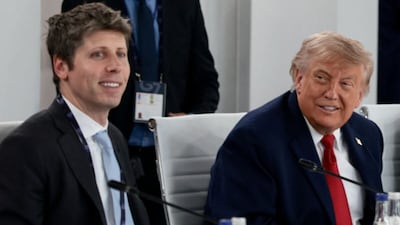
The extra seating was not around a table G7 summit In French Evian, these were merely protocol arrangements. Rather, they were an announcement of the entry of new great powers into the international decision-making arena. As the summit began on Monday, traditional political titles competed with names that created the modern technological revolution, led by Sam Altman, CEO of OpenAI. This exceptional scene sums up a new reality: the future of the world is no longer being cooked in the corridors of politics alone, but also inside artificial intelligence laboratories.
The allies of Western countries arrived at the G7 summit amid an atmosphere of anxiety and confusion, after the US administration’s decision to restrict foreign users’ access to Anthropic’s most powerful models, in a move that brought back to the fore European fears of Washington’s ability to cut off access to vital technology at any moment, and at the same time reinforced the “technological sovereignty” agenda within. European Union.
This comes at a time when transformation is accelerating artificial intelligence To a strategic asset capable of granting economic and military superiority to the countries that own and control it. Today, fears of what is known as the American “off switch” seem more present than ever before.
President Donald Trump and CEO of OpenAI (Image: Reuters)
Prominent names in the sector
Altman was not alone in this scene. Other poles who shaped the features of the current technical boom participated in the table, led by Demis Hassabis (Google DeepMind) and Dario Amodei (Anthropic), along with Arthur Mensch (Mistral AI). This presence represents a fundamental turning point; After years in which technology leaders’ participation in international forums was characterized by a protocol and honorary nature, today they have become direct partners at the official negotiating table with governments. Perhaps the repeated presence of technology pioneers in the White House, since the return of President Donald Trump, provides conclusive evidence of this growing influence. This new weight explains why a large space was devoted to artificial intelligence in a draft statement for the G7 Summit, where the leaders called – according to a Bloomberg report – for international coordination that balances the opportunities and risks of this boom.
The atmosphere of the summit was affected by Washington’s decision, which prohibited any non-American citizen from using the “Fable 5” and “Mythos 5” models. The speed of implementation and the size of the restrictions were considered a practical confirmation of one of the most prominent European fears: the possibility that the United States could cut off access to its most advanced technologies at any time, and by a unilateral decision. The practical result of this decision was shocking to European and Western allies, who suddenly found themselves without access to the most advanced artificial intelligence technologies in the world, a clear indication that reliance on American technology is no longer as guaranteed as it was before.
Artificial intelligence as an arena of influence
The US administration’s vision stipulates the necessity of establishing American artificial intelligence as a global standard, and ensuring that international systems are built on its technologies. While American companies dominate the sector, some observers believe that these restrictions may be counterproductive in the long term, by pushing other countries to accelerate the development of independent alternatives and reduce dependence on American technology.
This development has revived the old debate in Brussels about the “kill switch”, that is, the theoretical ability of states equipped with the technology to disable sensitive systems such as defence, finance or critical infrastructure. From the European point of view, the issue is no longer theoretical, and what happened proves that technological sovereignty is not an abstract concept, but rather an actual issue of sovereignty.