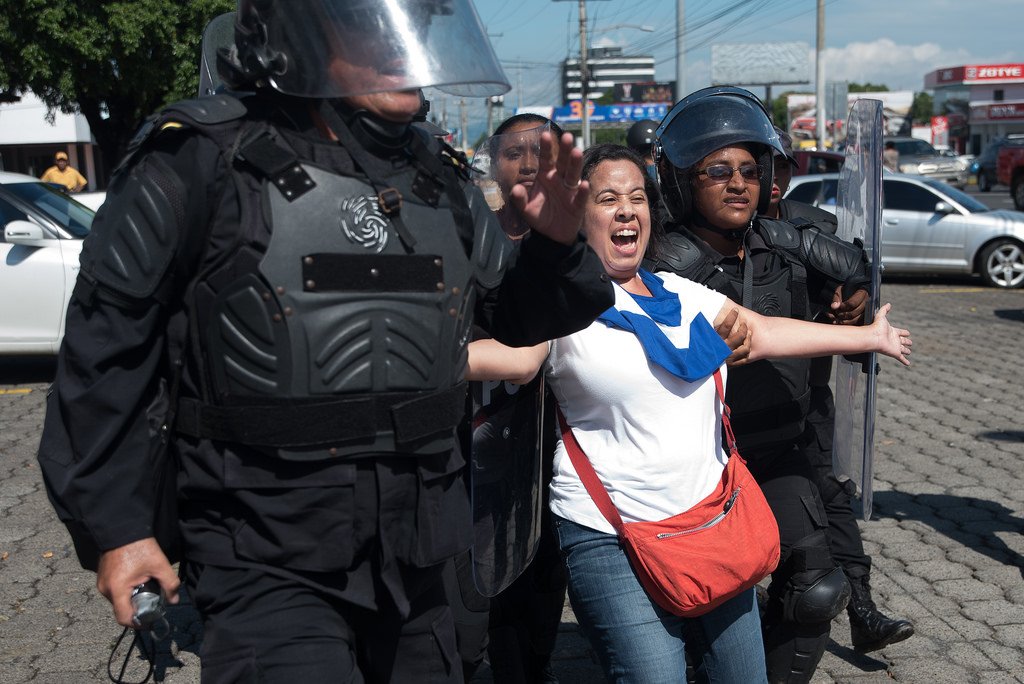
The serious violations and abuses of human rights committed by the regime of Daniel Ortega and Rosario Murillo have had “clear and systematic gender dimensions.” Evidence of a “deep contradiction” between the official discourse that proclaims gender equality and an unequal reality, according to the Group of Human Rights Experts on Nicaragua (GHREN).
In Nicaragua, state repression “has used gender as an instrument of control, humiliation and silencing,” the Group of Experts warn in its report Nicaragua: Repression in a Gender Key. They add that hundreds of opposition women have suffered discrimination, attacks and political persecution fueled by gender stereotypes and the manipulation of care roles, and deepened by social prejudices.
“The State has not only affected women, girls and LGBTIQ+ people in a differentiated way, but has also reproduced, instrumentalized and deepened structural inequalities and pre-existing gender stereotypes to punish, discipline and silence victims and to destroy networks of support, organization and resistance,” the report reads.
The use of gender as an instrument of control exposes the contradiction between official discourse and reality. Although the regime highlights its advances in women’s political representation, this participation occurs within centralized and controlled structures, with little real autonomy.
“The authorities promote a traditional model of women associated with motherhood, family and obedience, while they stigmatize dissident women as a threat to the social order. This narrative has served to justify attacks against women who exercise public leadership or defend human rights,” highlights the GHREN.
Gender dimension in rapes
Among the serious human rights violations where The Expert Group identifies a gender dimension They stand out: arbitrary arrests and forced disappearances, torture and ill-treatment in places of detention, constant surveillance, harassment and defamation campaigns and the prohibition of entry into the country itself.
The Group values that arbitrary detentions and forced disappearances have had “specific impacts on women.” They emphasize that women opponents or perceived as such have been subjected to processes without guarantees, isolation, unfounded charges and stigmatization based on gender roles.
These violations “interrupted professional careers, dismantled families and separated mothers from their sons and daughters. They also affected women who were searching for detained or missing relatives, who visited detention centers or who demanded justice. These women were harassed, watched and threatened,” the report highlights.
The GHREN also highlights that torture and ill-treatment in places of detention included “clear forms of sexual and gender-based violence, including rape.”
They add that detained women frequently highlight that they were subjected to sexist insults, threats of rape, forced nudity, sexual harassment, isolation, restriction of family visits and deprivation of adequate medical care.
“These practices sought to humiliate and punish them for their political participation and for deviating from traditional roles. Sexual violence and threats directed against their motherhood or the custody of their children deepened their psychological suffering. Relatives who visited detainees also suffered abusive searches and degrading treatment,” the report reads.
“Bad mothers”, “abortionists”, “traitors” or “enemies of the family”
For the Group of Experts, constant surveillance, harassment and smear campaigns have served to isolate and silence a large number of women inside and outside Nicaragua. “Many were called ‘bad mothers’, ‘abortionists’, ‘traitors’ or ‘enemies of the family’,” they emphasize.
Additionally, “women from the LGBTIQ+ community faced homophobic and stigmatizing attacks; while indigenous and Afro-descendant leaders also suffered due to racism against them, and the violence and impunity linked to this form of discrimination,” the report says.
Likewise, experts warn, the prohibition of entry into one’s own country, the denial of passports, expulsions, the arbitrary deprivation of nationality and the confiscation of assets have left many women in a situation of uprooting, economic precariousness, family separation and, in several cases, de facto statelessness.
Furthermore, the cancellation of nearly 300 women’s organizations and the LGBTIQ+ community “has eliminated essential spaces for protection, support and denunciation.” Many of these organizations provided legal, psychosocial, community, and sexual and reproductive health services. Its closure has disproportionately affected women, girls and LGBTIQ+ people.
For the Group, several of these violations constitute the crimes against humanity of imprisonment, torture, forced disappearance, deportation and persecution for political reasons. “Although the main reason for the persecution is political, the gender of the victims has influenced their selection by the perpetrators, the repressive methods used and the impacts suffered,” they emphasize.