GOVERNANCE
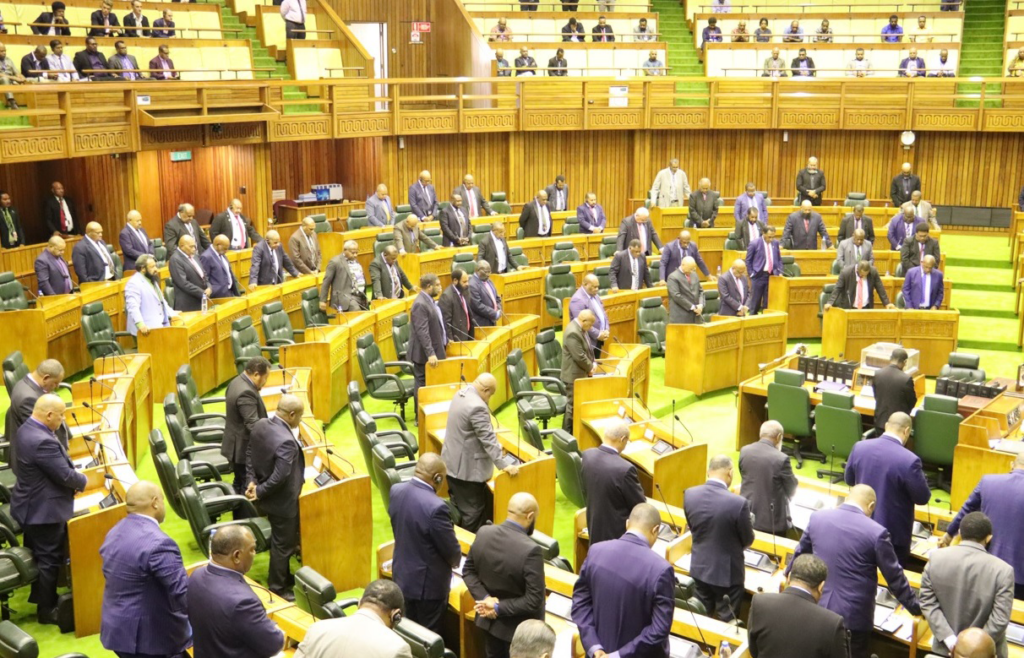
RURAL and Economic Development Minister Joseph Lelang made a presentation in the National Parliament last month on a transformative initiative of the Marape-Rosso Government called the Bilum Digital Platform.
It is more than a technological innovation that is aimed at assisting all electorates across Papua New Guinea to improve acquittals of Service Improvement Programme (SIP) funds received, improve transparency and overall accountability.
“The name reflects a uniquely PNG concept. Just as the traditional bilum carries and holds important items that support daily life, the Bilum Digital platform is designed to carry the weight of our nations aspirations connecting communities, and institutions in one shared space,” Minister Lelang said.
“It is a bold step forward to strengthen the foundations of transparency, accountability, and efficiency in the delivery of basic services across PNG.
“Through the Bilum Digital Platform, every kina invested in development will be traceable. Leaders and citizens alike will have real time access to information on the projects, ensuring that resources reach the people for whom they are intended and every project will be monitored.
“The Bilum Digital Platform will strengthen national government through the Department of Implementation and Rural development (DIRD) and equip them with the capacity for oversight, enabling the department to track progress, identify challenges and effectively address them.
“The SIP remains one of the government’s most significant funding mechanisms for delivering development services to our people, particularly those in rural and remote communities across PNG,” he said.
The purpose of the SIP is to provide minimum service standards through reestablishment or creation of new basic infrastructure and facilities and initiate socio economic activities for essential services.
SIP is delivered within the established administrative and financial arrangement governed by the Public Service Management Act 1995, the Organic Law on Provincial and Local Level Government 1995, the District Development Authority (DDA) Act 2015, Public Finance Management Act (PMFA) amended 2018, National Procurement Act 2018, National Responsibility and Monitoring Act 2016, Section 27 of the Constitution on Leadership Code of the Ombudsman Commission and others.
Through programmes such as the district (DSIP) and provincial service improvement programme (PSIP), the government continues to invest substantial public resources into improving infrastructure across the country.
In March this year, Prime Minister James Marape visited East Sepik and challenged all leaders to use the SIP funds wisely to develop their districts and provinces.
Through the Bilum Digital Platform, every kina invested in development will be traceable. Leaders and citizens alike will have real time access to information on the projects, ensuring that resources reach the people for whom they are intended.
As reiterated through to the media, Marape said when the funds are sent to districts and provinces, work must be done in delivering services in each electorate such as schools, hospitals, roads, classrooms and other projects.
Since the inception of the SIP in 2008, accountability remains one of the main criticisms that past governments and including this government as billions of kina are appropriated each year for development at the district and provincial levels.
According to a report from the department of economic and rural development, about K1.1180 billion is appropriated annually under the SIP for the 96 districts and 22 provinces while an additional K59.0 million is also appropriated under the district support grants thus bringing the total appropriation to electorates to K1.1239 billion.
Critics are simply asking for greater transparency and accountability of these funds and whether or not, the SIP monies are properly applied and used to deliver basic public goods and services for the benefit of the people.
A DIRD report from 2025 showed an outdated list of acquittals dating back as far as 2015 and the reasons for delays being poor logistics, the creation of new districts, lack of funding or late disbursements, loss to property, tribal warfare and other reasons.
Despite, the Ombudsman Commission’s (OC) notice for districts and provincial administrations to submit on the mandated date of March 31, most leaders and administrators have failed to deliver on the date sanctioned.
DIRD faces significant challenges in processing and monitoring DSIP and PSIP acquittals, struggling with chronic backlogs, poor reporting quality and limited on-site verification. The critical challenges include systematic backlogs, poor reporting quality, capacity constraints and lack of public transparency.
To address these hurdles, DIRD is working to enforce compliance alongside OC and has been rolling out the Bilum Digital platform as a centralized national monitoring tool.
The failure to address DIRD challenges regarding missing DSIP and PSIP acquittals centers on jurisdictional overlaps, a lack of institutional transparency and systematic non-compliance by MPs.
The OC frequently issues deadlines (such as March 31 deadline previous funding cycles) and threatens to charge non-compliant MPs with misconduct in office. However, the DIRD has continued to accept late acquittals, creating a disjoined enforcement.
DIRD in year ending 2025, reported that over K830 million in SIP funds remains unaccounted form, with upwards of 86 percent of districts and provinces failing to properly acquit these public monies.
Under the District Development Authority (DDA) Act, MPs act as both lawmakers and project managers. This dual role fosters unchecked discretion and conflict of interest.
Watchdog groups and civil society organizations, such as ACT NOW PNG, have accused the government of “weaponizing” the release of DSIP and PSIP funds, withholding them from Opposing MPs while enabling friendly MPs to spend millions with little to no oversight.
Lelang said it is within this such a context that the Bilum digital platform was developed.
“The digital platform is a centralised or interactive digital system designed to support the DIRD monitor compliance on SIP implementation and to ensure timely paperless reporting are done by the provincial, districts and city authorities. The platform enables provincial and district administrations to capture project information, update implementation progress and submit reports through a structured digital interface. This information is then made available at the national level to support oversight, planning and evaluation,” he said.
The DIRD has undertaken a progressive phase one rollout of the Bilum digital platform across seven provinces; Milne Bay, Morobe, Western Highlands, West Sepik, Chimbu, Eastern Highlands, East New Britain and West New Britain.
Awareness and induction workshops have been conducted for districts and provincial administrations in these provinces to introduce the platform and its functions. The sessions provided participants with an understanding of how the platform supports improved reporting and project monitoring.

In addition, critical skills building training had been conducted for nominated officers from selected provincial and district administrations.
These trainings focus on practical skills required to utilize the platform, including data entry, project reporting and system navigation.
Through these exercises, officers responsible for programme implementation are equipped with the necessary capacity to manage and report development activities using the system.
Lelang said: “The feedback received from provincial and district officers during the training have been invaluable. As the primary users of the platform, their insights have helped inform improvements and refinements to the system.”
This collaborative approach ensures that the platform continues to evolve in a way that meets the operational needs of provincial and district administrations.
Benefits of the Bilum platform are:
• It strengthens transparency and accountability in the management of public funds by providing structured and accessible information on development projects;
• It improves the quality and timelines of reporting from provinces and districts; and
• It enables government agencies to make better informed decisions based on reliable data. Ultimately, it supports the governments boarder commitment to improving service delivery for the people.
“A lot has been done to get electorates within these provinces to be ready to use the Bilum digital platform. The Marape-Rosso government also recognises that challenges remain in the implementation of the platform nationwide.
“These include logistical constraints faced by remote districts, connectivity limitations in some areas, and the ongoing need for capacity building among officers responsible for program implementation. This has prompted the DIRD to work closely with provincial and district administrations to address these challenges and ensure a smooth transition of the usual business operations into the use of the platform.
In November 2024, Nuku in West Sepik became the first district to submit its 2020 DSIP report using the platform. In mid-May, Lufa in Eastern Highlands was the second district to submit its 2025 DSIP report using the platform and West Sepik was the first province to submit its 2025 PSIP report using the platform.
The DIRD has advised through a circular dated Feb 10, that it will not accept physical acquittal reports from administrations that have been on boarded to the platform.
The following electorates and authorities have been instructed to upload their 2025 PSIP and DSIP reports suing the Bilum digital platform: Western Highlands; Mt Hagen City Authority; Tambul-Nebilyer; Mul-Baiyer; Chimbu; Kerowagi; Gumine; Eastern Highlands; Henganofi; Milne Bay; Alotau; Samarai-Murua; Esa’ala; Kiriwina-Goodenough; East New Britain; Gazelle; Pomio; Rabaul; Kokopo; West New Britain; Talasea; Nakanai; Vanimo-Green; Aitape-Lumi; Lae City Authority; Markham; Wau-Waria; and Nawaeb.
Minister Lelang sdaid: “Looking ahead, we are committed to continue expanding the rollout of the digital Bilum platform across the country for those that have not been included with the first 31 electorates, including my very own electorate Kandrian-Gloucester. Further training and capacity building programmes will be concluded to ensure provincial and district administrators are fully equipped to utilise the system.”
A circular instruction dated Feb 10 was issued by the DIRD secretary to all provincial and district administrations and their respective finance offices, directing that all SIP reports be submitted through the platform.
Lelang said initiatives such as the platform demonstrate the Government’s commitment to modernising governance systems and strengthening accountability in the management of public resources.
“By embracing digital solutions, we are now better positioned to ensure that development programmes deliver meaningful outcomes for the people of PNG,” he said.