COVER STORY
For the PNG media team, the takeaway was less about debate and more about process – accuracy over speed, welfare over spectacle, and a clear communication system over confusion
IN a week-long unique International Media Visit (IMV) programme, seven PNG mainstream media representatives went down to Sydney purposely to gain an insight and firsthand experience of Australian-standard National Rugby League (NRL) reporting, ahead of PNG Chiefs participation in 2028.
The group comprised sports reporters, producers, and managers from TVWan, EMTV, NBC, FM100, Post Courier, PNGFM, and The National.
The goal was simple; see how elite sport media and operations actually work. The visit included significant tours around the training facilities of the Wests Tigers, Parramatta Eels, and South Sydney Rabbitohs, just to get a fair idea of how the Santos National Football Stadium (NFS) will be transformed into and what can be reported and what cannot be reported.

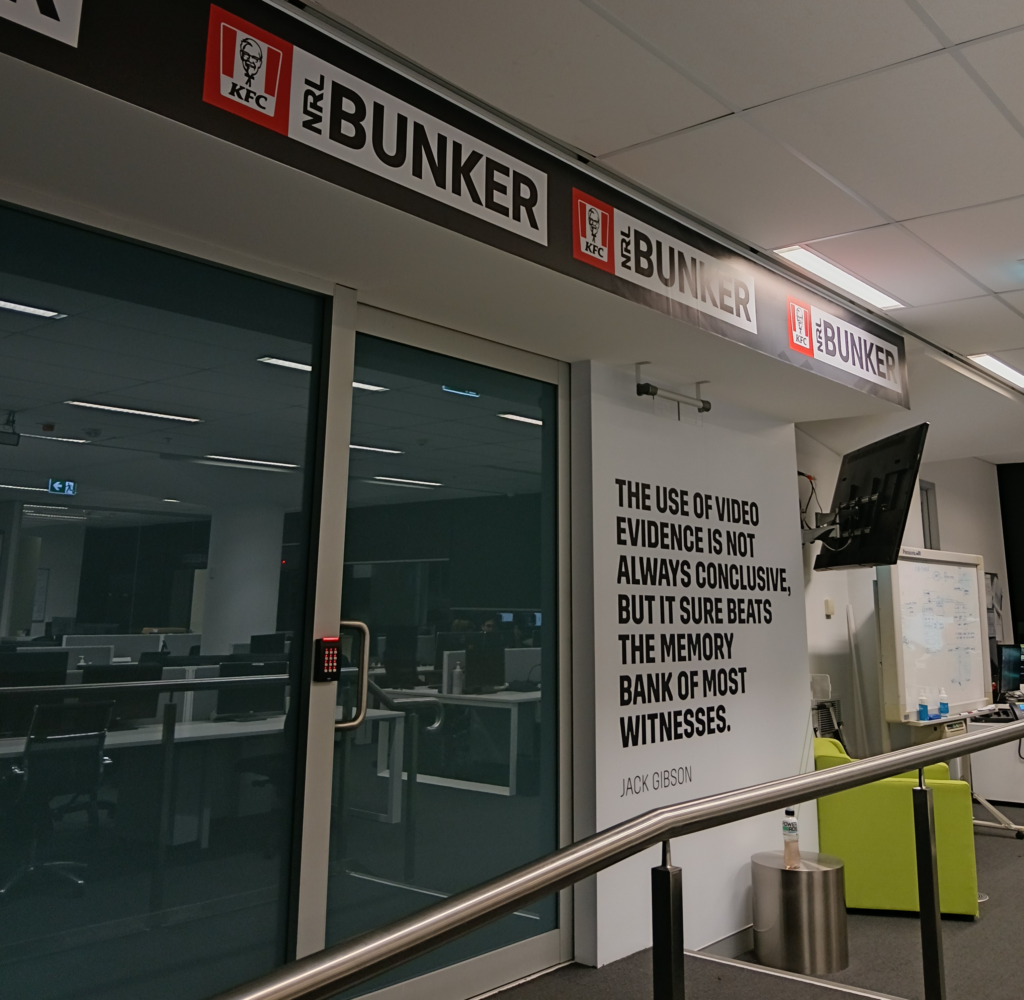
However, the payoff and highlight of the programme was standing inside the place every league fan argues about – the NRL Bunker.
While most people think that the Bunker is stationed inside one of the rooms in every stadium where the an NRL game is played, it is pleasing to announce that the Bunker is located at the Australian Technology Park in Eveleigh, Sydney.
NRL senior journalist Brad Walter and Pacific Programmes Manager NRL Michael Asensio opened the door to this rare opportunity where not so many people get to step inside, look around, and understand what people actually do in there and how much work it takes which determines calls made during every NRL game each week.
The vision that we saw last Friday (June 5) when we went into the Bunker, was generated by their broadcast partners – either Channel Nine or Fox League.
Inside the Bunker, the delegation got the full picture of what it does from Round 1 to the grand final, including the three State of Origin games. Amazingly, the first State of Origin game had around 26 broadcast cameras placed at all the different angles of the playing field at Accor Stadium on May 27.
Think of the Bunker as mission control for the whistle because it runs in every NRL premiership match and scales up for Origin with a video referee and a supervisor (which is a former player), and their role is to oversee every element of the game in real time.
During a try review, every grounding gets checked, which means the Bunker gets feeds from over 12 broadcast cameras plus in-goal and sideline angles, where the officials look for ball control, loss of possession, double movement, obstruction, or an offside.
If there’s clear evidence to overturn an on-field call, they do, but if not, the referee’s decision stands.
Most of the Bunker’s accuracies sit between 96 and 98 per cent of the time.
The room has the ability and strength to talk to the world, into the fan base stadium, and into your lounge room at home watching the game, which is incredible because not many other sports have that ability in real time.
The Bunker talks directly to the referee and touch judges through a live audio link. No middleman. They can stop play, request a captain’s challenge review, or confirm a decision with 100 per cent accuracy plus speed within 20 seconds. Because the continuity and the speed of the game is the best thing about it that people love.
There’s also pressure in coming up with a fine balanced decision because they want it quick but it also must be right.

The Bunker doesn’t know what the commentary box is saying during a live game so they just hope they strike the right balance so the commentator can deliver the decision to the viewers and listeners.
The Bunker is never going to win in relation to how people perceive the room and how it should be used but people who are interested in finding out what it actually does, they get a better appreciation on how things are done. And they may not agree with things but at least they have a fair idea of what is done and why.
The Bunker scans for high tackles, crusher tackles, shoulder charges, and other reportable incidents the on-field officials might miss. They can recommend a penalty, sin bin, or send-off. That’s why you often hear “Bunker is having a look” after a big collision.
And what actually happens in the Bunker during that brief pause, is that the video referee gets all the camera angles pulled up and replayed over and over before making any call. And mind you, the decision must be made within 20 seconds or less and under strict pressure.
As mentioned earlier, State of Origin humps everything up – same tech, but the risks and analysis multiply. The game’s harder, the pressure’s higher, but the Bunker also has better resources to make decisions.
Therefore, the Bunker team is also expanded in terms of having more camera angles and more staff watching for foul play, because Origin intensity means more collisions.
Every big hit gets an extra look and the Bunker doctor’s role also tightens – with national pride and player safety on the line, Category 1 and Category 2 HIA (head injury assessment) calls are made faster and with zero tolerance.
The Bunker doctor controlling on-site HIA decisions was the clearest example of trust.
Chiefs will be no different
The Chiefs’ club doctor has to be plugged into that system – meaning shared medical software, concussion baselines uploaded pre-season, and PNG doctors sitting in on NRL medical webinars (seminars conducted over the internet) weekly.
Player safety can’t be a “we’ll figure it out in 2028” problem.
Standing in the room, the reporters saw it’s not just tech, it’s people under pressure making calls that swing games and with the Bunker doctor, who’s a very powerful little Asian man, controlling Category (Cat) 1/Cat 2 HIA decisions.
Cat 1 means the player is out immediately – no return, while Cat 2 means a 15-minute off-field assessment, with the Bunker doctor having the final say on the player’s return onto the field of play.
Even though the sideline medic executes, the Bunker doctor owns the decision.
For the PNG media team, the takeaway was less about debate and more about process – accuracy over speed, welfare over spectacle, and clear communication system over confusion.
That’s the reality behind every “Bunker decision” you hear on TV.
And when the game hits a pause and the video ref exhausts all the camera angles to make a final decision, the vision you see on your television at home are not from the broadcast, but the Bunker.
I’m still replaying it in my head – standing inside the NRL Bunker in Sydney and listening to the video referee give insight on their job.
From NFS to Sydney
The thought of PNG Chiefs entering the NRL in 2028 and every week, calls will come from this room to Port Moresby has built the question of how do we wire that connection properly, from the Bunker in Sydney to Santos National Football Stadium?
And not just “good internet” – we’re talking dedicated broadcast-grade links from NFS to Sydney, with satellite backup so when the Bunker doctor is making a Cat 1 call, you can’t have delays.
The Bunker runs on fiber, redundant audio loops, and backup communication system.
Tech is only half of it. In the Bunker, the officials, doctors, and refs all train together and they know the pace, the terminology, plus the pressure.
For the Chiefs, that means exchange programmes. We can start sending PNG touch judges, video refs, and club medicos down to Sydney to train them in the Bunker protocols because when 2028 hits, you don’t want someone learning the headset on live television.
Asensio and Walter’s connections proved how much access changes everything. The media and PNG needs more of that.
Seven of us got this trip, but imagine if it was 70 sports reporters and editors or managers, over the next three years.
Both senior and young PNG reporters, producers, and camera operators need to learn how Fox League, Channel Nine, and the NRL’s own media team cover the game at this level, then they bring it back home to PNG.
When the Chiefs run out in 2028, the story should not only be told from Sydney. It should be told from all the mainstream media houses wherever they are located around Port Moresby, with crews who know how to feed content back to the Bunker and to broadcasters in real time.
The bridge from Sydney to PNG won’t be built in 2028. It’s being built now, in visits like this, in training deals, in communication system lines, in trust.
The Bunker drives PNG fans crazy during NRL games. The Chiefs’ games are going to be broadcast and done exactly the same way so what they try to do with every decision is educate people as they are going, what the rule is, how they’re ruling, and why they are ruling that way.
Education is the big thing and understanding the rule of the game is a massive part of what needs to happen and that’s what the Bunker is focused on because when you understand the rules, you don’t end up yelling at the referees when a decision is made.
The main calls video refs makes are;
- Try/No Try – Did the ball get grounded? Did a knock-on happen in the build-up? This is 90 per cent of Bunker calls where the video ref checks for grounding, obstruction, offside, or knock-ons, and in an instance where the video ref accidentally touches the wrong option, there will be a 10-seconds window to correct the decision that will appear on the big screens at the stadium.
- Obstruction – Did a runner block a defender illegally? “Inside shoulder” vs “shepherd” is the debate every week.
- Knock-on/Forward pass – Slow-motion to see if ball went forward out of hands, while “touched by defense” gets checked too.
- Sin bin/Red card – Dangerous contact, crusher tackles, and high shots. Bunker tells on-field ref what grade it is.
- Captain’s challenge – Team gets one wrong challenge per half. If they’re right, they keep it.
Noting the biggest confusion for PNG fans; the Bunker can only rule on what the on-field ref asks.
The Bunker is not made for everyone; you could be the world’s best referee but be the world’s worst video referee.
Because it’s a very personality-driven, tech savvy room to be in and you need to be up to speed with all that.