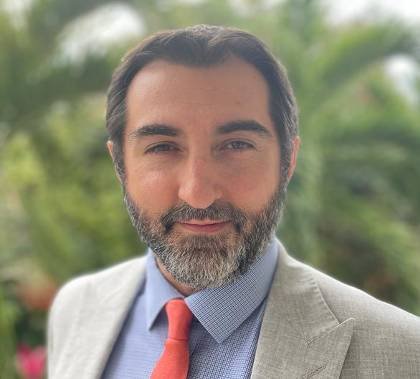
by Victor Clark, Resident British Commissioner to Grenada
Hurricane season is here again in Grenada. For many of us, that brings a familiar mix of concern, experience, and quiet determination. We know what these storms can do, but we also know what we are capable of when we prepare.
For me, preparedness always starts with staying informed. I keep an eye on updates from the US National Hurricane Centre throughout the season, and for what matters closest to home, NaDMA remains the trusted voice for Grenada.
Start at home
But before any official plans or partnerships, I start where most of us do: at home.
Like many families across the tri-island state, I’ve been going through the practical checklist: clearing drains, trimming trees, securing anything that strong winds could carry away. Checking the roof, the doors, the windows. Making sure we’re not scrambling at the last minute, but planning ahead.
More importantly, we’ve talked through our plan as a family. If we get separated, where do we meet? If phones go down, how do we stay in touch? If we need to leave, where do we go? These conversations aren’t always easy, but they make all the difference when it counts.
We’ve also put together a grab bag with the essentials: water, food, a flashlight, a radio, first aid supplies, medication, and a little cash. Important documents are sealed away safely, and we keep enough supplies at home to get through at least a few days. It’s not about perfection; it’s about being ready enough to protect the people you care about.
Every household will have its own version of that list. What matters most is taking those first steps.
Preparing Grenada
Of course, preparedness doesn’t stop at our front door. Grenada, as a nation, carries an even bigger responsibility, and a shared one. NaDMA works constantly behind the scenes, training, planning, and preparing for whatever the season may bring.
The UK is proud to be part of that effort. Together, we’ve been working to strengthen the systems that communities rely on most, especially in moments of crisis.
One example that stands out is the UK investment in strengthening health facilities across Grenada and Carriacou. After Hurricane Beryl in 2024, the Hillsborough Smart Health Centre was able to continue operating when it was needed most, care that made a real difference in those first critical hours and days. It’s a powerful reminder that resilience isn’t an abstract idea; it shows up in very real ways, when people need it most.
We’ve also worked closely with regional partners through Caribbean Disaster Emergency Agency (CDEMA), recently extending our memorandum of understanding (MOU) helping ensure that emergency support can be deployed quickly (within 24 hours) like it worked after Beryl with over 200 expert responders. In a crisis, time matters.
But true resilience is built long before a storm ever forms.
That’s why under UK-Caribbean Infrastructure Fund (UKCIF) we’ve invested in strengthening water systems with Nawasa, helping reduce flooding, improve reliability, and prepare infrastructure to withstand the growing impacts of climate change. It’s why we support training and leadership development, like the recent Chevening scholarship for an RGPF Assistant Superintendent to pursue a Master of Science in Crisis and Disaster Management in the UK. Strong systems need skilled people behind them.
Insurance and Finance
For many across the Caribbean, traditional insurance has simply been out of reach. But new approaches, like parametric insurance, are changing that. Instead of waiting for costly and time-consuming assessments, these policies keep costs down and pay out quickly when certain conditions are met, helping families, businesses, and governments recover faster.
In fact, Hurricane Ivan in 2004 helped catalyse the creation of the Caribbean Catastrophic Risk Insurance Facility (CCRIF), the world’s first non-profit regional risk pool — co-financed by the UK almost 20 years ago. Through that facility, Grenada received over US$55 million after Hurricane Beryl, funds that helped the country respond and recover when it mattered most. Grenada triggered 5 CCRIF policies, including new social protection top up cover that provides cash or food assistance for vulnerable persons, and Caribbean Water Utility Insurance Collective (CWUIC) where the UK subsidised Nawasa’s premium by around 90% days before Beryl hit.
We continue to support further innovations and improvements. The Global Shield, a trust fund that the UK helped establish, helps close the most urgent protection challenges. New instruments now allow for early‑warning-triggered support to help low-income households prepare before impact, state loans with clauses that pause debt payments after disasters, targeted financing that protects health and education continuity as well as coral restoration and digital platforms to improve reach and effectiveness.
A visit by the UK Centre for Fisheries and Aquatic Science in 2025 explored how the Caribbean Oceans and Aquaculture Sustainability (COAST) parametric insurance facility under CCRIF was used by fishing communities in Grenada. The London Centre for Global Disaster Protection (established by the UK and World Bank) helps nations plan for disasters and obtain access to finance. It analysed the impact of Beryl and continues to advocate for smarter global funding systems. The UK has spearheaded the introduction of Climate Resilient Debt Clauses (CRDCs) within international finance, including UK Export Finance (UKEF), becoming the first export credit agency in the world to embed CRDCs into its direct sovereign loans.
But we are also keen for some of these new initiatives to reach ordinary workers and small business owners. One of the most promising latest innovations is a microinsurance facility being supported by a £25m UK investment in the National Disaster Fund (NDF). The Livelihood Protection Policy (LPP), is set to be piloted in Grenada alongside a few other Caribbean nations. It follows the support NDF provided to Corp-EFF parametric insurance products that paid our US$1.5m to the Grenada Nutmeg Association after Beryl. LPP is designed with real people in mind, farmers, fishers, vendors, construction workers, and others whose incomes depend on stability that storms can quickly disrupt. When extreme weather hits, this kind of support can mean the difference between starting over and moving forward.
We can all play a role, together
Jumbo-sized cheques and donations after extreme weather can only go so far. All these preparations, whether strengthening hospitals, improving water systems, training leaders or expanding insurance, comes back to one simple idea: giving Grenada agency to bounce back faster and stronger itself. That is several times more powerful.
But there is also no plan, no policy, and no partnership that can replace individual action. Preparedness begins with each of us.
It might be something small, measuring a window so you’re ready to install shutters, cutting back a tree branch before it becomes a hazard, or finally putting together that emergency kit you’ve been meaning to assemble. Perhaps a conversation with your family or exploring whether new insurance options could give you a bit more peace of mind and financial resilience.
These steps may seem simple, but together they build something powerful: a community that is ready.
Grenadians have always shown resilience in the face of adversity. That spirit is one of this country’s greatest strengths. Hurricane season asks us to lean into it, not just by responding when storms arrive, but by preparing before they do.
Because in the end, preparedness isn’t just about protecting what we have. It’s about looking out for one another and making sure we all weather the storm together.