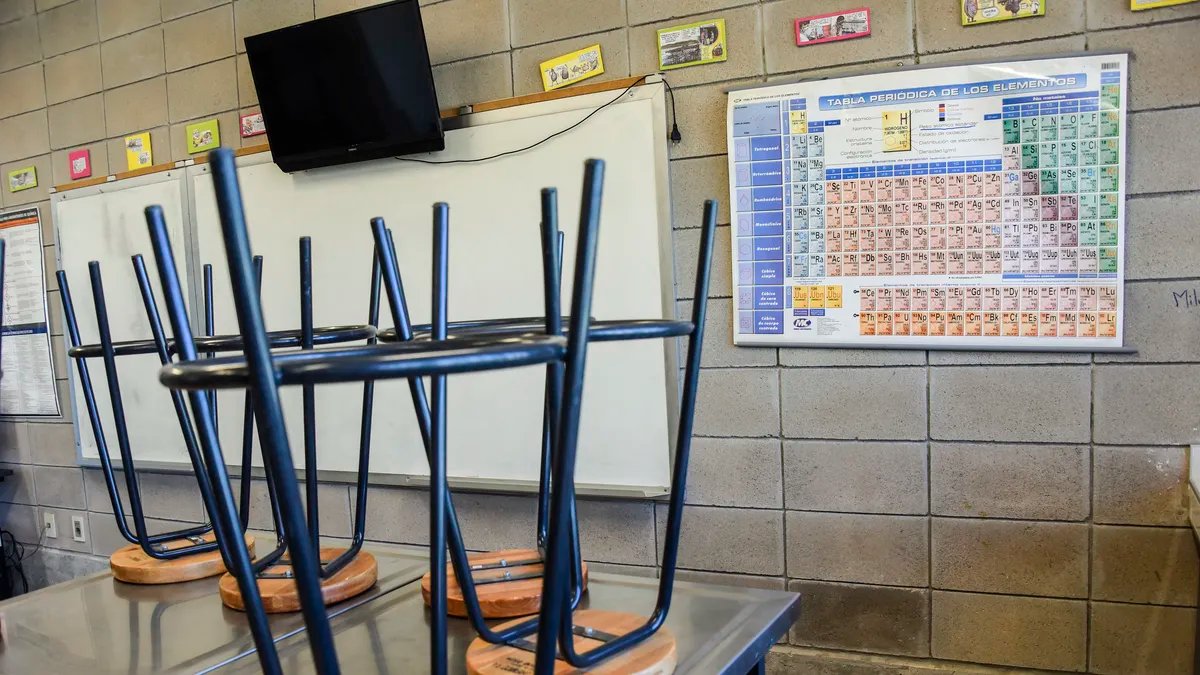
The Association of Secondary Education Teachers (Ades) of Montevideo will carry out a series of 24-hour zone strikes and occupations of high schools during this week, demanding a greater budget for public education. The measures will begin this Monday, June 15, with the occupation of Liceo No. 72, located in Cerro, and Liceo No. 36, in Prado. According to the schedule released by the union, the strikes will be zonal and will last for 24 hours,
The actions will continue throughout the week with new strikes and occupations, on Tuesday the 16th the measure will reach the zones, 103, east and northeast; while on Wednesday the 17th it will be extended to the northern, central and Special Projects (PEP) zones. On Thursday, meanwhile, a strike is planned throughout Montevideo accompanied by an assembly.
Under the slogan that “the time to promise more budget for education has passed,” Ades demands that the budget allocated to education reach the so-called “6+1”: 6% of the Gross Domestic Product (GDP) for public education and 1% for research and innovation.
In dialogue with The Observerthe president of Ades Montevideo, Verónica Méndez, explained that the measures were defined in an assembly held on Wednesday, June 10.
“Faced with the announcement of zero spending, the teachers gathered in assembly resolved this series of strikes to spread the word about why we must reach 6+1 for all education: ANEP, Udelar and UTEC,” he said.
According to Méndez, one of the main destinations that a budget increase should have is educational infrastructure. The leader stated that there is widespread deterioration in high school buildings, with structural, electrical, accessibility and leaks problems.
“There are high schools with classrooms that get rained on and there is also still a need to build new educational centers in different areas, such as La Teja, Colón or Belloni,” he noted.
Another of the union’s proposals points to the creation of new positions and support teams within educational centers. In that sense, Méndez mentioned the need to incorporate more members, psychologists, social workers, sexual education references and other socio-educational profiles.
“In each high school we have to have a socio-educational team to work on the different situations that are experienced daily. An example is the episodes of violence that students and teachers face,” he indicated.
The president of Ades also highlighted the importance of expanding high school cafeterias. In his opinion, the experiences implemented so far have proven to be a tool to guarantee access to food for students in vulnerable contexts.
The demands also include more hours of support and tutoring for students, as well as the recovery of the two hours of teaching coordination that, according to the union, were lost during the previous administration.
“Those hours are essential for planning, correction and pedagogical work. We also propose a reduction in the working day without loss of salary,” Méndez concluded.