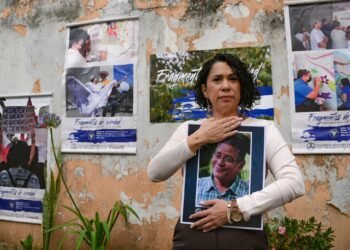
The diffusion of photographs of Miskito indigenous leader Brooklyn Riveraemaciated and in serious health, intubated in a hospital bed, after having been missing for 971 days as a political prisoner of the dictatorship in Nicaragua, was the omen of a fatal outcome, but his relatives never imagined that after his death, three days later, the torture would continue.
At 8:30 p.m. on May 30, Rivera was declared dead by the Ministry of Health, although the Government only made the news official 24 hours later. The authorities attributed his “physical and neurological deterioration to a bacteria generated by the Covid 19 virus), without admitting that he was a prisoner of the State for two years and eight months, during which he was never allowed to have contact with his relatives, or to be visited by international human rights organizations – GHREN-UN, IACHR-OAS, Amnesty International – which expressed deep concern about his disappearance and demanded his freedom.
The official version was denied by his daughter Tininiska Rivera, exiled in Costa Rica, who recalled that although “he had had Covid in 2020, that was overcome and he had a normal life… a few days before his arrest (in 2023) we had a very long conversation, about his entire situation and he was fine, he walked well, he ate well… they cannot claim, after three years, that we do not know where they had him, what condition he was in… what they did with my father “It was murdering him for three years, we do not know what type of torture he must have suffered to reach that state and die.”
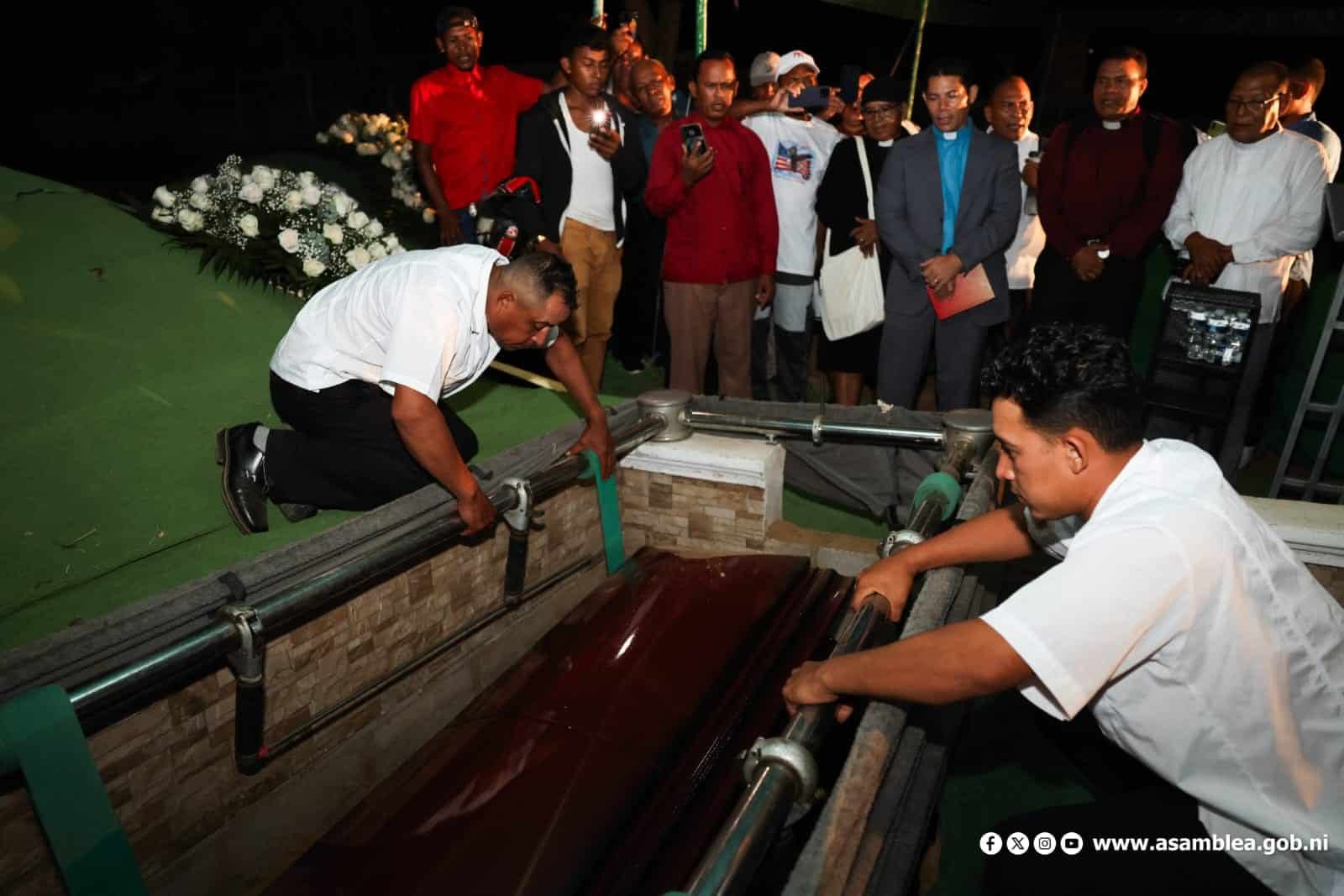
Brooklyn Rivera’s body was not subjected to an independent autopsy to determine the causes of his death, and even after death he remained a prisoner under the control of the dictatorship. The web of power that the “co-president” Rosario Murillo manages down to its last details, refused to hand him over to his relatives so that they could bury him in the community of Sandy Bay, in the Northern Caribbean. On the contrary, when they were trying to make these arrangements, six of their relatives were disappeared, and the “co-presidency” orchestrated an express burial in Managua, led by the president of parliament, Gustavo Porras, and the electoral magistrate and “commissioner” of the Sandinista Front in the Caribbean, Lumberto Campbell, the same executioners who stripped Rivera of his deputy in the National Assembly and his political party, Yatama, of its legal status. Thus was fulfilled that saying of Latin American cynicism that says “they kill and set sail,” to which Daniel Ortega and Rosario Murillo now boldly add: “and we also rob the dead man and kidnap his relatives.”
Between fear and silence, the death and kidnapping of Brooklyn Rivera has caused a deep wound in the Nicaraguan Caribbean, “there is pain, mourning, there is sadness, but they cannot be expressed freely.” says the coastal anthropologist and political scientist, Miguel Gonzálezprofessor at the University of York, “but the dictatorship will not be able to erase the legacy of the most important indigenous leader in the country after the triumph of the 1979 revolution.” Brooklyn Rivera was one of the organizers of Misurasatawhich vindicated the rights of indigenous peoples during the revolution. In 1981, he was imprisoned and accused of promoting “separatism,” and after achieving his freedom, he joined the armed movement on the Caribbean Coast against the Sandinista government. In 1985, he negotiated the first peace and disarmament agreements, until he achieved the signing of the Statute of Autonomy of the Caribbean Regions, which was incorporated into the 1987 Constitution. Rivera founded the indigenous political party Yatama (“Children of Mother Earth“), and since the political transition of 1990 he participated, from the State, in social movements, and in regional and national elections, in the advances and setbacks of this process. For three decades Rivera was, therefore, an uncomfortable ally and adversary of the Sandinista Frontalways as an interlocutor of the interests of indigenous peoples, until in 2023, in the totalitarian drift of Ortega and Murillo, he was expelled from the National Assembly and his political party banned.
In April 2023, Rivera denounced the dictatorship at the United Nations Permanent Forum on Indigenous Peoples in New York, and when he tried to return to Nicaragua by air they denied him entry, imposing de facto exile on him. However, the indigenous leader entered the country through the Honduran mosquito, and was detained by the Police in his home in Bilwi, on September 29, 2023. Since then he was erased from official history, until in November 2024 the regime recognized his detention during the sessions of the UN Universal Periodic Review, and accused him of “treason to the country, conspiracy, and undermining national integrity.” But when the dictatorship was forced to publish the photographs of Brooklyn Rivera, dying in the hospital, in the Orwellian language of Ortega and Murillo, the disappeared political prisoner “traitor to the country” was never mentioned, but rather a kind of guest of the five-star health tourism service, called “brother Brooklyn.”
Psychiatrists and experts in criminal sociopathy surely have various theories to explain the political calculation of Ortega and Murillo in the handling of Brooklyn Rivera’s state crime, but the reality is that his death does not represent an isolated case, but rather responds to a pattern of isolation and torture against political prisoners who remain in impunity. Since 2019, six other political prisoners have died in the custody of the regime, among them: Eddy Montes, shot dead by a guard in the Cárcel Modelo (2019); Santos Flores, remained imprisoned in the Modelo prison for eight years and five months in inhumane conditions (2021); the former Sandinista guerrilla and retired colonel Hugo Torres remained imprisoned in the El Chipote prison (2022); the former Chief of the Army and retired general Humberto Ortega, brother of Daniel Ortega, was detained under the house arrest regime, and died under isolation in the military hospital (2024); and the opposition citizens Mauricio Alonso and Carlos Cárdenas, who died in prison after having spent less than two months in prison (2025). Their deaths have never been investigated and remain unpunished.
After the death of Brooklyn Rivera at the hands of the State, the Secretary of State of the United States, Marco Rubio, described the “Murillo-Ortega” dictatorship as an “enemy of humanity” and held it responsible for the death of the indigenous leader and sanctioned 100 Nicaraguan officials and their families with the visa suspension for his complicity with the dictatorship; Canada, the UN, the OAS, the European Union, and 30 former Ibero-American presidents are demanding an independent investigation of the state crime against Brooklyn Rivera and the accountability of Nicaragua’s co-dictators.
However, unlike the crisis of the Somoza dictatorship in 1979, when Mexico and Venezuela broke diplomatic relations, the OAS ignored the Somoza regime, and an international alliance was formed with the active participation of Costa Rica, Cuba, Panama, and the United States, to isolate the dictatorship, the warnings against Ortega and Murillo have, without a doubt, great political symbolism, but do not represent true continental pressure to cause the suspension of the police state in Nicaragua.
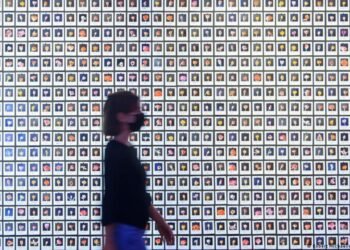
Nine other political prisoners are in a condition of forced disappearance, and their relatives ask “who will the next photos be of in a hospital in a dying state”, “at what moment will they call us to tell us that our relative has died?” They all demand his immediate release and that of 40 other political prisoners, before it is too late.
*This article was originally published in The Country.