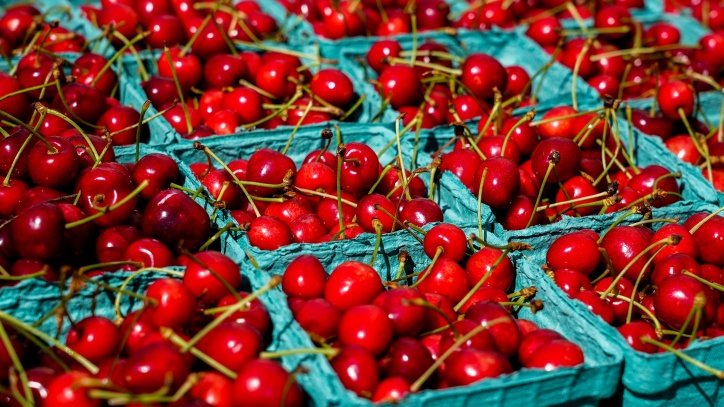

An average cherry harvest is expected this year, as a significant portion of the orchards is located in areas that were less affected by frost damage, the Hungarian Chamber of Agriculture (NAK) and the Hungarian Interprofessional Organization for Fruit and Vegetable (FruitVeB) told MTI on Friday.
Nationwide, harvest prospects are mixed, with significant differences depending on region and variety. Losses were only expected for early varieties; the yield of late varieties, available until early July, is above average.
Total production could reach 6,000–8,000 tons this year;
in better years, it has reached 10,000–12,000 tons, but last year it was only 2,000–3,000 tons due to frost damage.

Photo: Pexels
Drought has been causing problems during the ripening period this year, and this affects not only the quantity but also the quality. In non-irrigated orchards, the cherries are smaller and can only be sold at lower prices, but in many places the fruit has split open due to June rainfall. Based on experience, a reliable supply can only be expected from irrigated orchards that are protected from frost, covered with anti-hail netting and insect screens, and shielded by rain-proof plastic sheeting, they added.
In Hungary, the most important growing region is Pest County, but Bács-Kiskun, Borsod-Abaúj-Zemplén, Fejér, Jász-Nagykun-Szolnok, Heves, and Zala are also significant. Harvesting began around May 20, but only got fully underway in early June.
Consumers typically look for large, glossy, dark red cherries, and the market offers numerous varieties bred in Hungary. Variety innovation is an ongoing process, and in addition to consumer expectations, commercial, cultivation technology, and weather-related factors must also be taken into account.
Improving production could reduce imports of 2,000–3,000 tons, mainly from Türkiye, but labor requirements also pose a challenge, as cherries do not ripen after harvest. They mature all at once and can only be harvested by hand.

Via MTI; Featured photo: Pexels