In Suriname there are a number of notaries who provide services to the public. One of them is drawing up wills. Nowadays that is no longer fashionable. When children ask for a will from their parents, you hear: ‘You want me dead’. But to avoid arguments among themselves, it is wise to have a last will drawn up so that everything can be divided fairly, as the wealthy person wishes.
In the past, drawing up a will was very common because people only lived to be about 40 years old on average. The death rate was very high due to childhood diseases, and men generally died earlier than women. This was often due to venereal diseases, sexually transmitted diseases, which are now also the subject of much discussion. It was possible for a woman to sometimes survive four or five partners, because the previous ones had died.
Wills in the archive
There were so many wills that they were bound in chronological order twice a year. I’ve looked at some of them.
| Part I1786 | 60 business total | 45 men | 6 couples | 3widows | woman alone | 4 Lovemaking man | 2 Lovemaking woman |
| Part II | 59 | 38 | 6 | 7 | 1 separated | 4 | 3 |
| 1798 | 59 | 32 | 1 | 2 | 2 | 10 |
The pieces consist of an average of 8 pages, with a few endpapers around them. The archive book is about 600 pages in total. An alphabetical list of names is included at the back, listing all people who visited the sworn clerk (the current notary). In 1798 this was Van Claveren, who stated the ethnicity of three of the manumitted women: a negress, a mustice and a carboegress.
A commissioned man from the Corps

Only one book from 1798 has been preserved, in which a will of a free man is worth discussing. The free Bentje (no further name) served as captain of the Free Corps and lived on the Lands Free Corps grounds, then outside Paramaribo. His heiress was the Vrije Betje from J. Smith, with the addition that the black girl Patient would become free after his death. She listened to him and Betje together, who was also her guardian. And executor on the execution of this will. Bentje also stated that Betje had to arrange his funeral and pay for it from the estate. When Patient had received the release, she would become the full heir to the estate. Interference by the Orphan Chamber was ruled out. Bentje had not yet received 5000 guilders. He signed the deed, so presumably he could write.
We assume that Bentje was one of the people who was freed from slavery in 1772 by the government under the leadership of Governor Nepveu to serve in the Black Hunters Corps, or the Mulatto Corps. These people, about 500 in total, drew lots to obtain a yard on a piece of land: now called Fri Man Gron. They built houses there and lived there with their families when they stayed in the city. These men were recruited and trained as soldiers to protect the city against Maroon attacks, but also to chase them into the jungle and capture them. So that they could be tried by the Court in the city. They received uniforms and guns, spice and lead. After five years of service they were given their parole. Most of them later performed trades. Many became carpenters and built houses in the ever-expanding Paramaribo.
Growth of the Colored Population: In Numbers and Assets
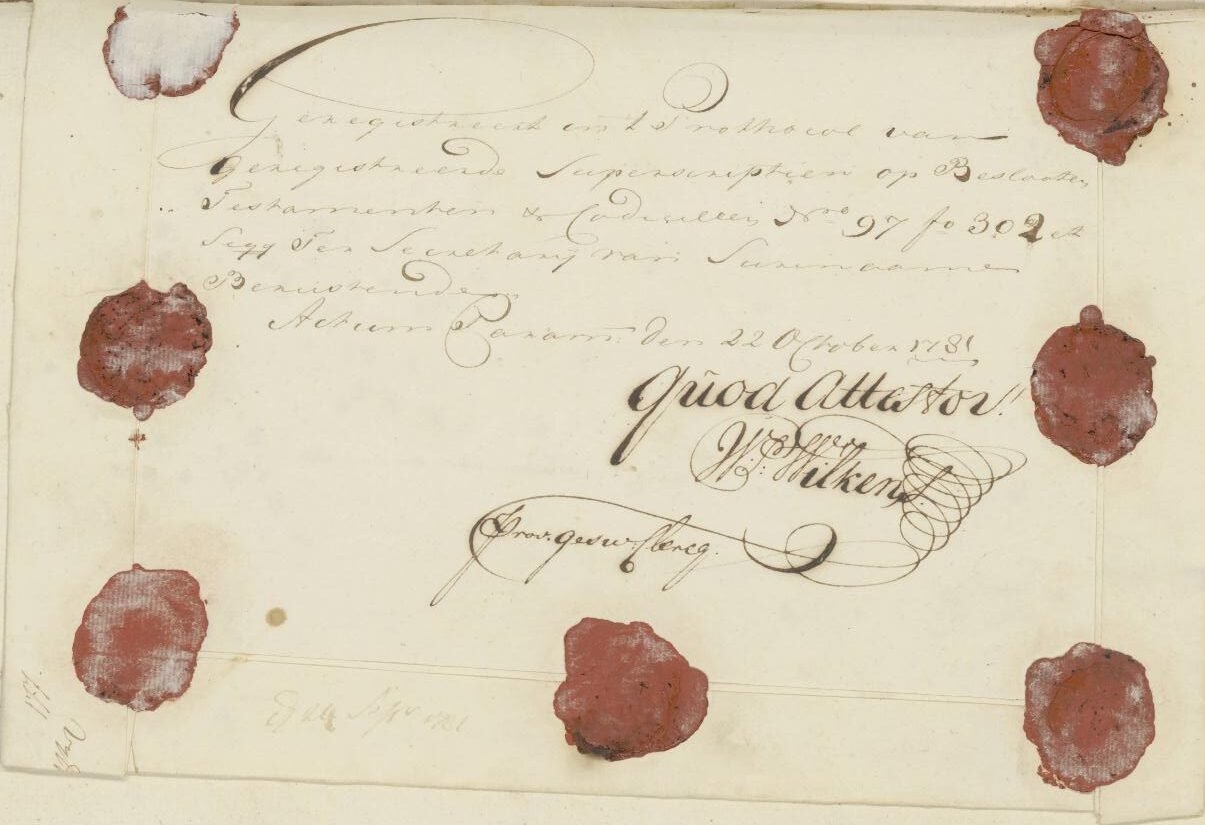
There were costs associated with drawing up wills. The lowest allowance was paid for people who had less than €5,000 in wealth. The rates are listed in the Placard Book for each bracket. On October 13, 1781, the free Coridon of Everhard presented a will to the sworn clerk Wilkens. It was sealed in ‘7 distinct places’. Coridon died in 1786 and JJ van Dusxelle (sic) had the last will opened. He donated f5,- to the Reformed Church. His children Johannes Jacobus and Coffy van Duzelle received his ‘carpentry tools’. The black women Affiba and Laurensa inherited all his belongings and the property on the Weidenstraat and what else was ‘solid and solid’. If they died, everything would go to the two boys. He appointed Affiba as executor.
Studying wills can provide interesting information about the social rise of the colored free population of Paramaribo. It provides data on the growth of numbers, but also on gender, color and class. And the networks in eighteenth-century Paramaribo.
Hilde Neus