Of Mario Panizza
The Sagrada Família, the tallest church in the world, represents a symbol for Barcelona that goes far beyond its architectural value. The Tower of Jesus Christ (172.5 metres) inaugurated by Pope Leo The complex, both shy and theatrical personality of its designer, Antoni Gaudí (1852-1926), contributes significantly to strengthening this character. The events of his life, characterized by many difficulties and misfortunes, become even more tragic if connected to his death, which occurred one evening, on his return from the construction site of the Sagrada Família: hit, due to his distraction, by a tram, only after some time was he rescued and taken to hospital. Not recognised, because he was unkempt and poorly dressed, he was admitted to the poor’s ward, where he died three days later, on 10 June 1926. This aura of “diversity” that accompanied his person was often transferred to his architecture, leading him to be considered by many a unique artist, distant from any school and any stylistic model.
Gaudí dedicated over 40 years of his life to the Sagrada Família, with a growing intensity that profoundly marked his character. The last 15 years have seen him constantly on the construction site, completely absorbed professionally and emotionally. On the other hand, the stable presence of the architect was part of the nature of the work, governed by a precise idea that guided its general layout, but, in its creation, continuously updated by new construction experiments and by the sensations aroused by the place.
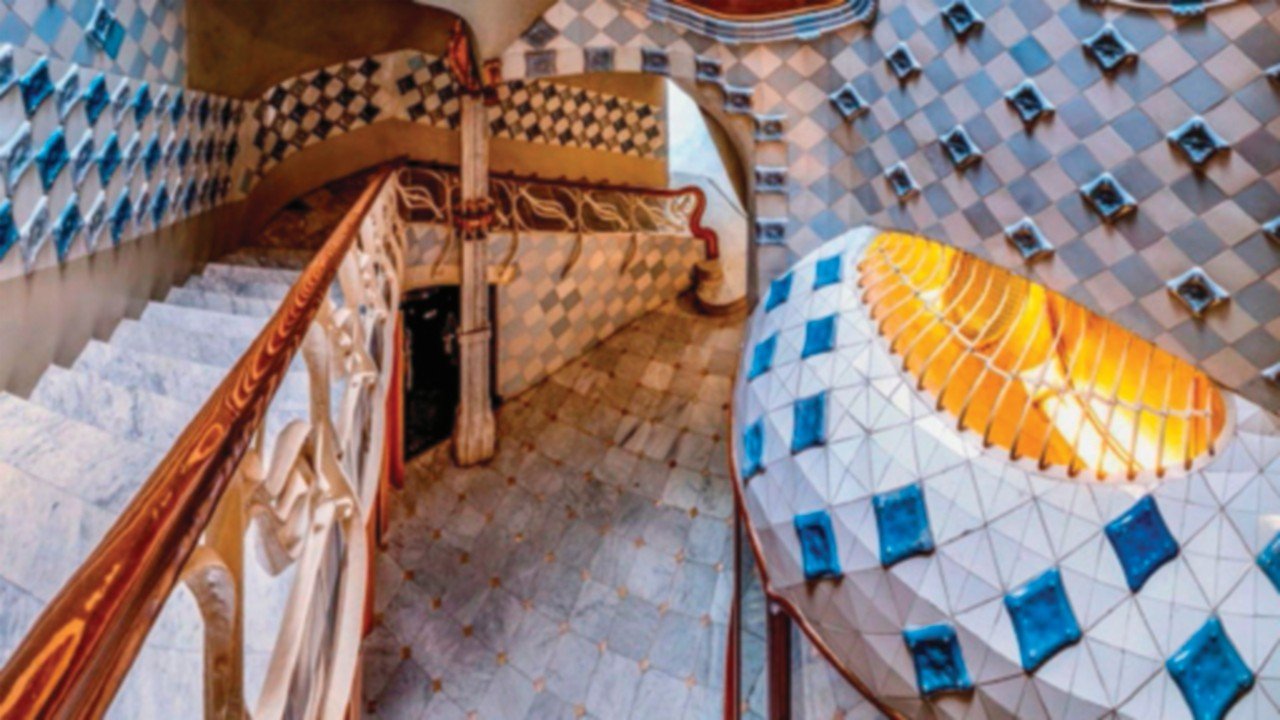
Like the large church complexes, this too is a constantly evolving factory which, over the course of 150 years, accepts being modified and contaminated by the succession of styles. Conceived in 1882 by the architect Francisco de Paula del Villar as a neo-Gothic structure, it was reinterpreted by Gaudí, who took over the following year, in a Liberty style, but only apparently. In reality the composition has its own originality, where the organic shapes and geometry chase each other and overlap in an image that seems to want to capture, from the artistic research of the beginning of the twentieth century, also the silhouettes of Art Deco and the colors of Cubism. The intimate coherence of the work lies precisely here, in the intention of making the project susceptible to modifications, capable, like a living organism, of growing over time. Entering the basilica, consecrated by Benedict XVI in 2010, it seems like immersing yourself in the natural environment of a forest, where the pillars that order the naves appear like trees whose branches form the roof.
On the occasion of the graduation, achieved with the evaluation of excellent, the commission, although impressed by Gaudí’s talent, did not hesitate to express the opinion: “are we graduating a genius or a madman?”. In reality the situation is less extreme; Gaudí’s professional life received widespread recognition and many of his works, registered as a UNESCO World Heritage Site, were supported, at the time, by significant investments in order to be built. His projects in fact required capable workers and the use of noble and expensive materials: stone, glass, ceramic, iron. Considerable support, including economic, comes from the industrialist Eusebi Güell, whom he met at the beginning of his career, when he had not yet created any demanding works. Gaudí is a brilliant and convincing architect, who captures the interest of his clients, building important residences in the heart of Barcelona, all full of significant technical and formal experimentation. Casa Vicens (1883-88), Palacio Güell (1886-90), Casa Calvet (1898-1900) Casa Battló (1904-06), Casa Milà (1906-10) together with many others, constitute important opportunities to increase his professional prestige. In Park Güell (1900-14) formal research finds full realization: the natural elements, transferred into the architectural composition, build a very rich repertoire, where vegetal themes are accompanied by anthropomorphic motifs and zoomorphic suggestions.
In its architecture, that idea of Modernism that Catalonia and, in particular, Barcelona impose as a line of research takes shape which, even today, represents a significant point of reference. Gaudí is therefore not an isolated phenomenon: he is certainly the most prestigious exponent, with his own originality and talent, but he is part of that cultural current present in the area, a source of inspiration for other architects, of fame and social and political commitment, who give life to the so-called Catalan Modernism.
Among these, the best known is certainly Lluís Domènech i Montaner, who created in Barcelona, during the same years in which Gaudí worked, works of great expressive value, also characterized by rather innovative distribution and functional solutions. The Palau de la Música Catalana (1908), a national monument since 1971 and registered as a UNESCO World Heritage Site since 1997, constitutes an important example both in its external image, which clearly stands out in terms of shape, size and decoration from the surrounding buildings, and in its interior, where the structural elements, all evident, are composed in a scene of chromatic harmonies, rich in crystals and enamelled glass, shining at night, under the light of chandeliers, and during the day, illuminated by the large windows overlooking the street. Equally precious is the Hospital de Sant Pau (1902-30) not far from the Sagrada Família, also recognized as a UNESCO World Heritage Site in 1997. Made up of 12 pavilions, set in a large park, it offers patients a peaceful and livable condition, reassured by the quality of the architecture and the amenity of the place. The general distribution system is resolved through long underground passages which, by connecting the pavilions to each other without altering the harmony of the whole, completely free the healthcare routes from the public and ensure that doctors are guaranteed sterile environments.
Starting from the second half of the nineteenth century, Barcelona also experienced the revolutionary experience of the Cerda Plan, an urban planning project that frames the development of the city within an open chessboard, where buildings and streets are regulated by standard, equal and perfectly ordered measurements.
Gaudí’s genius therefore fits into a very fertile cultural climate – Catalan Modernism – which indicates a way to build the city through a balanced composition between the free experimentation of buildings and the rule that prevents dysfunctions and urban imbalances. Even today the Catalan city demonstrates that it has, much more than others, the space and potential to respond to the principles of sustainability.