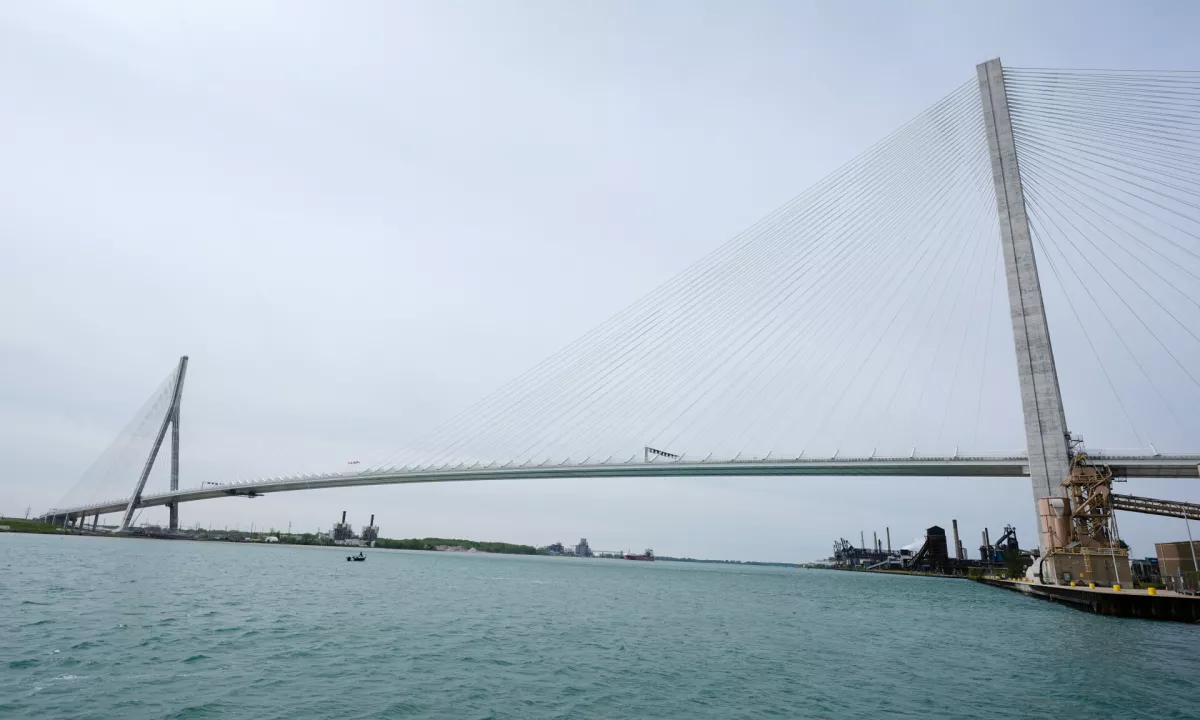
Construction of the approximately $6.4 billion project began in 2018 and took seven years. Photo: AP
A new bone of contention: Trump threatened Canada over the opening of the bridge, but it ignored him
Canadian Prime Minister Mark Carney has confirmed that the Gordie Howe Bridge will be open to traffic by the end of this week. Canada will open the bridge connecting Detroit, Michigan, and Windsor, Ontario, despite threats from US President Donald Trump, who announced at the beginning of the year that he would not allow the bridge to open.
In a brief statement to the media on Parliament Hill in Ottawa, Carney dodged questions about potential negotiations with Trump. Instead, he focused on praising the project as an outstanding achievement of cross-border cooperation.
“This is great news. The bridge will of course be open by the end of the week,” Carney said, according to the AP, calling the project “a symbol as well as a real proof of cooperation” between the United States and Canada. “This is great for Canadians and Americans crossing the border, as well as for the economy. I just want to acknowledge everyone who built it on both sides and look forward to the completion of the project.”
Trump’s threat of blockade
The fate of the bridge came into question in February when Trump posted a post on social media in which he portrayed the construction as an exploitation of the United States. His comments related to criticism of the Moroun family, which owns the nearby Ambassador Bridge, which also connects the US and Canada. The aforementioned family called the new bridge unfair competition and launched a lawsuit to stop the project, and even ran an ad campaign against the construction during Trump’s first term as president.

Opposite the private Ambassador Bridge is the Gordie Howe Bridge, which is jointly owned by the Canadian government and the US state of Michigan. However, in his February announcement, Trump falsely portrayed the project as an exclusively Canadian venture.
“Imagine, Canada is building a huge bridge between Ontario and Michigan. They own both the Canadian and American sides,” Trump wrote. “And now the Canadian government expects me, as President of the United States, to allow them to simply ‘exploit America’! What does the United States get? Absolutely nothing!”
At the time, Trump threatened to block the completion of the bridge and demanded that Canada hand over “at least half of this property” to the US government. “I will not allow this bridge to open until the United States is fully repaid for everything we have given them and, importantly, until Canada begins to treat the United States fairly and with the respect we deserve,” Trump said.

The straining of relations between the United States and Canada
The threat further strained relations between the neighboring countries. Since taking office, Trump has constantly criticized Canada for what he says are unfair trade practices and pressured it to cede some of its sovereignty to the United States. The pressure continued this month, when Trump repeated his call on Truth Social on June 1 to make Canada “the 51st. American state’.
Although Canada and the United States have traditionally been close partners with highly intertwined economies, Trump sparked a trade war shortly after his second inauguration by imposing high tariffs on Canada. Canada responded with countermeasures, some of which have since been lifted, while others remain in place. Recently, the Trump administration proposed using the 1974 trade law to impose tariffs on 60 countries, including Canada, that it accuses of using forced labor.

The project should be a symbol of partnership
Before it became the subject of political controversy, the Gordie Howe Bridge was considered a model of cross-border partnership. An agreement to launch the project was reached in 2012, and in 2017 Trump and then Canadian Prime Minister Justin Trudeau even issued a joint statement expressing hope that the project would be completed quickly.
Construction of the approximately $6.4 billion project began in 2018 and took seven years. The bridge, named after the legendary Canadian hockey player who played for a professional team in Detroit for many years, is designed to facilitate supply chains, reduce traffic congestion and promote trade between the United States and Canada.