According to the United States Central Command (CENTCOM)he Apache AH-64 helicopter was knocked down by Iran at 7:33 p.m. ET on Monday, leaving its two pilots in waters near Oman.
On Tuesday, the president donald trump confirmed that Iran shot down the Apache during a patrol mission near the Strait of Hormuz, and announced retaliation. Hours later, what the president said led to US bombings against Iranian targets and Tehran’s response towards countries of the Gulf where there are United States military bases.

A Boeing AH-64 Apache attack helicopter similar to the one shot down by Iran. (Photo by Johan NILSSON / AFP).
/ JOHAN NILSSON
How was the Apache shot down? There is no official version on the matter, but CBS News reported, citing US officials, that initial reports suggest that An Iranian Shahed drone hit the helicopter.
It was about the first loss of an Apache helicopter since the war with Iran began last February 28.
How was the rescue?
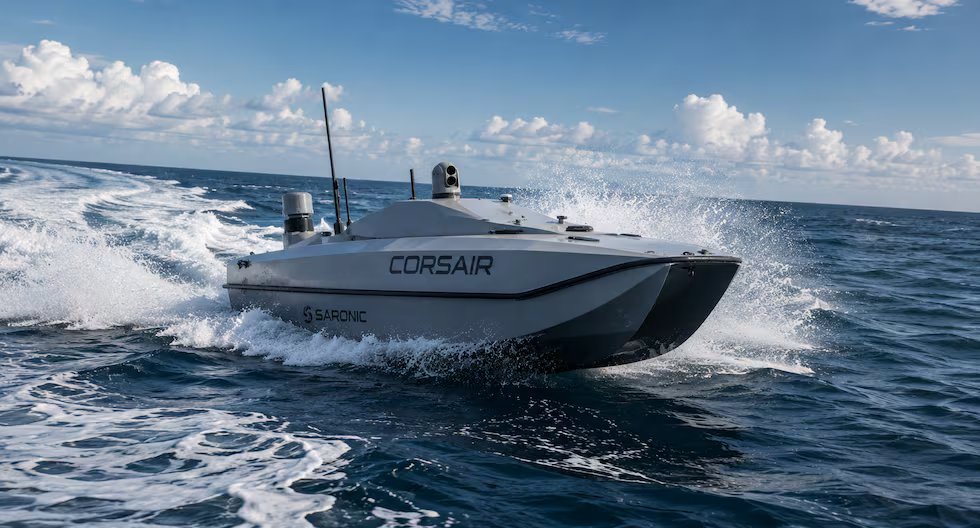
He autonomous naval vehicle used by the United States to rescue the pilots was a Corsairoperated by Task Force 59 of the Fifth Fleet United States.
This Navy unit, specialized in unmanned systems, is based in Middle East and operates in strategic areas such as the Persian Gulf, the Red Sea, the Arabian Sea and parts of the Indian Ocean.
The spokesperson of CENTCOMthe captain Tim Hawkinsexplained that in search and rescue operations “the best resource that is closest and arrives fastest” is used.
This statement reinforces the hypothesis that the corsair It was used because it was the closest available asset to the place where the pilots fell.
It should also be taken into account that if the helicopter was shot down by enemy action, immediately sending another manned aircraft or a vessel with personnel on board could expose more military personnel to a new attack in a highly sensitive area from a military point of view and where Iran maintains important surveillance and attack capabilities.
CENTCOM told the Axios portal that The Corsair “picked up” the crew and “transported them to another location in the water.””, where they were then “hoisted into a helicopter.”
This is the Corsair, the autonomous vehicle that rescued the Apache pilots

The Corsair is an autonomous naval surface vehicle. (Saronic).
According to Axios, the corsair it’s a unmanned surface vehicle (USV) developed by the American company Saronic Technologiesbased in Texas. It was publicly presented in October 2024 and began being deployed by Task Force 59 of the US Fifth Fleet in the Middle East at the end of March 2026.
Although it is usually described as a “naval drone”actually has dimensions similar to those of a small speedboat. Measure 7.3 meters in length, can carry up to 454 kilos of payload, It has an autonomy of approximately 1,852 kilometers and can exceed 65 km per hour speed.
According to Saronic Technologieshe corsair can sail without a crew on board thanks to a combination of artificial intelligence, advanced sensors and remote communication systems. These capabilities allow it to plot routes, identify obstacles, coordinate with other unmanned platforms, and continue operating even in scenarios where communications are affected.
Despite its high degree of autonomy, The vehicle remains under human supervision. Its operators can monitor the mission and take direct control at any time.
One of the most striking capabilities of corsair is that it can remain for long periods at sea without direct intervention.
Saronic Technologies ensures that fleets of corsair have completed exercises of more than 90 continuous hours and that the system can remain stationary in an area while automatically managing its energy consumption.
Regarding its use, Saronic Technologies maintains that the corsair has been designed for missions such as maritime surveillance, reconnaissance, patrolling, support for naval operations and transport of sensors and specialized equipment.
Precisely for this reason, his participation in the rescue of the pilots of the Apache set a precedent. According to the information available, Never before has an autonomous surface vessel been used to recover military personnel in a real combat situation. or emergency.
Drones are changing the way we think about war

The United States used the Corsair naval drone to rescue the two pilots of the Apache helicopter that was shot down by Iran in the Strait of Hormuz. (Image generated by AI, Chatgpt).
For the defense and intelligence specialist Andrés Gómez de la Torrethe use of autonomous vehicles corsair in the rescue of the pilots of the Apache reflects an increasingly visible trend in modern conflicts: the growing participation of unmanned systems in tasks that previously depended exclusively on human operators.
As explained to The Commerceboth the alleged downing of the helicopter using an Iranian drone Shahid as the subsequent recovery of the pilots using an autonomous vessel show how The so-called “unmanned wars” are transforming military operations.
“The human element is replaced by the so-called autonomous systems, both in attack and surveillance operations and also in rescue”he pointed out.
However, Gómez de la Torre considered that the use of corsair It should not be interpreted as a revolutionary fact in itself. In his opinion, the most relevant aspect of the episode continues to be the downing of the AH-64 Apache, one of the most emblematic combat helicopters in the US arsenal.
“The Apache is the backbone of the United States Army rotary wing,” he stated. He also recalled that this aircraft has participated in some of the main conflicts of recent decades, including the invasion of Panama in 1989, the Gulf War, the military campaigns in Iraq and the war in Afghanistan.

Iran’s Shahed drone. (AFP).
However, he highlighted that The incident also highlights the effectiveness of much cheaper technologies. Everything indicates, he said, that the helicopter would have been knocked down by a Shahed dronea platform that has become one of the symbols of Tehran’s asymmetric war strategy.
“It is a low-cost technology”he indicated. He added that this type of drones, which fly at low altitude, They have characteristics that make them especially suitable for facing rotary wing aircraft such as helicopters.
Regarding the strategic impact of the incident, the analyst considered that, despite the symbolic effect of the demolition, This does not represent a decisive blow against US military capabilities..
“Although it is effective, it is not something that allows us to affirm that it is a neuralgic attack on the military infrastructure of the United States,” held.
Therefore, he estimated that The United States should keep negotiation channels open with Iran. In his opinion, the conflict shows characteristics of a war of attrition, in which neither party seems to be in a position to obtain a quick or conclusive victory.