Berlin during the interwar period was considered radically modern, aggressive, fast-paced and hectic. In Vienna one found its sentimentally adored counterpart: the Austrian capital was imagined from Germany as a cozy, beautiful, culturally conscious and friendly place of longing. “There was always a tender relationship between the two capitals. The rough, sober, thoroughgoing nature of the Berlin Bear happily paired with the tender, romantic, easy-going nature of the Lady Vienna,” as the Berliner Tageblatt put it in 1925, drawing on all sorts of gender clichés.
Such attributions also shaped the view of those artists who belonged to Viennese Modernism and were temporarily active in Germany, as well as the cultural exchange between the cities, as the literary and cultural scientist Hermann Schlösser writes in the new anthology “A Viennese school in Berlin 1900–1933” (De Gruyter) states. He states: “Vienna was considered a city of sumptuous food and good wine, the Viennese women were imagined as ‘sweet girls’, the dialect as ‘cute’ and the Danube as ‘beautiful and blue’.” What these positive prejudices concealed was that job opportunities and prospects for success were modest in impoverished Austria after the First World War.
» The roughness of the Berlin Bear happily paired with the tenderness of the Lady Vienna.«
Berliner Tageblatt,
1925
In contrast, the great artistic careers were made in the city with its hectic pulse. “Whether in the theater or in film, in literature, the press or on the radio – anyone who had ambitions for national or even international attention had to go to Berlin in order to succeed or fail there,” writes Schlösser. For newcomers from Vienna it was either a matter of leaving the legacy of their origins behind them and being open to the temptations of their new home, like the director Fritz Lang has done – or to distinguish oneself precisely by emphasizing one’s own “otherness”. Examples of the latter include the feature writer Alfred Polgar (1873–1955) and the actress Elisabeth Bergner (1897–1986).
The author shows that they by no means had to bow to the most trivial Vienna clichés and were certainly valued as sophisticated conveyors of the Viennese way of life. Polgar published, among other things, in the “Weltbühne”, which formed opinions among left-wing intellectuals. He was considered a clever contemporary critic, dealt with questions of Americanized everyday culture and party-polarized politics, reviewed films and wrote travel essays. The philosopher and cultural critic Walter Benjamin saw Polgar as an equal kindred spirit, but could not avoid using Viennese associations in his characterization. He found that its humor was based on a rebellious sense of justice that came from a specific Viennese tradition.
In contrast, according to Schlösser, the right-wing enemies of Weimar culture did not place Polgar in the Viennese context: “They fought him as a representative of Berlin’s foreignness to the people.” They viewed the capital as “un-German, degenerate and decomposing”. In 1933 Polgar fled into exile.
»Viennese artists transformed their self-image as outsiders into a social utopia.«
Elana Shapira,
Cultural and design historian
Elisabeth Bergner also made her way to Berlin, becoming a star of cultural life here in the 1920s. She oscillated between gender roles and was seen by some as the type of “child-woman” who was celebrated as an ideal in the Viennese intellectual scene at the turn of the century. However, Bergner combined her androgynous charisma “with an independent acting talent and a sharp intelligence”. Schlösser: “Perhaps this is also a reason why ‘Die Bergner’ was never as popular in Vienna as it was in Berlin.” In the German feature pages, she was celebrated for her Viennese characteristics, such as her tone, and corresponding clichés – sweet, amiable, melancholic – were transferred to her. The NSMeanwhile, the inflammatory newspaper “Der Völkischer Observer” branded Bergner a “high-spirited Jew”: “The only characteristic that anti-Semitic resentment still grants her is greed for money.” Bergner left Berlin in 1932 and started a second major career in London.
The rise of National Socialism interrupted the work of many Viennese artists in Berlin. It is our task to “rethink the relevance of their legacy for today’s society,” explains the editor of the anthology, the Viennese cultural and design historian Elana Shapira (University of Applied Arts Vienna), the intention of the publication. The focus of the contributions by, among others, Wolfgang Müller-Funk, Gilles Mastalski, Elizabeth Ann Danto, Christopher Long and Andrea Winklbauer are further case studies on writers like Robert Musil and Vicki Baum, composers like Arnold Schönberg, painters like Emil Orlik, designers like Friedl Dicker-Brandeis, directors like Max Reinhardt and scientists like Otto Neurath, about their networks, careers and works.
The analyzes reveal how much the Viennese School in Berlin was determined by the sense of belonging of its protagonists. The coffee house culture – reading the newspaper in the morning as a secular ritual act – was retained in the new home and was cultivated, for example, in the Café Monopol not far from the Jewish Scheunenviertel. Max Reinhardt, for example, came and went here.

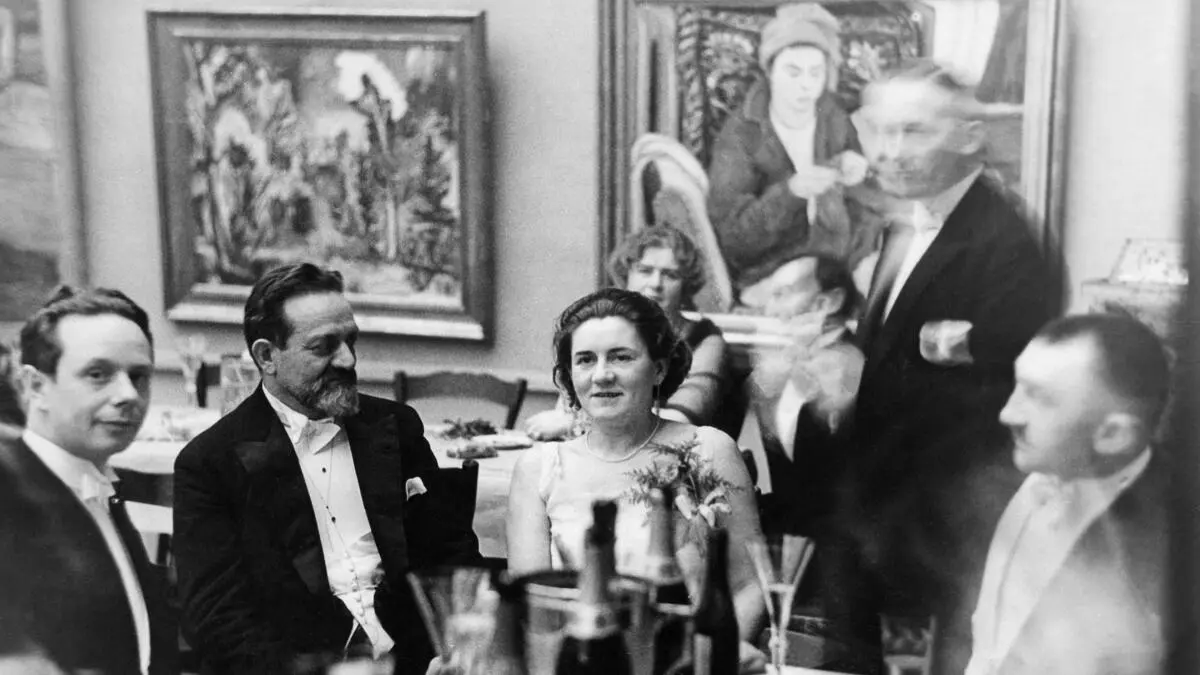
On October 25, 1895, the young Max Reinhardt wrote in his diary: “I now go to Monopol almost every day in the afternoon to read the newspapers.” (pictured: Reinhardt with his wife Helene Thimig in London in 1935) Imago / Imago Stock&people/United Archives International
From Berlin, the Viennese (often Jewish) emigrants helped shape the development of modernity in the two cities. They transformed their self-image as outsiders into artistic freedom and social utopia, says Shapira. “The aim was to show new ways of seeing and making modernity visible, to create a critical awareness of a changing society and to promote public debate.”