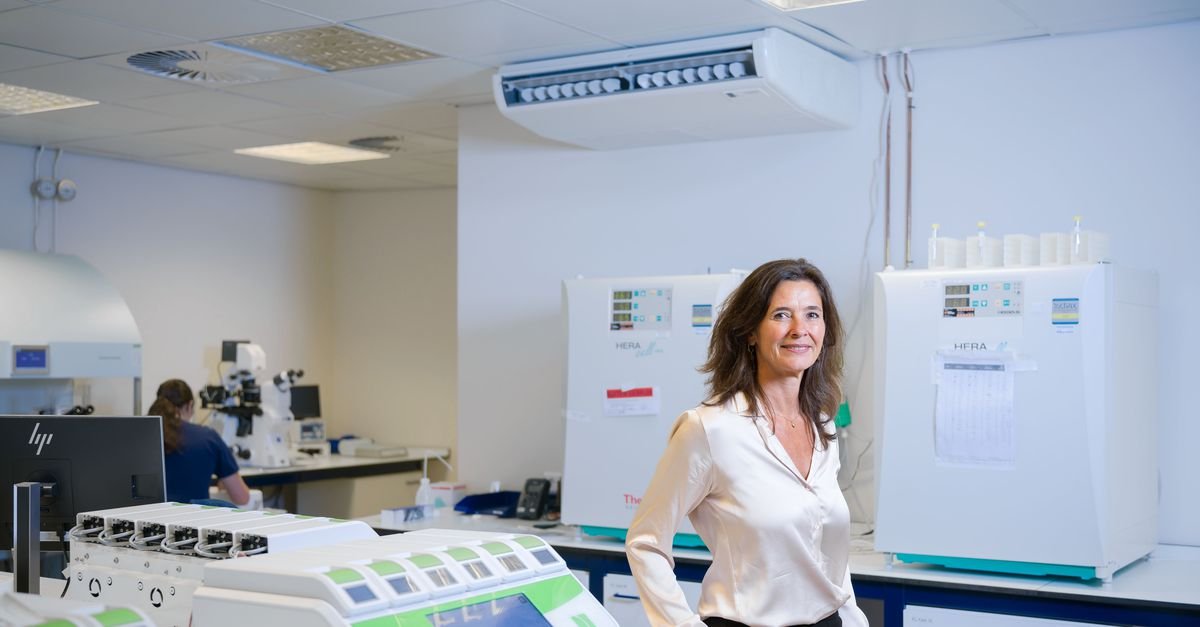
Right next to the busiest highway in the Netherlands is MC Kinderwens (MCK), a fertility clinic in an impressive mirror-glass building. The clinic in Leiderdorp serves a significant proportion of Dutch prospective parents and is especially popular among people who are considering donor conception. “We represent a large part of healthcare in this area,” says director Eugenie Kaaijk. The majority of the clientele consists of single women and lesbian couples.
Kaaijk receives you in her office, the full waiting room nearby.
A report from the Healthcare and Youth Inspectorate will be published on the MCK on Wednesday afternoon. The criticism is harsh. The inspection concludes that MCK’s information between 2003 and 2018 did not meet the legal requirements and that the clinic did not adhere to the applicable standard of 25 children per donor. There are now 36 known ‘mass donors’.
The common practice of 25 children has been in place for years to prevent large kinship groups of half-brothers and half-sisters from arising. Many clinics often serve the immediate area and if a group is too large, the risk of incest increases. Half-siblings could start a relationship with each other without knowing it. Moreover, it can be stressful if you suddenly find yourself part of such a large group.
Why didn’t your clinic adhere to the standard?
“The report states that the clinic has 25 families per donor, instead of 25 children. This has created groups of, for example, thirty, forty or more children per donor.
“I did not work in this clinic at the time and to find out more about the past, I spoke to former administrators. One of them said: we just wanted to help people and we thought in terms of families. That in itself is an understandable thought, because people who use donor conception usually want all their children from one donor.
“Before 2004, anonymous donors were used almost exclusively in the Netherlands, and I understand that the idea was that larger kinship groups would be less harmful because there was more openness about donors after 2004. The population also changed: there were more lesbian couples and single women, who were thought to give their children openness about the existence of a donor. The number standard was mainly there because of the risk that consanguinity, blood relationship, entails. I find that a more pleasant word than incest. The perception in the clinic was that the risk would not increase if the standard of 25 families were maintained.”
:format(webp)/s3/static.nrc.nl/wp-content/uploads/2026/06/09144315/090626BIN_2034195333_mck4.jpg)
Cooling with embryos in the MCK.
Photo Merlijn Doomernik
The deviation from the norm was therefore based on assumptions.
“That standard of 25 was also arbitrary. But it is of course very remarkable that as a clinic you decide to make something different. And that you do not explicitly discuss this with the prospective parents. I don’t think they have realized at all that this could have consequences for children.”
Do you understand the thinking of your colleagues?
“I can follow that line of thought. But I have difficulty with the period around 2018. In that year, it was discussed internally that there were exceedances and they started working with smaller numbers, but the mistakes made were not shared with parents and donors. I find that very complicated.”
Why were parents and donors not informed at that time?
“The explanation I heard is that the clinic was not allowed to provide the necessary personal data, which meant that victims could not be contacted. It was then decided to put something on the website about the past and to inform people who were still being treated. If we had contacted the victims more proactively, we could have avoided a lot of unrest and questions. Now we have to explain why we did nothing about it for seven years.”
Also read
‘Fertility clinic used donated sperm for years for more than the permitted number of conceptions’
:format(webp)/s3/static.nrc.nl/wp-content/uploads/2025/06/06205808/web-0606BINspermadonatie.jpg)
The inspectorate started its investigation after reports and revelations about the MCK by the journalistic program News hourand subsequent unrest. The first broadcast in that series was a year ago, just after gynecologist Kaaijk started her new job as director.
The clinic has not previously responded extensively to the allegations and research results.
The inspection report contains nothing about age violations with regard to donors. Previously revealed News hour that some donors were older than the standard prescribed, they were over 45.
“I checked that. It was indeed common practice for donors to be used up to the age of fifty. A former director said that they extended that age limit due to donor scarcity. That 45 years was based on the future of the child, so that he could possibly get to know his father later. The former director’s thinking was that people are getting older, so that donors could also be a bit older.”
Why are you here to explain the abuses in the clinic? You weren’t there.
“There are still people working who were there at the time. They might also have been here, but I feel responsible as director. I cannot change the past, but I am there for the present and the future.”
We meet people at a very vulnerable moment in their lives. With a primal desire to produce a child. They only understand the consequences later
Last week it emerged that a large majority of the cabinet wants an extensive investigation into the past of donor conception. What went wrong and who was responsible? In recent years, more and more abuses have come to light. About mass donation such as in the MCK, but also about gynecologists who used their own sperm or other sperm than promised for treatments. Research into some of those gynecologists showed that they wanted to help the prospective parents and thought that they could sometimes do that with their own sperm. In the predecessor of the MCK, it previously appeared that a laboratory technician used his own sperm for treatments.
Also read
He is descended from a fertility doctor. Now he investigates gynecologists who secretly used their own semen
:format(webp)/s3/static.nrc.nl/wp-content/uploads/2026/05/06090447/090526VER_2031746276_Illu_Gynaecoloog_Caitlin-Becker-Hof_WEB.jpg)
How do you deal with that past?
“This is about a laboratory technician who used his own sperm in the 1980s when no donor showed up. Sixteen descendants are now known. We published an interim report on that issue in 2024 and the final report will soon be on the website.”
Two-thirds of Dutch children conceived with donor sperm are conceived with sperm from Danish donor banks. These banks adhere to the law in the Netherlands, which since 2025 has stipulated that a donor may help twelve families, but they can father more children through efforts in other countries.
Large kinship groups are currently being created that exceed Dutch guidelines in size. How do you view that?
“You see that there is a lot of awareness in this area. We have to keep asking ourselves whether we are doing it right. Because large kinship networks are indeed emerging. That is a very current topic within our profession. A committee has been set up to create new preconditions on this topic.
“When I started working as a fertility doctor at the age of twenty-four, it was mainly about the woman who had a strong desire to have a child. And you wanted to help her. The discussion with prospective parents was mainly about the nest in which such a child would end up. Were there any concerns about that? If not, then it was possible. Now you see that the emphasis is much more on the identity of the donor child and the existential questions that arise for such a person.”
Could the professional group also conclude that it is no longer possible to conceive children with sperm from foreign sperm banks?
“That is possible, but that is precisely the dilemma. If you no longer do it here, people will go abroad not only for sperm, but also for the treatment itself. If you do not offer an alternative, you do not take responsibility. Then you say: as long as it does not happen in our field of vision, we have not done it.
“A plan that is being discussed in the professional group is to set up a national donor bank. Such a thing does not exist in the Netherlands. Prospective parents can now receive sperm from Dutch donors through some clinics, but there is often a waiting list or poor infrastructure. How can we convert this fragmented donor recruitment into good recruitment?”
In the meantime, your waiting room is full.
“We meet people here at a very intimate and vulnerable moment in their lives. Many of them have an intrinsic wish to produce a child. They may only realize the consequences later. That is why I think we need to better guide prospective parents, that we need to have more conversations about the consequences of donor conception for the children. There are no concrete plans for this yet, but we have to make them together.
“It is now a lot about what went wrong in the sector in the past. I understand that on the one hand, but a lot of energy is being spent on it, while we are also dealing with a current problem. I hope that there is still money and time left for that.”
Also read
Nieuwsuur: at least 85 mass donors in the Netherlands, with many more descendants than allowed
:format(webp)/s3/static.nrc.nl/wp-content/uploads/2025/04/14084000/web-1404BINdonoren.jpg)
Correction (June 10, 2026 10:50 am): An earlier version of this article stated that the lab technician who worked in the predecessor to MCK fathered eleven children with his own sperm. That must be sixteen. The number eleven is mentioned in an interim report that was published in 2024, but the number has since increased.