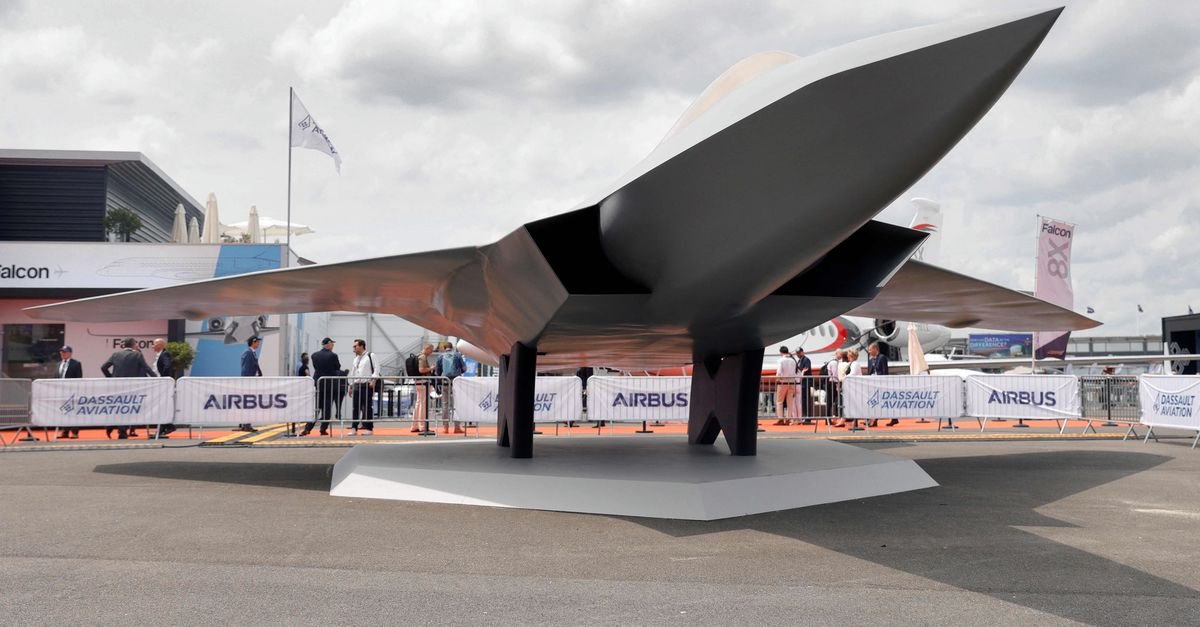
It is in “a brain-dead state,” the French newspaper described Le Monde the French-German project to jointly build a fighter plane earlier this year. There was not much more enthusiasm on the German side. The German Defense Minister Boris Pistorius (SPD) had already emphasized as a precaution that stopping the project “would not be the end of the world and that German-French friendship would continue to exist.”
Although billions have already been invested in the project, the total cost of which was estimated at 100 billion euros, it had been clear for some time that the Franco-German efforts for a new fighter plane would fail. On Monday, Germany finally pulled the plug on the project.
This conclusion is not unexpected given the difficult cooperation, but it is painful: after the seizure of Crimea in 2014 and the large-scale invasion of Ukraine in 2022 by Russia, and the changing foreign and defense policy of the US, the need for more European cooperation has actually increased. Why then have the European Union’s two largest economies failed to establish successful defense cooperation? Four questions and answers about the project.
1What was the plan?
Shortly after taking office for his first term in January 2017, US President Donald Trump called NATO “obsolete” – a shock to transatlantic relations. In response, French President Emmanuel Macron and then German Chancellor Angela Merkel wanted to show that Europe can operate independently of the US and take European defense into its own hands. In July 2017, just before Trump’s first visit to Macron, Macron and Merkel decided that a Franco-German fighter plane should be created. The name of the project: the ‘Future Combat Air System’ (FCAS).
FCAS would consist of a manned fighter aircraft, which should have been produced from 2040. In addition, FCAS would consist of an ‘unmanned’ system (drones) and a ‘combat cloud” that connects data from aircraft and drones.
The fighter plane would be a project of the French Dassault and the German-French Airbus Defense. In 2019, Spanish Indra joined the project. The aircraft should be of the “sixth generation”, an innovation step further than the fifth generation of aircraft that have been flying since this century. The degree of technical innovation in fighter aircraft has been measured in generations since the 1940s, with several countries working on a sixth. The ‘Joint Strike Fighter’ used by the Dutch Air Force is of the fifth generation, the French Rafale and the German Eurofighter are both of the fourth generation. In total, the costs of FCAS were estimated at 100 billion euros.
2What was the point?
Chancellor Friedrich Merz informed Macron last Friday during a summit in Montenegro that he no longer sees any benefit in the joint fighter plane. On Monday evening, the Élysée confirmed that the project is being halted. The Élysée press release mentions the lack of “agreement between manufacturers”, and states that Germany no longer saw any opportunities to further increase the “pressure on manufacturers”.
In Berlin, the end of the project had been expected for months. The French manufacturer Dassault claimed the leading role in the development of the fighter jet, but Airbus, whose defense branch is based in Germany, wanted more control and was not satisfied with a supporting role. “If Airbus holds on to that position, the project is dead,” Dassault CEO Éric Trappier said in March.
Merz and Macron had mediators mediate between the companies, but those talks collapsed in April. According to German media, Chancellor Merz spoke with Trappier last week, but that did not yield any results. Merz drew his conclusions from this. Another reason for the timing of the decision is the ILA aerospace fair, which takes place this week in Berlin. Merz will give a speech at the fair, in which he immediately wants to outline new possibilities for European cooperation.
In addition to the difficult industrial cooperation between Dassault and Airbus, Merz also saw a flaw in the design of the project. In the podcast Machtwechsel, Merz said in February that at the start of the project it was not properly determined which specifications the aircraft must meet, and that it now appears that the French and Germans have different wishes. Merz: “The French (…) need a fighter plane that can carry nuclear weapons and is suitable for an aircraft carrier. We have that in our Bundeswehr not necessary at this time.”
In the podcast Merz also says why European cooperation is important at a practical level: “We need to have fewer systems, which are less complicated and less expensive to build, and which we can produce in larger numbers.” According to it Handelsblattwhich is based on German government sources, would be based on the so-called combat cloud are still being worked on.
:format(webp)/s3/static.nrc.nl/wp-content/uploads/2026/06/09101251/090626BUI_2034323571_2.jpg)
German Chancellor Friedrich Merz (left) and French President Emmanuel Macron on Friday at the EU-Western Balkans summit in Porto Montenegro, Tivat.
Photo Ludovic MARIN / AFP
3What are the political consequences?
FCAS was intended as a response to transatlantic relations under pressure, as the symbol of European sovereignty. It is a bitter pill to swallow that nine years after the project’s conception it is found that it will not succeed because the interests of the companies and the Member States in which they are located differ too much. According to Merz, the failure is not due to a lack of political will. But the report from the Élysée does suggest that the German government could have exerted more pressure on Airbus. The FCAS failure is a serious setback for the unity that Europe wants to radiate, to Moscow but also to Washington.
For Macron the direct damage is greater than for Merz. Macron was at the origin of the project, and has been the pioneer of the idea of European sovereignty since he took office in 2017.
Even after Merz expressed his doubts about the project earlier this year, Macron continued to defend FCAS. The Élysée stated in February that Macron would remain committed to the success of the joint fighter jet and called it “incomprehensible” that the participating companies failed to bridge the differences at a time when Europe “must show unity and decisiveness.”
The Élysée called it “incomprehensible” that the participating companies failed to bridge the differences
As the end of Macron’s presidency approaches, it is painful that a project he has worked on for years is failing. The French will therefore do everything they can to give the project a positive twist. In its statement, the Élysée stressed “that Franco-German cooperation is essential for both countries and for our European partners, in the areas of defense and security.”
In the long term, French-German cooperation is also in France’s economic interests. German defense expenditure is already almost twice as high as that in France (approximately 110 billion euros in Germany this year, in France around 60 billion euros), and that difference will increase further in the coming years. French defense companies want to benefit from this.
General Fabien Mandon, Chief of Staff of the French Army, warned last month in the French Senate for too large a gap between German and French investments, which could ultimately upset the balance of power. “We could fall behind. If Germany continues at this pace, in five years it will no longer count that we have operational experience and a certain culture. (…) For the Americans, Germany is gradually becoming the European reference point.”
4What are alternative scenarios for the continuation of the project?
No plane is not an option. The British newspaper Financial Times (FT) reported on Tuesday that Airbus is proposing an alliance with eight aerospace and defense companies to develop an alternative to the failed French-German project. The companies reported to Merz and German Defense Minister Pistorius earlier this week, according to a letter seen by the FT.
According to the newspaper, the alliance will probably announce itself later this week at the aerospace fair in Berlin. These are mainly German companies, which, according to the FT, are frustrated by the inability of politicians in Berlin and Paris to reach a decision on the joint aircraft project. The politicians, in turn, point to the manufacturers who, according to them, cannot reach an agreement.
Since the Second World War, Germany has not made a fighter plane on its own, writes Handelsblatt. There were collaborations that were successful, with the United States, the United Kingdom, Spain and Italy. Even now, the German manufacturers who would come forward ultimately propose European cooperation, with the idea: if we take flight, new partners will join. Spain, for example, which also participated in the FCAS project.
Three scenarios, according to the Handelsblatt. The British BAE-Systems is working with the Italian Leonardo on an air defense program, with which they are also making a sixth-generation fighter aircraft. Airbus Defense could join this, the newspaper suggests. Another option: collaborate with the Swedish defense company Saab, which produces, among other things, the Gripen (Swedish for Griffioen) fighter plane. Saab is already working with German industryand will need a partner in the future to develop a new generation of fighter aircraft. A third option is the German flight forward, and betting that partners will join later. Because Germany does need that help: it does not have the knowledge and skills for all parts of a fighter plane – something Dassault CEO Éric Trappier has been happy to repeat in recent months.
Also read
The war in Ukraine is shaking up the European defense industry: in La Spezia, Italians and Germans are now jointly making a hypermodern tank
:format(webp)/s3/static.nrc.nl/wp-content/uploads/2025/01/14125836/data126199314-d5b50d.jpg)