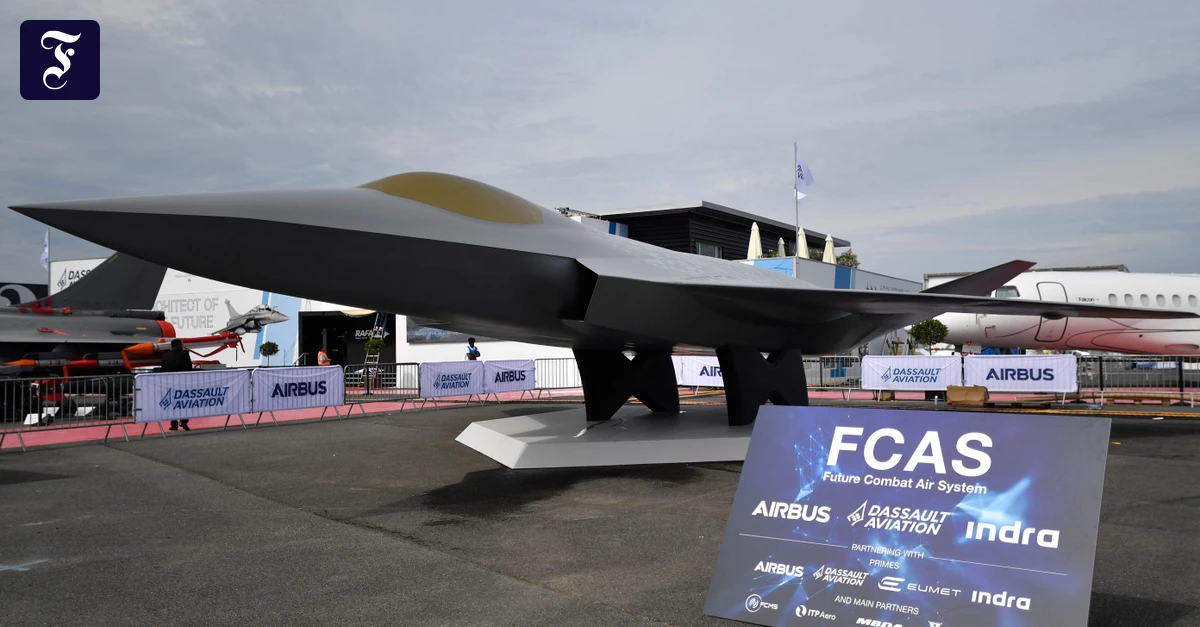
The German-French fighter aircraft project FCAS no longer has a future. Chancellor Friedrich Merz (CDU) has recommended that French President Emmanuel Macron not continue to build a joint combat aircraft, according to FAZ information. Government circles said on Monday that Macron and Merz had come to a divided assessment that the companies would not come together to build a joint fighter aircraft. They would acknowledge this reality. However, it is still unclear whether Paris actually shares this insight and consequences.
Because in the French capital people reacted with surprise at the lack of coordinated communication from Berlin. From the French perspective, it is the responsibility of politicians to give industrialists clear guidelines. FCAS is an important joint project to strengthen European defense preparedness. There is growing discontent in Paris that the federal government is increasingly relying on national solutions, such as the military cloud for the Bundeswehr. It is said that FCAS will not fail because of Paris. Military experts point out that Germany is questioning the only pillar of FCAS, in which France claims leadership.
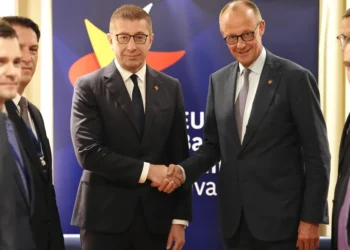
Macron and Merz are said to have discussed FCAS last Friday on the sidelines of the EU-Western Balkans summit in Tivat, Montenegro. In the past few months there have been repeated attempts to save the project. However, Merz had also expressed increasingly clear doubts about it.
Criticism of the FCAS exit came from the Greens. The CDU-led government did not show enough leadership in the difficult project, said party leader Franziska Brantner to the “Handelsblatt”. Berlin only refers to the blockade attitude of the industry involved – “but this is exactly where the real failure becomes apparent: Where industry blocks, it is the job of politicians to show leadership and enforce it.” The fact that both – a Franco-German consensus and a viable industrial model – have not been achieved is a serious setback for European security and defense policy in an increasingly dangerous world, Brantner continued. “If things go badly, there will be no modern European at the end Fighter aircraftor just one with an American engine. This is negligent.”
The security policy spokeswoman for the Green parliamentary group, Sara Nanni, described the end of the fighter jet as “bitter”. What is important now is “not to get stuck in blaming one another, but rather to work on ensuring that Europe gets its own fighter jet alternative,” Nanni told the “Rheinische Post”. The end of FCAS does not mean “an end to German-French arms cooperation”.
A response to Donald Trump’s first election to the White House
The then Chancellor Angela Merkel and French President Emmanuel Macron designed the “Future Combat Air System” (FCAS) in 2017 as a response to the fact that Europe could be left to its own devices in the future – Donald Trump had recently moved into the White House for the first time. At that time, the American president shocked the public by remarking that NATO was “obsolete.” The joint aircraft should be produced from 2040 and, among other things, have the ability to transport nuclear warheads.
In February of this year, however, the Chancellor complained that many things had not been clarified “sufficiently and conclusively” when justifying the project. The requirements of France and Germany for the next generation fighter aircraft are very different. “What are the specifications of a future fighter aircraft that we actually need?” said Merz. “Specifically, the French need an aircraft capable of nuclear weapons and an aircraft capable of carrying aircraft carriers in the next generation of combat aircraft. We don’t need that in the German Bundeswehr at the moment.” France wants to align the aircraft “practically to the specification that France needs. But that is not the one we need,” said Merz. “And that’s why it’s not a political dispute, but rather we have a real problem in the requirements profile. If we can’t solve that, we can’t maintain the project.”
There was also criticism in Germany that the French manufacturer Dassault did not want to back away from its leading role in the development of the aircraft. In recent months there have been attempts at working level to bring the companies involved onto a common path. This failed. The “actual core of FCAS” should be continued as a European system of systems, the federal government said.
In this “Combat Cloud” aircraft and drones are to be connected to one another. This month at the German-French Council of Ministers, both defense ministries are expected to formulate a joint work plan for defense-industrial cooperation, it was said, which will focus on “a few realistic, relevant” projects.
Aviation industry: Don’t let the entire FCAS project fail because of the jet issue
In the conversation, von Hahn did not see the FCAS defense system, which, in addition to the aircraft, should include the development of drones, digital battle clouds and other high-tech components, as threatened by the aircraft dispute. “We don’t have to let the entire FCAS project fail because of the jet issue,” she said at the time. FCAS works well in the other areas, or at least well enough to develop it further. The BDLI therefore already called for a two-aircraft solution with a fighter jet tailored to German and a French needs, both of which should be integrated into the FCAS system.
The two-aircraft solution is now approaching immediately before the start of the ILA aviation trade fair – and also increases the chance for the German aviation industry to participate more strongly in the next German fighter jet. The industry had recently been pushing for this more loudly. The federal government announced the presentation of an aviation strategy for Wednesday, which is intended to determine the course in civil and military aviation issues. Chancellor Merz wants to present the strategy for the opening of the ILA. In a draft available to the FAZ, there is only a vague commitment to “European and international cooperation projects” as a “central component” of military procurement with regard to FCAS. There is no concrete information about the new fighter aircraft. Only the placeholder sentence in square brackets about a possible “supplement and update” of the aviation strategy for the FCAS fighter jet by the Ministry of Defense fueled the hope that there could be more clarity by the time of the ILA trade fair. And there are now.