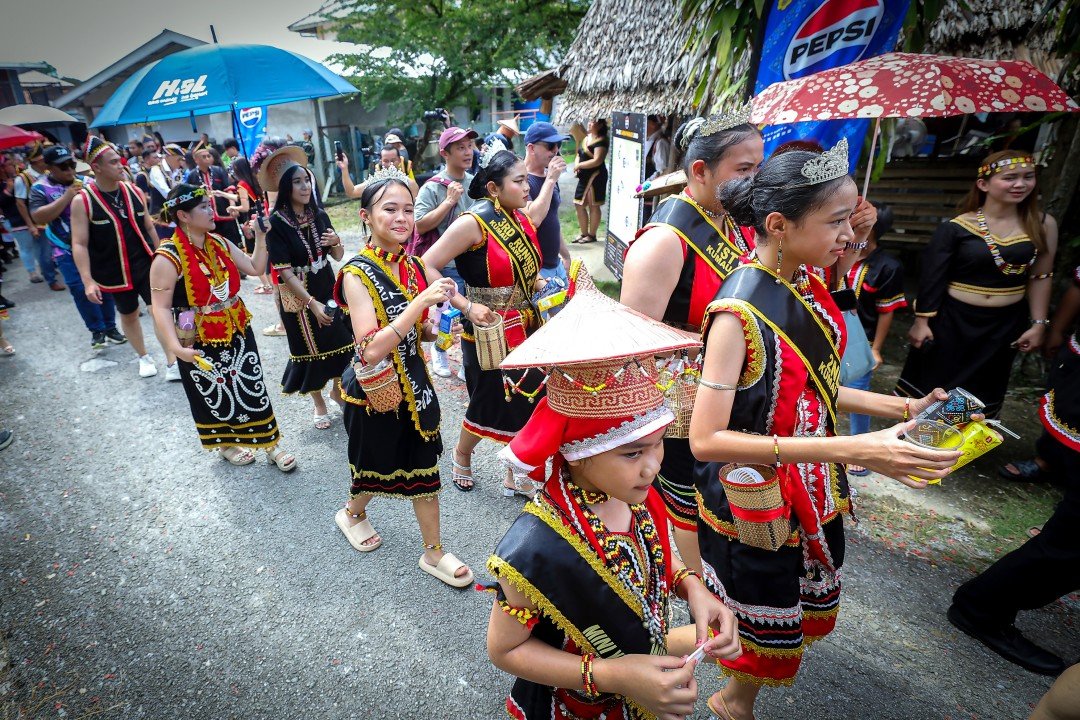

What stays is the feeling of being in the same place again, the sound of familiar voices, and the comfort of knowing, even briefly, that everyone has come home. — Bernama photo

SOME of the moments we remember most are not the ones we plan for.
They are often ordinary in the moment: long drives home where conversations come and go; meals that stretch into the evening because nobody is in a rush; or sitting around with family as stories are shared again, even if everyone already knows how they go.
At the time, these moments feel ordinary – almost forgettable. Yet it is often these very moments that linger long after they have passed.
Perhaps that is why festivals carry a different kind of weight.
Beyond the food, the traditions and the familiar routines that come with celebration, they offer something more basic: a reason to come home, to slow down, and to be with people we do not always make time for in everyday life.
That was something I found myself thinking over the recent Gawai Dayak celebration.
For many, the celebration is not just a festival marked on the calendar, but a journey.
It is the annual return to ‘kampung’ (village), the effort to reconnect with family scattered across towns, cities and villages, and the simple act of sitting in the same space again after months or years apart.
And in a way, it is also a reminder of how easily distance becomes normal.
People grow used to being busy.
Messages get shorter. Calls get delayed.
Plans to meet ‘someday’ stretch further into the future.
Then a festival comes along and compresses all that distance into a few short days of reunion.
It is why I keep thinking about ‘A Christmas Carol’ by Charles Dickens.
On the surface, it is a Christmas story, but at its core, it is really about what happens when a person spends too long disconnected from others, and what it takes to find their way back.
The story follows Ebenezer Scrooge, who starts off as someone who has built his life around routine, work, and isolation.
He is not necessarily evil or cruel. He is simply distant and detached from the people around him – comfortable in his own solitude.
But as the story unfolds; we learn that this did not appear out of nowhere.
He was once a child who experienced Christmas from the sidelines, left behind at boarding school while others went home.
That kind of absence does not disappear easily.
It slowly reshapes how a person sees connection, until distance feels safer than closeness.
That part always feels familiar in a different way when I think about Gawai.
Because this celebration, at its heart, is the opposite of that distance.
It is about returning and making the effort to close the gap, even if only for a short while.
It is the long drives across districts just to reach a village.
It is the multiple stops to visit relatives in different places.
It is the waiting, traffic and fatigue, all softened by the knowledge that at the end of it, there are familiar faces waiting.
It is also, increasingly, not something everyone can take for granted.
This year, rising travel costs and financial pressures have made the idea of going home more complicated for some.
With airfares reportedly reaching as high as RM1,500 during peak demand, many families found themselves weighing the desire to return against what was realistically possible.
For those who managed to make the journey, the time together might have felt even more precious.
For those who could not, it became another reminder of how distance is not always just emotional – sometimes it is financial too.
And that is where the meaning of presence becomes sharper.
Because when you strip everything else away, what most people remember is not the details of the journey or the cost of the ticket – it is who was there.
The relative who made the long trip back; the elder who stayed up waiting for everyone to arrive; the conversations that picked up as if no time had passed at all.
Scrooge’s transformation in ‘A Christmas Carol’ is often remembered as a dramatic change, but what stands out more is actually simpler than that.
He begins to see people again, not as interruptions to his routine, but as something worth showing up for.
That idea feels especially relevant during Gawai.
Because sometimes the most meaningful gestures are not grand or complicated.
They are small decisions to be present; to sit at the table a little longer; to make the journey home even when it is tiring; and to visit the relative you have not seen in a while, even if the conversation feels slightly awkward at first.
Even in everyday life, it is easy to forget how much weight those small choices carry.
We often rely on words to bridge distance.
We explain, apologise, promise and try to make up for time lost through conversation, but words alone eventually reach a limit.
At some point, what matters more is consistency and making the effort again because people do not only remember what we say – they remember whether we stayed.
Every relationship, in that sense, is a bit like a harvest. It needs attention over time and effort even when nothing appears to be wrong.
Left unattended, it slowly weakens, but when cared for, it continues to grow in ways that are not always immediately visible.
That is perhaps one of the lessons of Gawai this year.
It is not only a celebration of harvest, but also a reminder of what it takes to maintain connection in the first place.
And maybe that is why festivals like this matter so much.
They interrupt routine just enough to remind us of what sits outside of it: the relatives we keep meaning to visit; and the journeys we keep postponing because life feels too busy at the moment.
It is the feeling of being in the same place again, the sound of familiar voices, and the comfort of knowing, even briefly, that everyone has come home.
* The writer is a psychology graduate who enjoys sharing about how the human mind views the world. For feedback, email to [email protected].