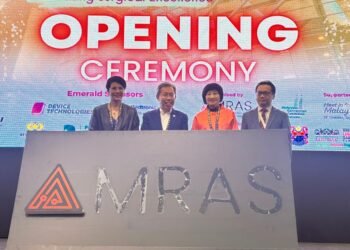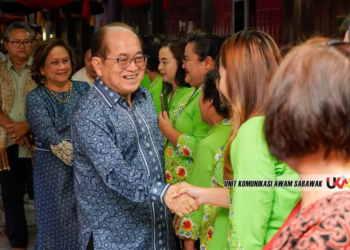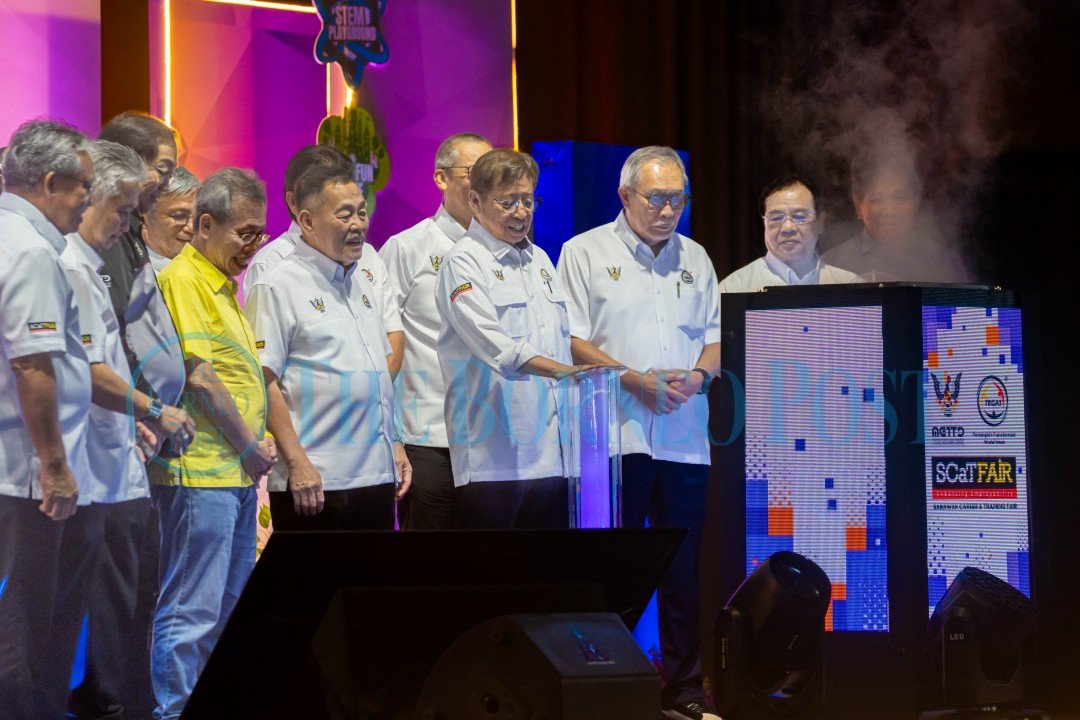

Abang Johari officiates the symbolic launch of the SCaT Fair at HEEC. – Photo by Chimon Upon
KUCHING (June 8): Sarawak is preparing to move towards advanced technologies for electricity generation in space as part of its post-infrastructure development agenda, said Premier Datuk Patinggi Tan Sri Abang Johari Tun Openg.
He said research is already being carried out into next-generation energy systems beyond Earth, including space-based solar technologies.
“Today, people are exploring the generation of electricity in outer space without the use of batteries. Research is currently being carried out to produce electricity in space, where sunlight is converted into electrical energy that generates power within satellites in space.
“This is all new. That is why we must prepare for this technology. God willing, Sarawak will be producing the cell that splits sunlight from Bintulu,” he said when officiating at the Sarawak Career and Training (SCaT) Fair at the Hikmah Exchange Event Centre here.
He said the initiative reflects Sarawak’s intention to move into next-generation and space-related energy technologies as the state transitions beyond its infrastructure development phase.
Earlier, he said Sarawak has largely completed its infrastructure development under the Post Covid-19 Development Strategy (PCDS) 2030 and is now charting a new economic direction.
“Today I would like to share with you the policies towards the future, not only within the framework of PCDS but beyond PCDS. What the young can offer and what role the young can play in the future for Sarawak and the region. We have now more or less come to the end of developing infrastructure.
“We have built bridges, we have built roads and we have sufficient renewable energy supply within the context of climate change. We have also expanded water supply systems throughout the state, meaning rural areas are now better connected to urban centres,” he said.
Abang Johari said Sarawak’s energy transition will continue to expand, with targets of 10 gigawatts by 2030 and 15 gigawatts by 2035, driven by renewable sources including hydro, solar, biomass and emerging biochar technologies.
He said Sarawak is also strengthening regional energy cooperation through the Asean Power Grid initiative, enabling energy sharing with neighbouring regions including Sabah, Singapore, Indonesia and Brunei.
On emerging technologies, Abang Johari said artificial intelligence (AI) is set to reshape economic systems and lead to what he described as a “machine-centred economy”.
He said while AI is increasingly important in managing economic systems, human input remains essential.
“The machine still needs natural intelligence as input. Humans will provide that input, and in return, new jobs will be created.
“In other words, we must move from job seekers to job creators. That is the new economy,” he added.
He said Sarawak must prepare its youth for this transition by strengthening skills in mathematics, physics, chemistry, cyber analytics and other scientific fields.
Abang Johari also said Sarawak is preparing to expand its digital and space ambitions, including plans to launch satellites by 2030 to strengthen data collection and development planning.
He added that Sarawak is increasingly being recognised as an emerging economic cluster in Asean, particularly under low-carbon industrial development frameworks.
“The world is watching us without our knowledge because of our policies, so much so that Sarawak is recognised as an emerging economic cluster, particularly in Bintulu, which has been categorised as Malaysia’s first Transitioning Industrial Cluster (TIC) under the World Economic Forum.
“In other words, our policy direction is sound. The only thing is for us to develop our talent,” he said.
Also present were Deputy Premier Datuk Amar Dr Sim Kui Hian, State Minister for Education, Innovation and Talent Development Dato Sri Roland Sagah Wee Inn, and State Deputy Minister for Urban Planning, Land Administration and Environment Datuk Len Talif Salleh.