Monday, May 25, 2026, 1:50 p.m
1191 readings

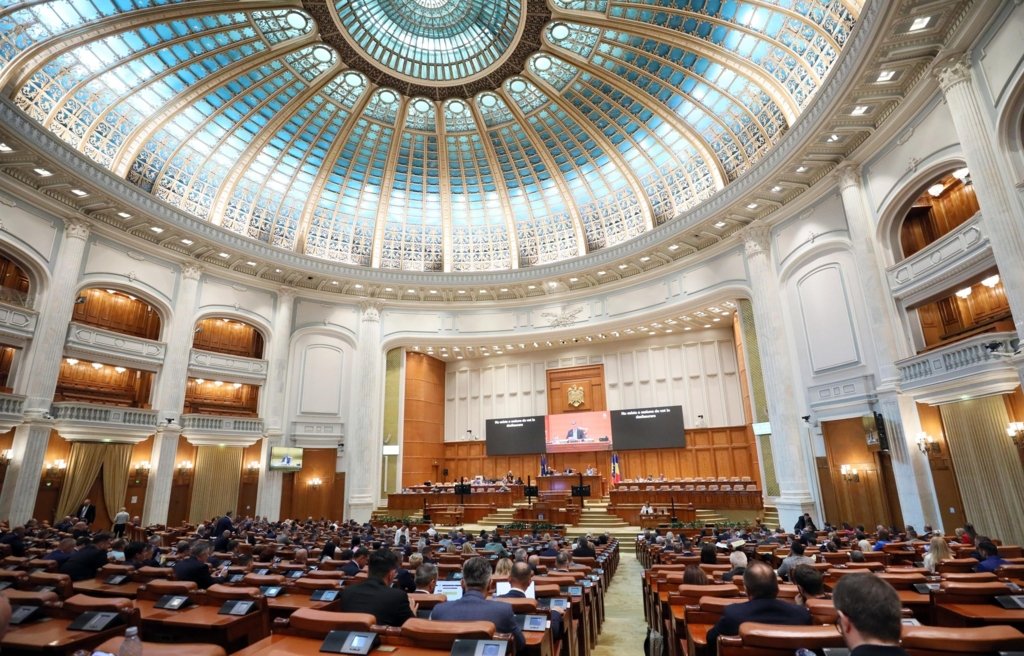
Parliamentary parties receive large sums from the Romanian budget/Romanian Parliament – Chamber of Deputies
A report published by Expert Forum warns that the financing of political parties in Romania continues to be dominated by public subsidies, substantial reimbursements for electoral campaigns and loans, in the absence of effective control and transparency mechanisms.
The analysis reveals that although party revenues have decreased compared to the exceptional election year 2024, the amounts remain at a high level, and current legislation allows opaque sources of funding and possible political influence bought through donations and loans.
The authors of the report criticize the lack of reforms after the cancellation of the 2024 elections and draw attention to the reduced capacity of the Permanent Electoral Authority to verify the origin of funds and how public money is spent.
Although 2025 did not reach the exceptional level of 2024, when reimbursements for campaigns and subsidies exceeded one billion lei, revenues remained high compared to previous years, amounting to 323 million lei for parties and 381 million lei for national minority organizations.
Financing of political parties in Romania remains dominated by subsidies (including massive campaign reimbursements) and loans – one of the major changes in the last two election years. The boundaries between party funding and electoral campaign funding are unclear. Some of the main problems remain the high level of subsidies and the unclear mechanisms for allocating funds, the lack of global limits for financiers, the opacity of the source of funds, especially in campaigns, or uneven reporting’, highlights EFOR.
Expense verification leaves much to be desired
According to the cited source, the lack of resources at the AEP level limits the control capacity.
“The reduced capacity of the authorities to effectively verify the origin of the money, including through inter-institutional collaboration, limits the transparency of the process. There is also little collaboration with institutions such as CNA, which could provide a more solid picture of how media and propaganda money is spent. A reform should eliminate political decisions and strengthen the independence of control actions. Sanctions remain low and are not dissuasive’, the authors of the report claim.
According to EFOR, funding for parties appears to be less ideological and more related to securing political influence, the fact that funders PSD contributed in 2025 to the revenues GOLD or members PNL they donated to PSD contributes to this conclusion.
We identified, as in previous years, possible cases of financiers for whom the donations or loans do not necessarily correlate with the data from the wealth declarations or the financial information reported to the Ministry of Finance. A reform of political funding should reduce the risks of buying political influence, limit the concentration of resources around narrow networks and ensure a better balance between public funding, real political competition and transparency towards voters. It should be noted that, after the cancellation of the 2024 elections, the decision-makers did not take any significant measures to improve the legal framework regarding political financing, which would limit the occurrence of major risks for the integrity of the electoral process in the future. The legislation on declarations of assets and interests has not been amended either, which means that we will probably not be able to do such analyzes in the coming years’, emphasizes EFOR.