Loading Text-to-Speech…
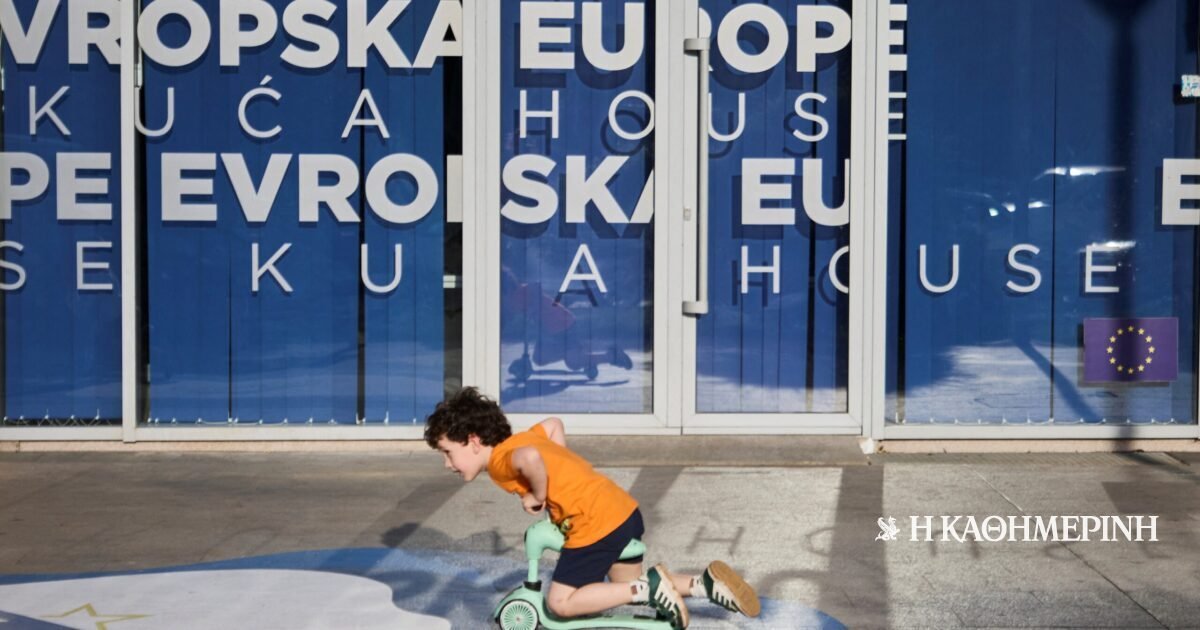
New dynamics in the Enlargement process will be attempted by the European leaders during today’s European Union – Western Balkans Summit in Tivat, Montenegro.
The president of the European Council, Antonio Costa, said the leaders would discuss ways to improve the Enlargement methodology, i.e. the framework of rules governing the accession processfrom the opening and closing of negotiating chapters to the assessment of candidate countries’ progress.
“Enlargement is not a utopia, but something that can become a reality in the coming years,” Antonio Costa emphasized, stressing that the E.U. must work “harder and faster” to achieve this goal.
A few hours before the meeting of the 27 leaders in Montenegro, however, France and Germany submitted a joint non-paper entitled “new Momentum for Enlargement” that “K” has at its disposal and where proposes, on the one hand, the simplification of the existing methodology through the merger of certain procedural stages and the faster opening of negotiation funds, where the European Commission recommends it, on the one hand the creation of a comprehensive “pre-accession” strategy.
The strategy specifically provides gradual integration of the candidate countries into individual policies and structures of the EU.with “in return” specific progress in reforms and with the possibility of suspending the relevant privileges in case of backsliding.
Among the incentives are included preferential access to the single market, participation in European programs such as Erasmus+ and Horizon Europe, enhanced cooperation in defense and security mattersas well as gradual yield of observer status in EU institutions and non-voting participation in certain Council and European Council meetings.
At a later stage, the plan even envisages full participation in the single market through a “EEA+” type modelbefore full integration.
The Franco-German initiative comes just a few days after German Chancellor Friedrich Mertz’s proposal for the creation of “associate member” status for Ukraine.
Although Paris and Berlin avoid the specific term in the non-paper, its logic bears similarities to Friedrich Merz’s proposal, as both seek to offer tangible benefits and deeper participation to candidate countries before full membership.
The main difference is that the Franco-German non paper presents the gradual integration as a ‘tool’ to speed up Enlargement and not as an alternative regime against full membership, insisting that the ultimate goal remains the full participation of candidate countries in the European Union.
In any case, (and) the new proposal of Berlin and Paris reflects on the one hand willingness of the EU to “invest” in Enlargement as a geopolitical “tool”as well as the intense concerns about the full inclusion of new members within it. The concerns are of course not new, but they have particularly intensified due to the “pressure” created by the new geopolitical conditions due to the war in Ukraine. After all, this fact was also the reason for putting the Enlargement back on the European agenda.
On the sidelines of today’s session, however, it is also interesting the attitude of Serbia, which is still considered the most critical, but also the most sensitive link of enlargement in the Western Balkans.
During his visit to Belgrade yesterday, Antonio Costa met with President Aleksandar Vucic, who reiterated his country’s commitment to reforms and called for the opening of new negotiating chapters.
However, the president of the European Council sent a clear message to Serbia – also due to its pro-Russian stance – that “enlargement is based on trust” and that Belgrade it must be aligned with EU policies and values. – in particular with the Common Foreign and Security Policy – and continue reforms.
At the same time, he emphasized the independence of the judiciary, the freedom of the media and the reform of the electoral law, avoiding, however, to refer to the mass anti-government demonstrations that are ongoing in the country.