Loading Text-to-Speech…
The continuous deepening of its defense cooperation Turkey with a number of countries highlighting agreements signed a few weeks ago. Only in Istanbul “SAHA” exhibition seven important agreements were signed with countries of the EU, Asia and Canadasome of which for co-productions of weapons systems and joint development of technological cutting-edge systems. OR Turkish defense industry is not limited to the European area and attempts to expand to Latin America as well.
In particular, an agreement that received wide publicity was the one between the Turkish Baykar and the French Safran. This is an agreement of high operational value for Safran, as it solves a very serious problem of unmanned aerial vehicles (UAVs) of the type Bayraktar TB-2, in which the French technology Euroflir electro-optical systems will be integrated. OR Franco-Turkish cooperation it also includes navigation and tracking systems, as well as so-called “smart” munitions. According to well-informed sourcesAthens has protested to Paris about this development.
Italian industry
At the same time, relations with her are deepening Italian industry. In particular, Baykar signed a contract with the Italian Gruppo Esse for a robotic automated UAV mass production line. It is recalled that Baykar has already acquired several Italian companies in the aeronautical and defense sectors.

The contract signed between ARCA Savunma and the Ministry of Defense of Estonia for the establishment of a factory for the production of long-range munitions. The plant will be built in Estonia at a cost of around 300 million euros. In addition, the Turkish Sarsilmaz and the Spanish EM&E Group signed a memorandum for strategic cooperation in research technologies.
Canada and UAE
Some agreements were also signed with small countries such as Kosovobut also important non-European countries and specifically the Canada and the United Arab Emirates. Specifically, Turkey’s Sefine Shipyards (in Yalova) and Canada’s Kraken Robotics have agreed to jointly develop autonomous underwater systems (i.e. UUVs).
At the “SAHA” exhibition in Istanbul, it was decided to cooperate in the defense sector with countries of the EU, Asia, as well as with Canada.
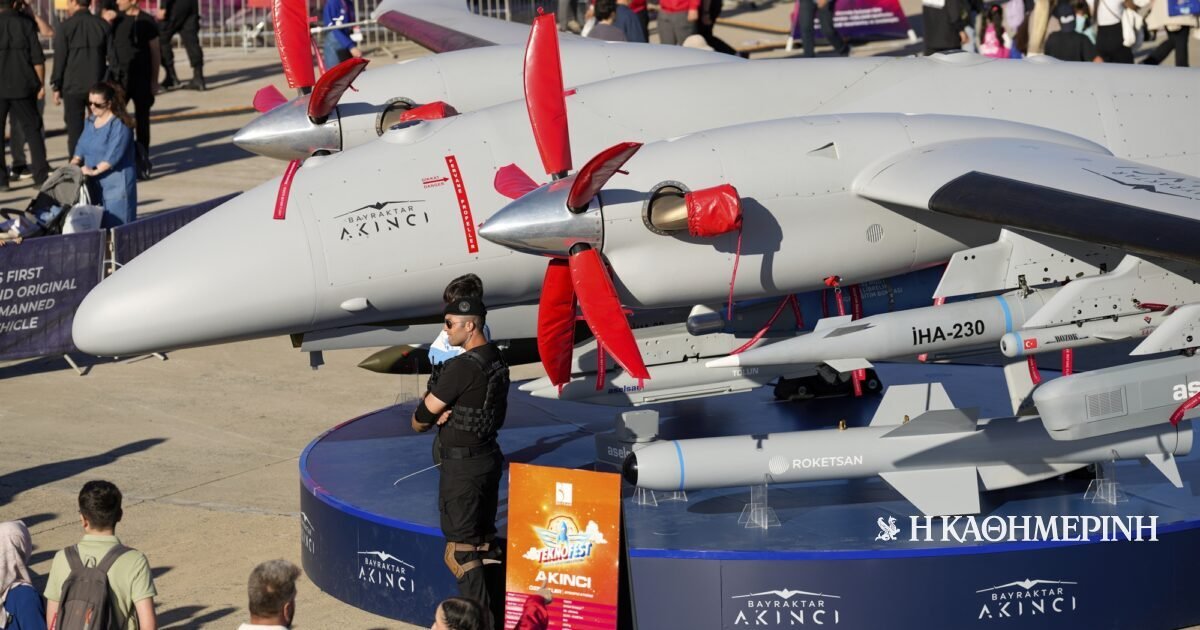
In addition, Baykar has agreed with the UAE’s Edge to integrate Emirati-made Al Tariq munitions into a Turkish Akinci-type unmanned combat aerial vehicle (UCAV). While a memorandum was also signed to expand cooperation in precision weapons and autonomous systems. OR signing of the Baykar – Edge memorandum it is far more important as a development, as it is based on the expressed intention of the Emiratis to become as independent as possible from Western defense technology and to cooperate with the Turks in the field of artificial intelligence (AI).
This particular agreement has been based on one of the pillars of the Turkish defense industry, which is the – approximately – copying American systems.

The restrictions imposed by the US State Department’s ITAR (imposed arms export regulatory framework) have been exploited by Turkey, which promotes its defense industry products as an alternative without export restrictions, with flexibility for third (non-NATO) countries and quick deals with reduced risk.
Among the non-European contracts, the one signed between the Turkish Aselsan and the Indonesian Ministry of Defense to further strengthen the country’s Navy (Indonesia has already purchased Turkish corvettes).
Latin America
It is also worth noting the effort that Turkey is making to “pierce” the Latin American marketi.e. the US backyard. An indicative example is the recent large Turkish presence at the international aerospace exhibition “FIDAE 26”, which took place in April in Chile, where 33 countries and 350 exhibitors participated. OR Turkey participated with six companies (Aselsan Latin America, TUSAS/TAI, Roketsan, Havelsan, MKE and STM and ASFAT shipyards, under the auspices of the Turkish Ministry of National Defense).

Aselsan is the most active company in Chile and focuses on subsystems such as sensors, communications, electronic warfare and anti-drone solutions. The choice is strategic and aims, as well-informed sources say, to create a “pre-bridge” for part of the Latin American market (Peru, Colombia, Brazil). Its most successful contract to date is the upgrade of the Leopard 2A4 tanks of the Chilean army, which Germany had attempted to stop. Electro-optical systems and Turkish technology communications have been installed in the upgraded tanks, that is, in the context of the more general tactic followed by Ankara to offer specific solutions and transfer know-how.