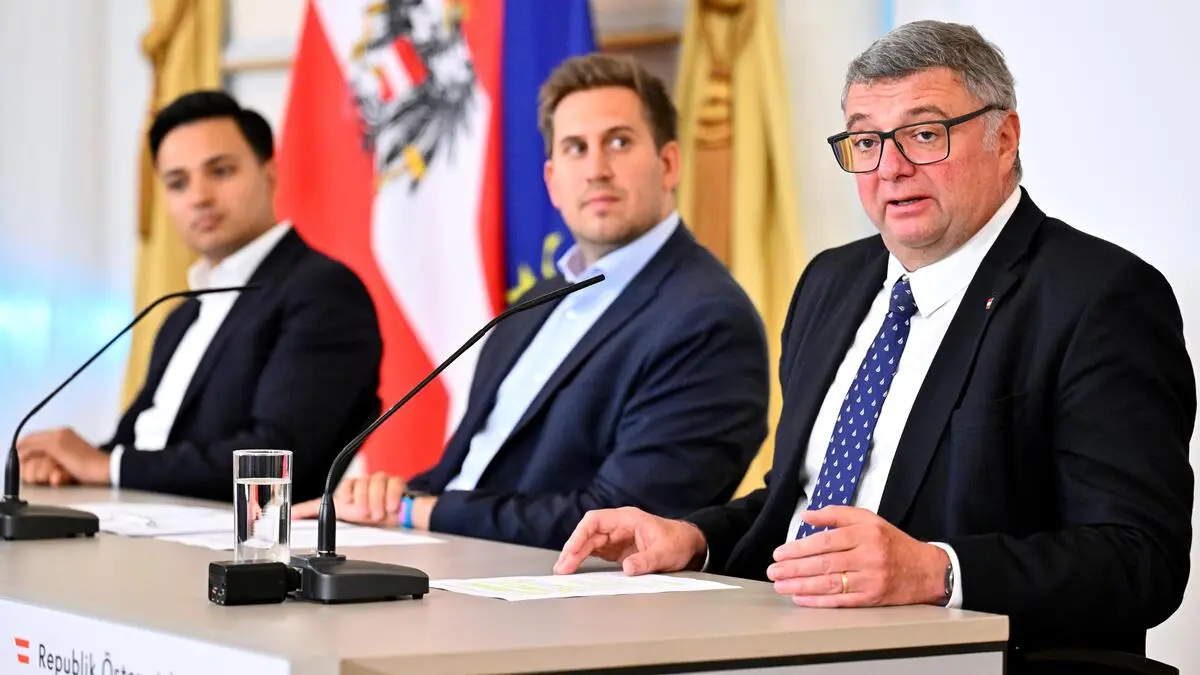
The government is “in the final stages of negotiations” on the budget. There is still a need for discussion regarding party support, for example.

Neos club chairman Yannick Shetty, State Secretary Alexander Pröll (ÖVP) and State Secretary Jörg Leichtfried (SPÖ) after the Council of Ministers. APA / APA / Hans Klaus Techt
The government asked for patience on Wednesday with regard to details of the double budget. “We are in the final stages of the negotiations,” said State Secretary Alexander Pröll (ÖVP) after the Council of Ministers. Neos club boss Yannick Shetty With regard to the budget accompanying law, said that it had to be carefully negotiated. “One should not underestimate how extensive and complicated a double budget is in times like these,” said the State Secretary Jörg Leichtfried (SPÖ).
We are confronted with a “global economic crisis of a magnitude that has rarely occurred before,” said the SPÖ State Secretary, explaining why the budget accompanying law was passed a week before the finance minister’s budget speech planned for June 10th Markus Marterbauer (SPÖ) is not yet available. “There needs to be measures that are effective. They have to be negotiated well.” It’s better that it comes “a little later, but it’s worth it.”
There is currently still a need for discussion regarding party support, as Shetty explained. “It’s no secret that this is a controversial debate; the positions here are still different.” There is no solution yet, but “we will solve it”. In any case, it will not be viable for the Neos to continue an “automatic” approach and increase funding in line with the inflation rate if this is not done for other items such as social welfare, pensions or civil servant salaries. When asked about a general new regulation of politicians’ salaries, Shetty referred to ongoing discussions, including with the opposition parties.
There are also unanswered questions in the social sector, Pröll explained. The ÖVP State Secretary once again emphasized that “everyone” had to make a contribution.
The three government representatives therefore also emphasized that savings had to be made in the system. According to Pröll, the administration can and must become leaner, there must be a reduction in bureaucracy and less duplication. The State Secretary referred to a decision taken by the Council of Ministers in December. When it comes to administrative employees, they don’t want to fill every second person who retires, says Pröll. According to the plans announced at the end of last year, a total of 540 million euros should be saved by 2030.
Shetty added that this means that “every official who has only been stamping forms in recent years will no longer be appointed”. Where possible, artificial intelligence will be used instead. “The state also has to cut back on bacon if everyone has to do it.”
In addition, Pröll referred to agreed “administrative deductions” amounting to 125 million euros; all departments would have to make a contribution here. Regarding funding, he emphasized that the “days of the funding watering can” are over. Here Pröll spoke of savings of up to 800 million annually. He also referred to structural reforms, for example in social insurance or in the health sector.
The goal, Pröll repeated the government credo, is to consolidate state finances sustainably and that EU-To leave the deficit procedure by 2028. Leichtfried emphasized that they wanted to “make savings where structures can be improved, but not on services for citizens”. (APA)