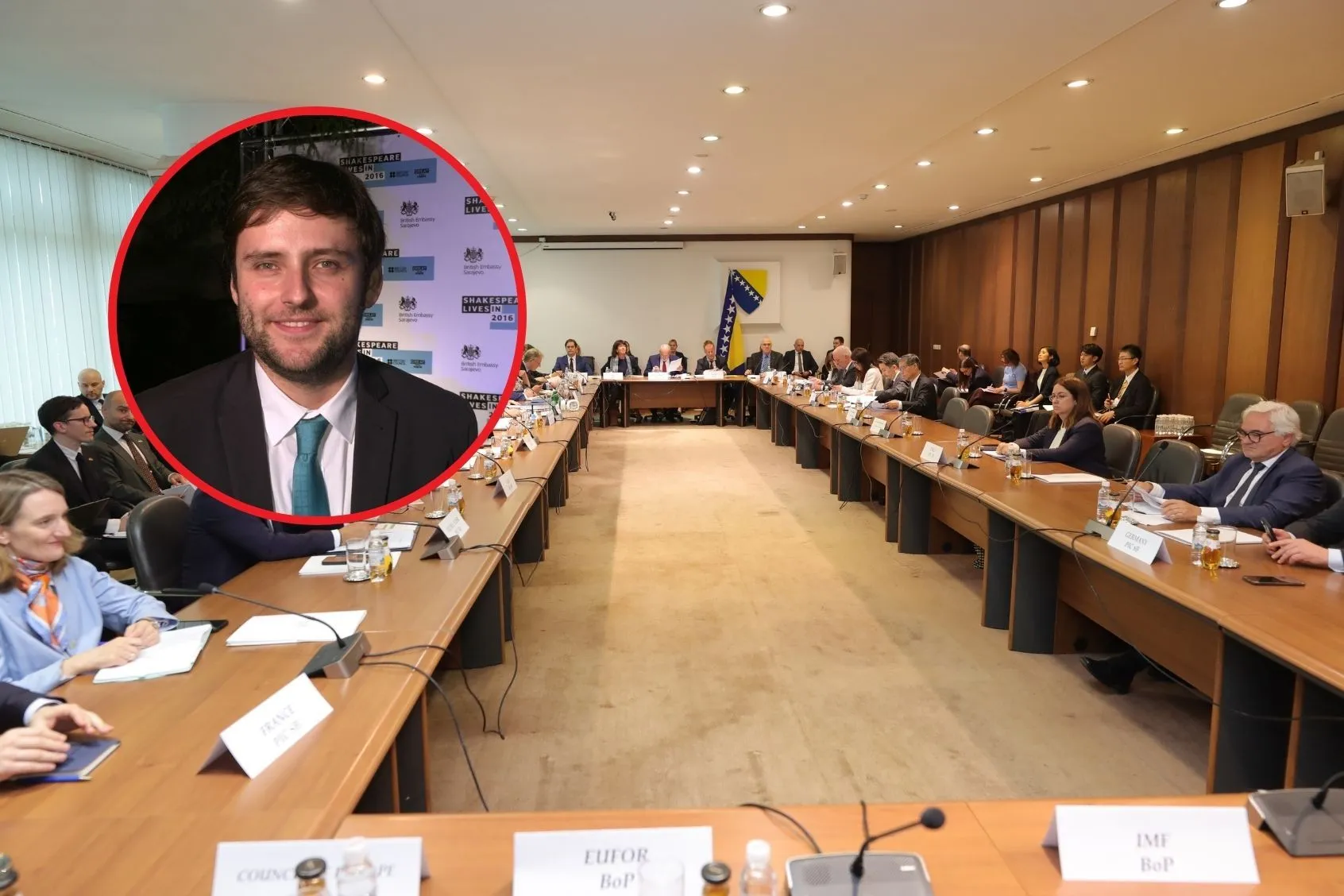
The two-day session of the Governing Board of the Peace Implementation Council (PIC), which began yesterday in Sarajevo, ended today, and one of the key topics was the election of a new high representative in Bosnia and Herzegovina, who should succeed Christian Schmidt, after he resigned in May.
According to the first information, the members of the PIC failed to agree on the name, and they should make a decision by June 30.

On this occasion, we contacted the senior analyst of the Initiative for European Stability (ESI), Adnan Ćerimagić, who pointed out in an interview with Oslobodjenje.ba that the United States of America has the initiative when it comes to international policy towards Bosnia and Herzegovina.
– If it wasn’t for Washington and the insistence that Christian Schmidt resign, and then to carry out the procedure for electing a new high representative, we would not be discussing this topic today, Ćerimagić believes.
According to his opinion, it was made very clear at the UN Security Council, as well as through later statements, that the United States of America wants to elect a new high representative as soon as possible. In this sense, they not only defined the framework that the new high representative should fulfill, but also offered specific names.
– We can see how important it is to them from the fact that State Secretary Marco Rubio spoke during the hearing yesterday about how the United States of America supports the Italian candidate Antonio Zanardi Landi. Also, the very fact that he sent his senior advisor to the negotiations in Sarajevo shows how important this issue is for Washington, says our interlocutor.
The outcome of today’s PIC session, says Ćerimagić, could mean that some European countries expressed certain doubts about the policy, intentions and goals of the United States of America. He adds that it is also possible that they offered their own alternative or simply wanted additional guarantees regarding what the US administration and its preferred candidate want to do in Bosnia and Herzegovina.
– Even the mere information that the high representative was not elected today does not necessarily mean that some other agreement was not reached, either on the name of the candidate, or on when and how he will be elected, he believes.
Nevertheless, Ćerimagić emphasizes that it is obvious that the initiatives, wishes and goals of American foreign policy, at least to a certain extent, have encountered questions, as well as possible alternative proposals from some European countries.
Speaking about the potential election of Landi as the new high representative, Ćerimagić points out that in that case we can expect a much more active high representative in terms of communication with different parties and actors in Bosnia and Herzegovina, as well as a more active search for solutions to issues that are of interest to the United States of America.
– First of all, we are talking about the issue of state property, which is considered one of the main obstacles to realizing the economic and energy interests of the USA in Bosnia and Herzegovina, he says.
However, Ćerimagić points out that the very fact that the process of Christian Schmidt’s resignation, as well as the selection of his successor, were accompanied by certain confusions, as well as different and even ambiguous statements by Schmidt himself after his resignation and before this meeting, shows that there is no complete trust between Europe and the United States of America when it comes to such an approach.