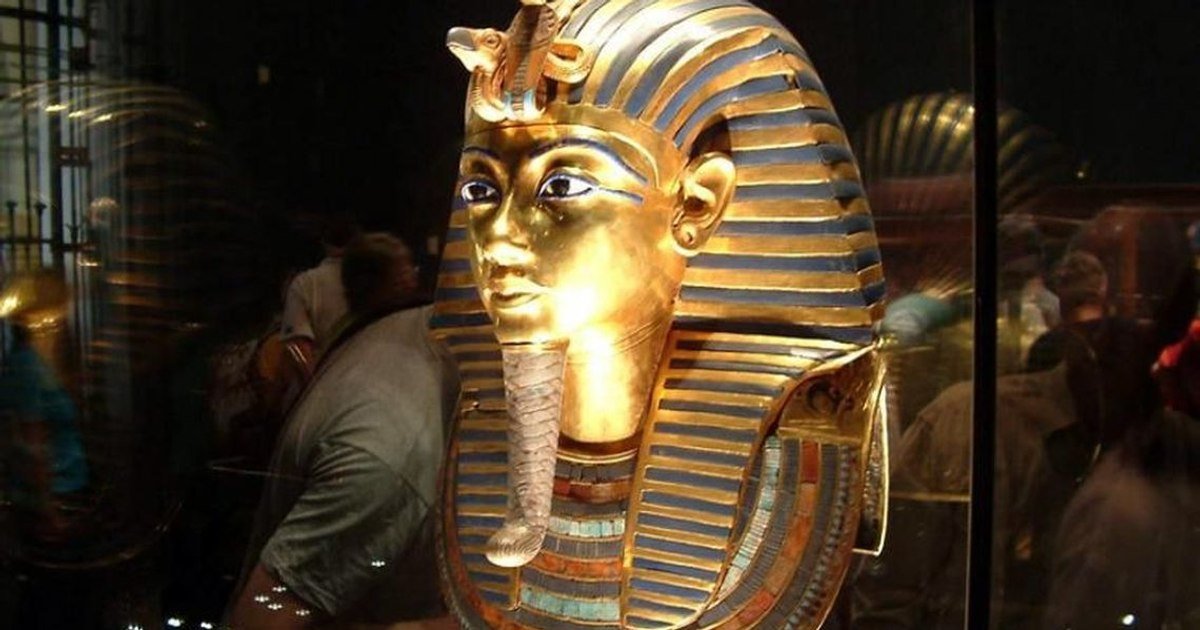
Mystery persists surrounding so-called “alien glass” associated with artifacts from Tutankhamun’s tomb, after researchers made a new discovery that could clarify the origin of this unusual material.
The yellowish substance, known as “Libyan Desert glass”, is found scattered across northern Africa, particularly in Egypt and Libya, and is believed to be the result of an extreme cosmic event produced around 29 million years ago.
In a new study, scientists have identified a rare zircon structure inside the glass that appears to have formed after the mineral was completely melted and then rapidly recrystallized. The discovery suggests that the material was exposed to temperatures in excess of 4,000 degrees Celsius—high enough to melt even minerals considered among the toughest on Earth.
The researchers say this “microscopic record” preserved in the crystal captures the extreme heating and cooling phases that led to the formation of the glass.
However, the exact origin of the phenomenon remains controversial. One hypothesis points to an asteroid impact, while another theory talks about the explosion of a cosmic object in the atmosphere, powerful enough to melt the surface of the desert without leaving a clearly identifiable crater.
The new discovery does not end the debate
The new discovery does not settle the debate, but reinforces the idea that the event involved exceptional temperatures and highly chaotic conditions.
The material was later prized by the ancient Egyptians, who used it in ornaments from Tutankhamun’s tomb, one of the most important archaeological sites ever discovered.
Over the decades, the origin of glass remained completely unexplained. The main theories involve either the impact of a cosmic body or a high-energy atmospheric explosion capable of turning the silica from the desert into glass.
A major problem for researchers is the absence of a confirmed impact crater directly associated with the area where the material is found. Several possible structures have been proposed over time, but none have stood up to scientific scrutiny.
In the latest study, researchers from the Università degli Studi di Milano-Bicocca analyzed a microscopic zircon crystal embedded in glass.
Zircon is an extremely durable mineral frequently used in geology to reconstruct past events because it can survive conditions that destroy other materials.
The specimen analyzed was only about 20 micrometers—thinner than a human hair—but had a dendritic structure, similar to a tree branch, formed during rapid cooling from the molten state.
Advanced analyses, including electron microscopy and three-dimensional diffraction, revealed fine details of the internal structure. Chemical tests indicated differences between the material trapped in the zircon and the surrounding glass, suggesting that there were separate droplets of molten material before solidification.
Surprisingly, no traces of the intermediate minerals that normally occur when zircon melts and recrystallizes were identified. This suggests that the mineral went directly through a process of complete melting and rapid recrystallization.
Further analysis also indicated atomic-level differences between the enclosing glass and the surrounding material, a sign that they had different thermal histories during cooling.
According to the researchers, all these indications support the hypothesis of an extremely violent event, in which the material was melted and then cooled so quickly that it “frozen” the traces of the process.
Based on chemical composition, estimates indicate temperatures in excess of 2,200 degrees Celsius, significantly higher than most volcanic eruptions.
Scientists describe the environment of formation as “far from equilibrium,” where ordinary geological processes could not keep up with the rate of transformation of matter.
Although the new data confirms exposure to temperatures much higher than those inside terrestrial volcanoes, the debate over the exact mechanism of its production remains open, keeping the fascination surrounding Tutankhamun’s jewels alive. The researchers point out that while the results strengthen the scenario of an extreme cosmic event, they do not yet provide a definitive answer as to the origin of the Libyan Desert glass.