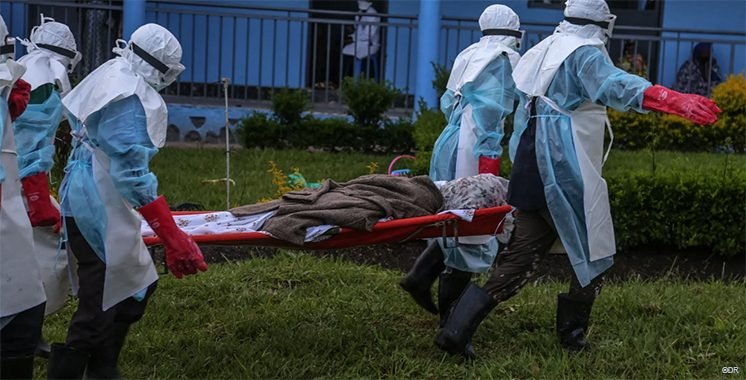
Situation: As of May 30, the Democratic Republic of Congo and Uganda had 263 confirmed cases of Ebola and 43 deaths. Suspected cases number more than 1,100.
More than 1,100 people were suspected of having contracted Ebola hemorrhagic fever in the Democratic Republic of Congo (DRC) and Uganda on Saturday, announced the director general of the African Union health agency (Africa CDC), in an article published Sunday by the British daily Financial Times. “As of May 30, the Democratic Republic of Congo and Uganda had 263 confirmed cases and 43 confirmed deaths, while more than 1,100 suspected cases were still under investigation,” said Jean Kaseya. On Thursday, Mr. Kaseya mentioned more than 1,077 suspected cases, including 246 deaths. “We must move at the pace of the epidemic,” added the head of the African health agency, criticizing the continent’s dependence on financing systems controlled elsewhere.
The health ministers of the DRC, Uganda and South Sudan recently adopted a $319 million intervention plan as part of regional coordination, he welcomed, calling for “this dynamic to extend to the entire continent”. “The Ebola epidemic represents a serious test for the Africa CDC and the African Union (…) this epidemic will not be the last,” he stressed. The epidemic was declared on May 15 in Ituri, a province in the northeast of the DRC, a country with more than 100 million inhabitants and among the poorest in the world. The virus that causes Ebola, which causes an extremely deadly hemorrhagic fever, has already been detected in three Congolese provinces as well as neighboring Uganda, where nine confirmed infections, including one fatality, have been recorded. In the absence of a vaccine and approved treatment against the Bundibugyo strain of the virus responsible for the current outbreak, measures to try to stem its spread are essentially based on compliance with barrier measures and the rapid detection of cases. The WHO has issued an international health alert, but the true scale of the epidemic is not yet known and international health authorities believe that the current figures are probably underestimated.
Treatments: WHO recommendations
The WHO on Saturday made public its recommendations for treatments and vaccine candidates that could be used to control the Ebola epidemic. The UN organization announced in a press release broadcast on In terms of treatments, independent experts recommended “for evaluation in clinical trials with confirmed cases” the monoclonal antibodies MBP134 and Maftivimab, as well as the antiviral remdesivir. “A combination therapy of a monoclonal antibody and remdesivir is also recommended for evaluation.” Concerning prophylaxis among contacts of confirmed or probable cases, the oral antiviral obeldesivir was deemed “priority”, even if, the experts stressed, “this approach depends on effective contact tracing, which remains difficult in certain affected areas of the DRC”.
The vaccine candidate deemed “most promising” is the single-dose rVSV Bundibugyo, developed by the International AIDS Vaccine Initiative (IAVI). “Its development will probably require another seven to nine months before it can be evaluated in a clinical trial,” specifies the WHO. Another candidate vaccine, ChAdOx1 Bundibugyo, developed by the University of Oxford and the Serum Institute of India, could be available in “two to three months for an evaluation of its effectiveness”.