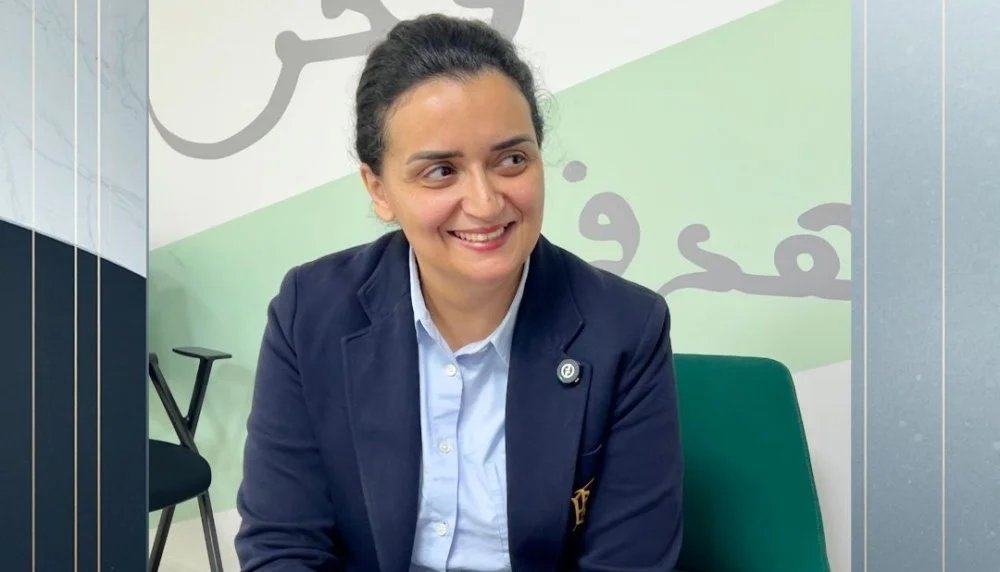
There are trials that shatter a life. Others who redesign it, or even relaunch it. Living the agonies of the prisonis much more than a difficult episode, it marks a brutal break with everything that has until then structured daily life, benchmarks, the environment, relationships and even the conception we have of life. Nawal Chafay, Today doctoral researcher in management economics has Hassan II University of Casablancaexperienced this breakup in all its brutality. Convicted in 2020 for issuing‘a bounced check Deposed by her ex-husband, Nawal had never imagined that her existence, peaceful and ordinary, would take this dramatic turn. She had plans, dreams, hopes and ambitions that she wanted to realize. Except that his journey seemed to be written with the pen of adversity, far from the optimistic plans that usually animate people of his condition. Former general manager of an insurance company, she has evolved for a long time in a demanding environment, punctuated by responsibilities, team management and decision-making. A structured, framed universe where everything seems calculated with rigor and precision. Holder of a degree in economics, a master’s degree in logistics engineering, a master’s degree in coaching as well as a certificate in insurance, everything predestined her for a brilliant professional career. Except that fate decided otherwise.
Trust tested
Nawal’s story deserves to be told, because it is that ofa woman who fought tirelessly against the relentlessness of destiny, of a resilient woman who was able to courageously and consistently chart her path, without ever losing direction, while the vicissitudes of life tossed her like a feather in a storm. After thirteen years of marriage, she still struggles to understand how such a stable trajectory could have been disrupted. She mentions absolute confidence, established over time, made up of shared family projects, daily life built together and promises made with a lot of good faith, even naivety. “I did not make this mistake because I ignored the law, but because I blindly trusted my husband,” she says, as if the words themselves were still trying to catch up with a reality that is difficult to integrate.
His incarceration comes at the height of Covid-19 pandemicin a context where isolation doubles the harshness of detention. The days drag on in an overwhelming languor, landmarks fade, visits become rare, perspectives uncertain. Its plus young child then only had two and a half years. Being away from one’s offspring gradually becomes a constant, almost unbearable pain. This torture filled his days and nights with solitude, introspection and questions. At the same time, another concern is taking hold: his mothera central figure in the family unit and essential support for the children, had to undergo open heart surgery. The fear of not being able to be there with her at these decisive moments was gnawing at her to the core. The anguish of losing her definitively without being able to pay her final honors added to her dismay. In this psychological chaos, she refuses to resign herself or give up. She clings to what remains accessible to her in the prison world: learning. Nawal then threw himself headlong into his studies. She continues thus a master’s degree in actuarial science and market financewhile following several professional training courses accessible in detention. Little by little, learning becomes a way of keeping a grip on time and not letting confinement entirely define one’s choices and one’s future.
After prison, the weight of looks
Because “liberation is not deliverance. We leave the prison, but not the condemnation», as Victor Hugo said. She must face another test: the company And the gaze of others, often silent but reproachful, was sometimes more suffocating than the walls that confined him, she confides. “Paradoxically, the release was more difficult than the detention. Once outside, you have to face the looks, the prejudices and sometimes the silent judgments of society,” she explains. She had to regain her freedom in an environment where everything seemed to have continued without her. Reconstruction then becomes a long road, made of invisible adjustments, patience and gradual reconquest of oneself.
Supported by her children (now aged 21, 14 and 8), his family and the Hassan II University of Casablanca, she resumes her academic career and moves towards doctoral research in managerial economics. Her experience today nourishes her thinking as much as her commitment to the rights of women prisoners and former prisoners. The challenges of reintegration are now part of the battle she wages daily between the academic and prison worlds. She wants to contribute to give hope to those whose destiny has been turned upside down by prison. This is why she likes to repeat: if we do not always choose what life imposes on us, we can at least choose the way in which we face life’s trials.. She refuses defeatism, the victimhood posture and resignation. For her, nothing is ever definitively lost, as long as we stay the course and agree to start again with all the energy of despair. The story of Nawal Chafay is certainly that of a bumpy life, but it is also and above all that of a woman who tamed adversity. “Le Matin” met her and she agreed to share her journey with readers without complexes or false shame.
“It is often the most difficult moments that allow us to evolve and know ourselves better”
Le Matin: Incarceration is often perceived as a difficult breakup. How did you get through this period?
Nawal Chafay: I don’t consider my time in prison as the end of an era, nor even the beginning of another. I see it more as a milestone in my destiny. It was an imposed parenthesis, a moment of stopping which allowed me to reflect, to review my priorities and to gain maturity. This experience taught me much more than it took away. I understood that trials can either break us or transform us. It all depends on how we look at them. For my part, I chose to make it an opportunity to grow. I am convinced that it is often the most difficult moments that allow us to evolve and know ourselves better.
What pushed you to resume your studies, despite the unfavorable context?
Studies have always played an essential place in my life. Even when my body was deprived of freedom, my mind remained free. Learning has always been my way of moving forward, whatever the circumstances. My academic background is rich and diverse: a degree in economics, a master’s degree in logistics engineering, a master’s degree in coaching, a certificate in insurance, and today a doctorate. During my detention, I chose not to break this dynamic by integrating a master’s degree in actuarial science and market finance, a demanding field which represented a real intellectual challenge for me. Beyond university studies, I also followed professional training accessible in a prison environment. For me, each learning is a way of progressing. I never stopped learning, whether inside or outside prison.
Paradoxically, the release was more difficult than the detention. Once outside, you have to face the looks, the prejudices and sometimes the silent judgments of society. Regardless of a person’s history, incarceration leaves a label that is difficult to shake. I experienced this period with great difficulty, because you not only have to rebuild yourself, but also find your place in the eyes of others. However, this reality gave me even more motivation to move forward. I chose to focus on what I could build rather than what others might think. I had to start from scratch, but with the conviction that my future should not be defined by this single stage of my life.
In the most fragile moments, who or what were you able to lean on?
I have never been alone, and today I realize how lucky that is. Throughout my detention, I benefited from the unwavering support of my family, particularly my children, whose presence and affection were a source of immense strength. I also benefited from the support – oh so precious – from the Hassan II University of Casablanca, which allowed me to continue my studies by facilitating my access to courses and educational resources. This support was decisive in my journey. Resilience is important, but it is also nourished by the presence of others. Behind every rebuild, there are often people who reach out at the right time.
Looking back, what would you like to say to those who think that everything is over after one mistake?
I would like to tell them that a mistake, even one with serious consequences, does not define an entire existence. A test is a sequence in a course, not its conclusion. Life always offers us the opportunity to get up, learn and reinvent ourselves. Our mistakes can become lessons, and sometimes even the source of our greatest successes, provided we have the courage to face them and move forward. No one knows the outcome of his story. As long as we are alive, nothing is definitively written. There is always an opportunity to start again, to rebuild and give new meaning to your journey.