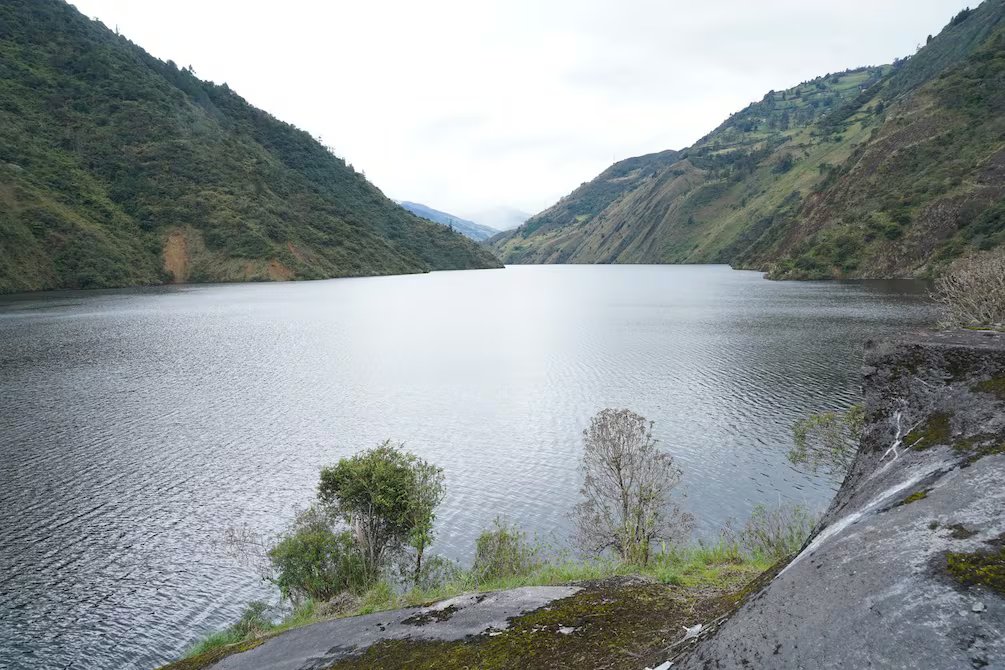
Government authorities have been emphatic in pointing out that the power outages recorded in different cities of the country in recent days are not due to a generation problem and that the reservoirs are fine.
They have indicated that Mazarthe country’s main dam due to its capacity to store energy, is more than 20 meters higher than it was in 2024 for the same time.
President Daniel Noboa assures that there are additional reserves in the Mazar reservoir
Energy production for this Thursday, April 16, 2026, was covered with 72.3% of hydraulic generation and the remainder between thermal and renewable, according to data from the National Electricity Operator (Cenace).
Hydroelectric production was led by the Coca Codo Sinclair plants with 40% and Paute Molino with 19%. These are followed by Minas San Francisco (12%), Sopladora (11%), Delsitanisagua (8%) and the rest of other hydroelectric plants.
Coca Codo Sinclair, a run-of-the-river hydroelectric plant, has a generation capacity of 1,500 megawatts (MW).
Paute Molino and Sopladora, together with Mazar, are part of the Paute Integral Hydroelectric Complex. The three plants contribute 1,757 MW to the national interconnected system. The Mazar reservoir is also located there, which has a capacity of 410 million cubic meters.
“We are good with the issue of electricity generation, we have water, we have a reservoir that is at 2,138 (meters) because we have managed it very well these days, that represents about 61% of stored energy and we are 22, 23 meters above what we were in 2024 with the Mazar reservoir when we had that period of energy restriction,” said the Minister of Environment and Energy, Inés Manzano, on radio Center on Tuesday of this week.
And he added: “As the president says, if I compare it with the other years, except for 2025, which was very good hydrologically, we are good, we are good in the reservoirs, in electricity generation…”.
Inés Manzano: There will be no blackouts because there is 5,700 MW of available power
On Monday, the President Daniel Noboa He commented that the reservoirs have been “managed well this year” and that it is normal that at this time of April, when the reservoir usually drops, it is at that level or is even at a level higher than the average of the last five years.
“2025 was an exceptional year, the reservoir was full, at 2,153 meters during April, now we are at 2,139, there is no problem with Mazar, nor with Paute Molino and at this moment we also have good flows in Coca Codo Sinclair, likewise, like good winds, we are generating more than 50 MW in wind energy,” the president assured on radio forever.
This week the Mazar elevation started at 2,139 meters above sea level (masl), on Wednesday it dropped to 2,136 meters, however, for this Thursday it was at 2,137 meters above sea level, according to the Celec report.
So far in April, the average level of the reservoir is recorded at 2,140.98 meters above sea level. 23.46 meters above.
For this Thursday, at 2:00 p.m., the Mazar elevation was recorded at 2,137.21 meters above sea level and two years ago it was at 2,108.62 meters above sea level, this is 28.59 meters above sea level for 2026.
The maximum level of Mazar is 2,153 meters above sea level, while the minimum is 2,098 meters above sea level.
Among the rivers that contribute to this reservoir, which has an extension of 31 kilometers, are those of Cuenca: Tomebamba, Yanuncay, Tarqui and Machángara, whose flows are in a normal state, according to the Municipal Public Company of Telecommunications, Drinking Water, Sewage and Sanitation (Stage).
The company also anticipated rain for this Thursday, a probability of 88% during the day and 66% at night. (YO)