Britain summons the Iranian ambassador

Washington – London – Tehran – (AFP) – Al-Zaman
Talks to end the war in the Middle East are facing a state of stagnation, with the United States announcing that it is studying new Iranian proposals related to opening the Strait of Hormuz, at a time when Tehran considers that Washington is no longer in a position to dictate conditions.
Foreign Minister Marco Rubio said, “It is clear that we will not negotiate through the media,” but he described Tehran’s offer as “better than what we expected them to make,” while insisting on the necessity of including in any agreement that prevented Tehran “from possessing a nuclear weapon.” However, Tehran stressed on Tuesday that Washington is not authorized to dictate conditions. State television quoted Defense Ministry spokesman Reza Talaei Nik as saying, “The United States is no longer in a position to impose its policies on independent countries,” adding that Washington “will accept that it must abandon its illegal and irrational demands.”
Iran has practically closed the vital strait for global oil and liquefied natural gas supplies, since the start of the American-Israeli attack on it exactly two months ago. The future of navigation in this region has become a major point of controversy, with Washington in turn imposing a blockade on Iranian ports. After White House spokeswoman Caroline Levitt said that Washington was studying a new Iranian proposal within the framework of the discussions mediated by Pakistan, the American CNN network suggested that President Donald Trump would not agree to what Iran had offered, which it was reported included opening the strait and lifting the blockade on the ports as a first step, and postponing discussion of other controversial points to later stages. On Monday, Trump gathered his national security team to research the Iran file. While no official position was issued regarding the meeting, CNN quoted two sources that Trump indicated during it that he would refrain from accepting an offer that included opening the strait without resolving the nuclear issue. Mediations and negotiations have not yet succeeded in reaching a final cessation of the war and reopening the Strait, despite the ceasefire being in effect for about three weeks. In normal times, one-fifth of the world’s oil and liquefied natural gas production passes through the strait. Its closure caused turmoil in global energy markets and concern in the Gulf countries, which depend mainly on their exports of these resources. In light of the faltering negotiations, Qatar warned on Tuesday of a “frozen conflict” in the Gulf. Qatari Foreign Ministry spokesman Majid Al-Ansari said in English in a weekly briefing, “We do not want hostilities to return to the region anytime soon, and we do not want to see a frozen conflict reignited whenever there is a political reason.” He added, “We very much look forward to ending this war in a sustainable manner that takes into account all our concerns in the region and beyond.” The Iranian Shura Council (parliament) is preparing a law that places the strait under the authority of the armed forces. According to this project, Israeli ships will be prevented from passing, and transit fees will have to be paid in Iranian riyals.
Rubio responded by saying, “The Iranians cannot be allowed to create a system in which they decide who can use an international waterway and how much they must pay for it.” However, a tanker loaded with liquefied natural gas crossed the strait, according to what Kepler company data showed on Tuesday, in the first passage of its kind since the closure of the passage. According to Kepler data analyzed by Agence France-Presse, the tanker Mubariz, affiliated with the UAE company ADNOC, left the Gulf in April with 132,890 cubic meters of liquefied natural gas on board. The American Soufan Center for Analysis believes that “Iranian leaders believe that the rise in oil prices and the imminent global shortage of its derivatives (…) put President Donald Trump under great pressure to accept a settlement of the conflict far from his demand for ‘unconditional surrender’.” On the American side, “Trump and his team seem to be betting, incorrectly according to many experts, that tightening the American blockade on Iranian ports will push the regime’s leaders to accept the main demands of the United States,” according to the same source.After the United States canceled a second round of negotiations in Pakistan, Iranian Foreign Minister Abbas Araqchi conducted a round of visits and diplomatic contacts, the most recent of which was a visit to Russia on Monday, where he met with President Vladimir Putin.
Araqchi attributed the failure of negotiations with Washington to “excessive demands” from the American side, stressing that his country remains solid despite the thousands of raids it has received and the blockade on its ports. Army spokesman Amir Akramenia told state television, “We have many cards that we have not played yet,” stressing that “the armed forces and the Iranian people (…) are capable of continuing this war in the long term.”
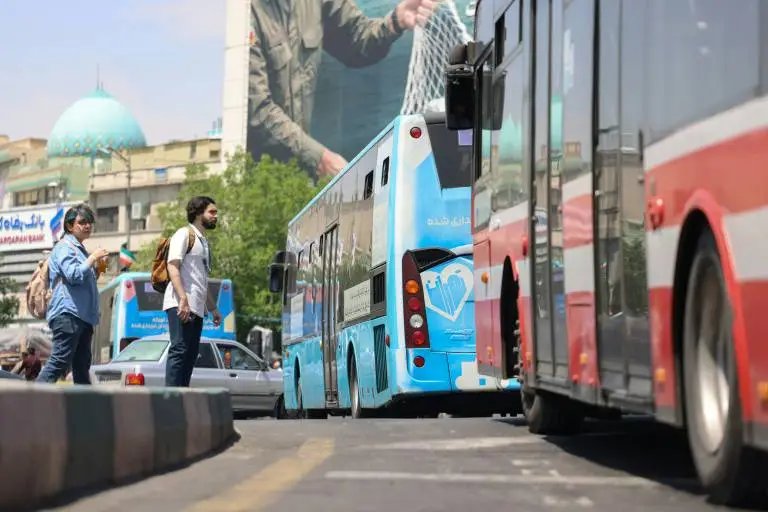
Two months after the outbreak of the war, residents of Tehran, in contact with AFP from Paris, complained about the repercussions of the conflict on their daily lives, which had been affected even before by an economic crisis and international sanctions.
Farshad, who owns a small business, said that everything is currently on hold. “I haven’t worked for a long time,” he added. He continued, “The country is in a state of complete economic collapse.”
Iran banned the export of steel products, according to what Fars Agency reported from customs on Tuesday, after major factories were subjected to strikes during the war.
On Tuesday, Britain summoned Iran’s ambassador to London after the Iranian consulate published a message urging its citizens residing in the United Kingdom to “sacrifice themselves for their country.”
The British Foreign Office said in a statement that the Minister of State for the Middle East, Hamish Falconer, “clearly indicated that these actions and statements are completely unacceptable, and that the embassy must stop any communication that could be interpreted as incitement to violence in the United Kingdom or abroad.”
In a message published on April 15 via its Telegram account, the Iranian Consulate in London called on “its citizens residing in the United Kingdom” to join a campaign launched by the Iranian authorities under the slogan “Self-Sacrifice for the Homeland.”
In Iran, pictures shown by official media in early April showed dozens of people forming human chains to protect the country’s power plants from Israeli and American raids.
The consulate’s message calls on Iranian citizens in London to “unite to express their solidarity, loyalty and national pride” by registering to participate in this campaign. The letter is attached with a link to the consulate’s website.
The United Kingdom has a large Iranian community, and London has witnessed protests against the authorities in Tehran since the beginning of the war in the Middle East.
British intelligence constantly warns of the activities and threats of the Iranian authorities against opponents residing in the United Kingdom.
!