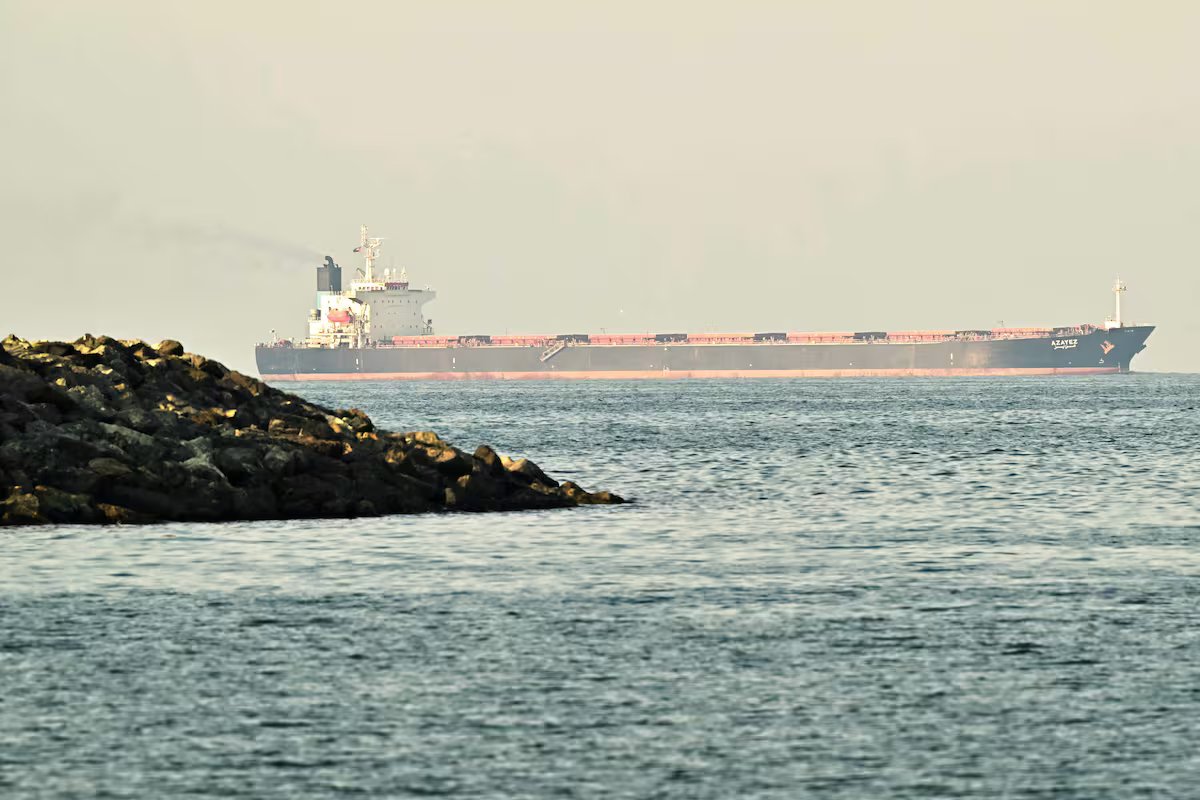
There is no doubt that the US military has the ability to impose a blockade on ships entering and leaving the Persian Gulf. The question is to what end?
“I think it is feasible“, he declared this Monday to the BBC retired American rear admiral Mark Montgomery. “And it is certainly less risky than the alternative, which would have been to force the Iranians back and create the conditions to form a convoy”, he concluded.
Some of the options raised by the president donald trump in recent weeks – the capture of Jark Island or the military escort of convoys through the Strait of Hormuz – would have been dangerous and potentially costly.
The US forces involved would have exposed themselves to attacks from Iranian missiles, drones and speedboats. The possible presence of mines in the water would have added another level of danger.
On the contrary, blockade allows US warships to patrol safelyfar from the coast, in the waters of the Gulf of Oman, track ships leaving Iranian ports and intercept them at will.
“This entails less risk than in the very confined area of the strait,” said Admiral Montgomery.
With special forces, helicopters and their own speedboats at their disposal, The US Navy has all the necessary resources for an operation of this type.
The recent blockades of Venezuela and Cuba have demonstrated this capacity. In early January, the seizure of the Russian oil tanker Marinera, offshore in the North Atlantic, demonstrated that these types of operations can be carried out virtually anywhere.
US Central Command (Centcom) says the latest blockade “will be applied impartially against ships of all nations entering or leaving Iranian ports and coastal areas,” but that ships using non-Iranian ports will not be stopped.
According to Centcom, ships carrying humanitarian supplies will be allowed through, but “will be subject to inspection”.
But will it work?
The logic seems clear. Since the war began, Iran has continued to successfully export its own petrochemicals across the Gulf, earning billions of dollars while preventing other Gulf countries from exporting their own hydrocarbons.
An effective US blockade could stem that flow, depriving the Iranian regime of urgently needed revenue and further weakening its economy.
But Iran, which has already demonstrated enormous resilience in the face of more than a month of attacks by the United States and Israel, may well consider itself capable of weathering yet another storm. Especially since any new blockade is likely to push up oil prices even further.
“They believe they can get through this, that the US will suffer the consequences of oil prices and that the Gulf states will ultimately pressure the US to reopen the strait,” David Satterfield, former US special envoy for humanitarian affairs in the Middle East, told the BBC.
According to him, Washington has not taken into account Iran’s iron determination.
“They think they have won,” he said. “Iranians believe… that they can endure more pain for longer than their opponents.”
Shipping experts are watching the trickle of ships leaving Iranian ports and passing through the Strait of Hormuz to see what impact the US blockade will have.
“I’m literally looking at the ships that are passing right now,” says maritime intelligence analyst Michelle Wiese Bockmann. “If I were a sailor, I would be very worried.”
“We saw some U-turns after Trump’s original announcement last night,” says Richard Meade, editor-in-chief of Lloyd’s List.
According to Meade, the last 48 hours have been the busiest period of traffic through the Strait of Hormuz since the war began in late February, with about 30 traceable transits (that is, vessels sailing with their automatic identification equipment activated).
“It seemed like an avalanche of ships trying to get out,” he says.
Given that there is currently very little movement, it may be some time – if ever – before we see the US Navy intercepting ships entering or leaving Iranian ports.
With the ceasefire still in place, the Iran war has transformed, for the moment, into a battle between two rival blockades, with the world economy caught in the middle.
Given that China has reportedly played a role in persuading Iran to participate in this weekend’s lengthy diplomatic talks in Islamabad, Washington may hope its latest move will result in greater pressure from Beijing.
China is the world’s largest importer of Iranian oil. Despite having vast strategic reserves, it cannot afford a prolonged supply disruption.
Donald Trump’s latest measure is a risky bet. Its repercussions could soon be felt.