
All those procedures are expected to be handled by Skyports Ltd., a British operator of takeoff and landing facilities.
Two Japanese firms, Mitsubishi Estate Co. and major trader Kanematsu Corp., both of which jointly hosted the demonstration event with SkyDrive, assume direct access from one building to another in central Tokyo by installing vertiports on the rooftops of existing high-rises.
“Providing premium services is also an option (in the future),” an official said, suggesting, for example, moving shops and restaurants on lower floors closer to rooftop vertiports so that passengers can use them easily.
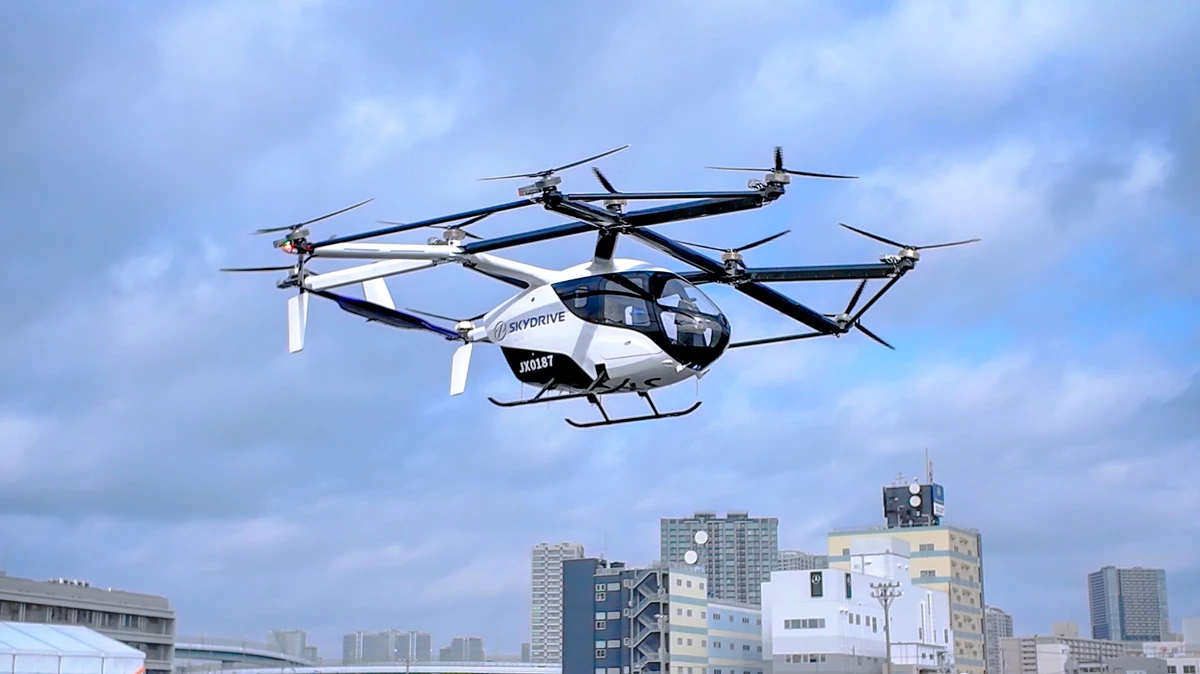
SkyDrive plans to launch SD-05 commercial operations in 2028, starting with tourism flights in Osaka Prefecture, western Japan, and the southwestern prefecture of Oita. The Tokyo metropolitan government, which also works with SkyDrive, hopes to see the flying car service begin around 2030 in the centre of the capital.
Fares, SkyDrive says, could ultimately settle at levels roughly twice those of taxis.
Experts in aviation policy and business say technology is no longer a binding constraint.

“Flying cars are technologically feasible,” said Hajime Tozaki, professor at Tokyo-based J. F. Oberlin University’s College of Business Management, who is well versed in transport policy.
Public acceptance, however, remains weak. “In Japan, risk awareness of falling objects is high,” shaping sensitivity more sharply than in parts of Europe, for example, Tozaki said.
This anxiety feeds into questions such as, “Who is in control?” and “Is it safe?”
SkyDrive says the SD-05 can be piloted with a helicopter license plus about 20 hours of simulator training.
Airspace is free of traffic congestion. Even so, in urban areas in particular, flying cars may need to share airspace with helicopters, which requires deep situational awareness. Tightening regulations would improve safety, but at the same time risk slowing implementation.
“Although autonomous flight is our long-term aim, human pilots remain in control for now,” Fukuzawa said at the Feb. 18 press conference.
Paradoxically, however, regulations “become more complex when human operation is involved,” Tozaki said.
Certification is also a key issue. In this regard, SkyDrive said March 9 that it has reached an agreement with the transport ministry on how to demonstrate the SD-05’s flight safety, a major milestone in the process of obtaining type certification for the flying car.
In addition, the company has obtained a certification known as Approved Design Organisation from the ministry’s Civil Aviation Bureau, becoming the first flying car developer to do so. A company with ADO is certified as having an adequate quality control and safety management system for aircraft design and post-design inspections.
In urban areas, the operational environment adds another variable.
Takeoff from and landing at the rooftops of high-rise buildings often face turbulent winds. A smaller aircraft body is a design advantage, but could be vulnerable to strong winds and other unfavourable weather conditions, hampering efforts to ensure safe flying car operations and offer frequent flight services needed for profitability.
“What matters is making the public understand why flying cars are needed,” Tozaki said, noting that they can ease traffic congestion, support tourism or be used as an emergency transport means. “Without public understanding, they will not fly often, and without frequent flights, they will not be viable,” he said.
“For local authorities and residents, the appeal is visible–enterprise tax revenue from operators and spillover effects such as smart city development,” Tozaki said.
“As well as engineers,” the professor added, “others must also help build public understanding.”
The machines are ready to fly. Whether they become part of daily life will be decided not in the air, but by people on the ground.
By Toshifumi Sekitsuka

[Copyright The Jiji Press, Ltd.]