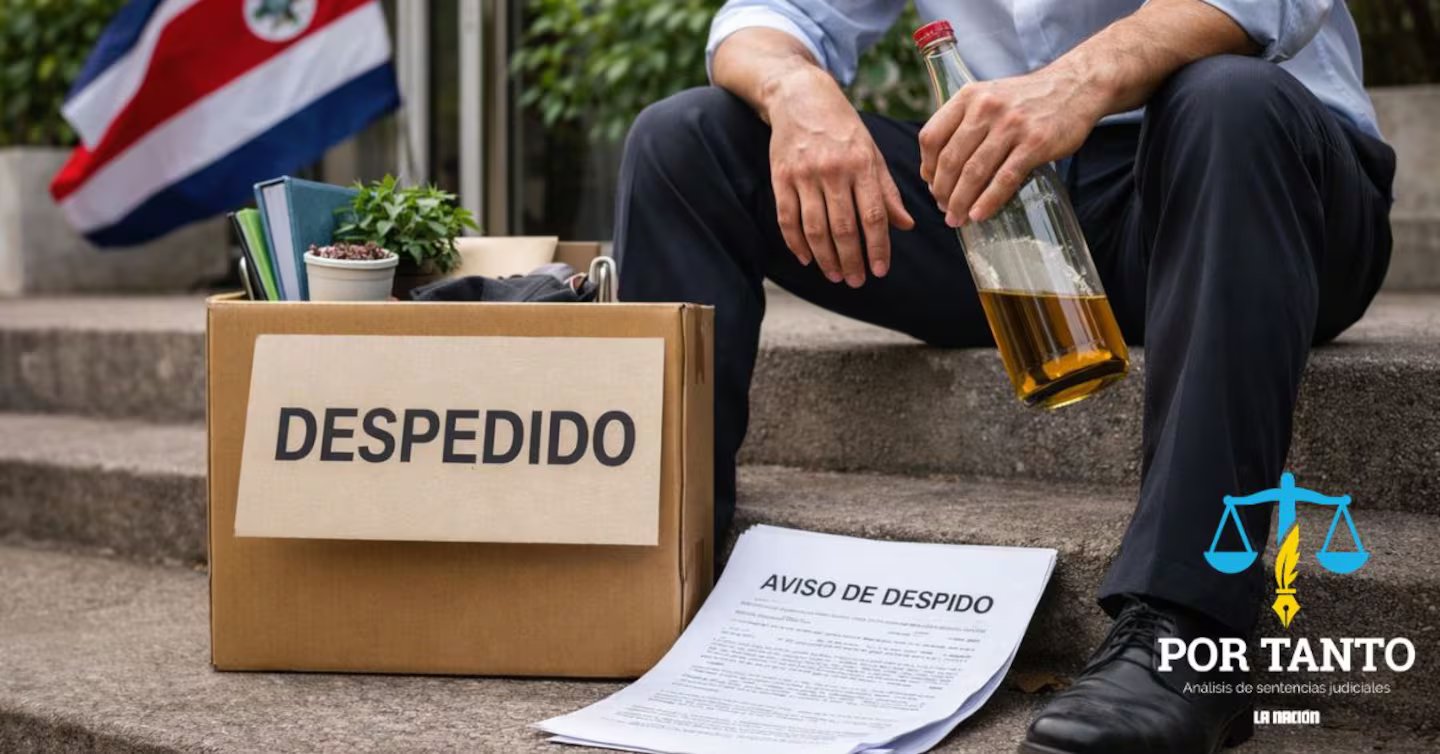
He alcohol consumption at work is usually interpreted as a serious offense, capable of justifying a dismissal immediate. However, when it comes to alcoholismemployers and workers of Costa Rica they enter a complex areawhere they converge work discipline and the right to health.
Constitutional legislation and jurisprudence establish criteria to determine when is a dismissal and when, on the contrary, they should exhaust previous measuressuch as warnings or facilities to receive treatment.
The labor lawyer and notary public, Viviana Sánchez Lanzoniexplained to The Nation the limits set by the rules regarding alcohol consumption by workers, the dismissal process and other aspects related to this issue.
What does labor law establish regarding alcohol consumption by workers?
Copied!
He article 72, subsection c)of the Labor Code prohibits the consumption of alcohol in the workplace, by preventing “working while intoxicated or under any other similar condition.”
For the purposes of the contract, the specialist pointed out that what is relevant is how this condition affects performance. If the person fulfills his obligations, The employer cannot intervene in your private spherein case the collaborator consumes alcohol outside of hours and the workplace.
Nevertheless, If you show up to work while intoxicated or are absent for that reasoneven on a single occasion, the regulations authorize the employer to act.
Sánchez recalled that the Labor Code also prevents this behavior from the employer. In general terms, the rule prohibits the employer from directing or supervising work while in a state of intoxication or under a similar condition.
In such a situation, the worker could choose to terminate the contract unilaterally.
What does the Labor Code say about working while intoxicated, unjustified absences and grounds for dismissal?
Copied!
The lawyer explained that prohibited conduct do not generate, by themselves, a dismissal without employer responsibilitybut less severe disciplinary sanctions; However, its reiteration does may lead to the termination of the contract.
Regarding unjustified absences, he pointed out that article 81, paragraph g) of the Labor Code qualifies them as serious offense and, therefore, as a cause for dismissal without employer responsibility.
This applies when the person is absent without justification – such as a medical disability or other official document – and without authorization from the employer for two consecutive days or more than two alternate days in the same calendar month.
Should the employer treat alcoholism as a disease and provide the opportunity for rehabilitation before dismissing?
Copied!
Viviana Sánchez pointed out that, according to the recommendations of the International Labor Organization and the jurisprudence of the Constitutional Chamber and the Second Chamber, alcoholism in the workplace should be addressed, in the first instance, as a health problemlike the consumption of other substances.
He added that, given the social nature of labor law, the employer must, before applying a serious sanction, urge the worker to seek professional help or rehabilitation. In his opinion, it is a duty of good faith that must govern every employment relationship and that is obligatory for the employer.
How does a dismissal process work in these cases?
Copied!
Before proceeding with a dismissal without employer responsibility, either for unjustified absences linked to consumption problems or for showing up to work in a state of intoxication or similar condition, The employer must impose a written reprimand with a warningexplained the lawyer.
This sanction warns the worker that, if they reoffend, the contract will be terminated. without employer responsibility.
In the notification must be includedFurthermore, the express recommendation to seek rehabilitationalong with information about care centers, such as the Institute on Alcoholism and Drug Dependence (IAFA) either support groups.
If the offense is repeated, the dismissal must be applied, unless the employer chooses to grant a new opportunity, according to his or her discretion.

How does the detection and documentation of these cases operate?
Copied!
Sánchez explained to this newspaper that, in terms of detection, it is up to the employer supervise and supervise the workby virtue of the power of subordination, so the necessary tools must be obtained to identify possible faults.
He added that, since the labor procedural reform of 2017, a greater burden of proof falls on the employer.
Therefore, you must investigate each case rigorously, collect evidence and safeguard it before imposing any disciplinary sanction. Among the elements to keep are the prior warning, proof of receipt of information about rehabilitation centers and other means of proof, such as messages, images, audios, videos or written testimonies of witnesses.
When can an employer consider that it has sufficient evidence to suspect an alcoholism problem in a worker?
Copied!
The employer must rigorously investigate the alleged misconduct and establish the truth of the facts before taking any action. To do this, you can rely on reliable testimonies, messaging conversations or even the worker’s own statements.
Sánchez added that the situation can be evidenced expressly or tacitlyFor example, if the employee shows up to work while intoxicated or under the influence of substances.
Also, recordings from security cameras that show irregular behavior linked to consumption during the work day can be used.
Is it advisable or possible to request breathalyzer tests at work?
Copied!
According to Sánchez, it is only advisable to apply these measures in cases where the consumption of alcohol or drugs by the worker may represent a risk to itself, to third parties or to the operation of the companyespecially when the functions require maximum diligence, care and responsibility.
He added that this obligation is supported by article 71, paragraph h), of the Labor Code, which establishes the duty to rigorously observe the preventive measures issued by competent authorities or by the employer for the personal safety, of co-workers or of the workplace.
However, he stressed that these actions must be applied only as a preventive measure in duly justified cases, since Its unjustified use could violate the rights of the worker..
What does the duty to ‘give the opportunity for rehabilitation’ required by the Constitutional Chamber and the Second Chamber consist of?
Copied!
In practice, Sánchez explained that the process consists of the employer initially invite the worker to seek support and provide you with useful information about centers where you can receive care.
If the person accepts the help and requires attending sessions during working hours, the employer must grant the corresponding permits.
He added that it is not the employer’s responsibility to follow up on rehabilitation or demand results, since their role is limited to the invitation and provision of information.
Is it enough for the employer to extend a generic invitation to the worker to ‘seek treatment’ or is more required?
Copied!
Sánchez pointed out that It could be a generic invitation included in the letter of reprimand with warning, applied when the worker shows up in a state of intoxication or incurs unjustified absences related to this condition, Sánchez explained.
In these cases, it is indicated: “The worker is invited to seek professional help to face their health problem.”
Additionally, the employer can provide information about rehabilitation centers, support groups or specialists. The specialist pointed out that its implementation is at the discretion of the employer.
Is there a minimum number of precautions or warnings before thinking about dismissal?
Copied!
According to Sánchez, It all depends on the employer’s tolerance.; However, in the field of Labor Law, only one prior opportunity is contemplated before applying the dismissal, explained the lawyer.
That is, when the worker engages in prohibited conduct, a written reprimand with a warning is issued, he or she is invited to seek support and is provided with information about rehabilitation options. If the failure is repeated later, whether the next day, a month or even a year, the contract may be terminated.