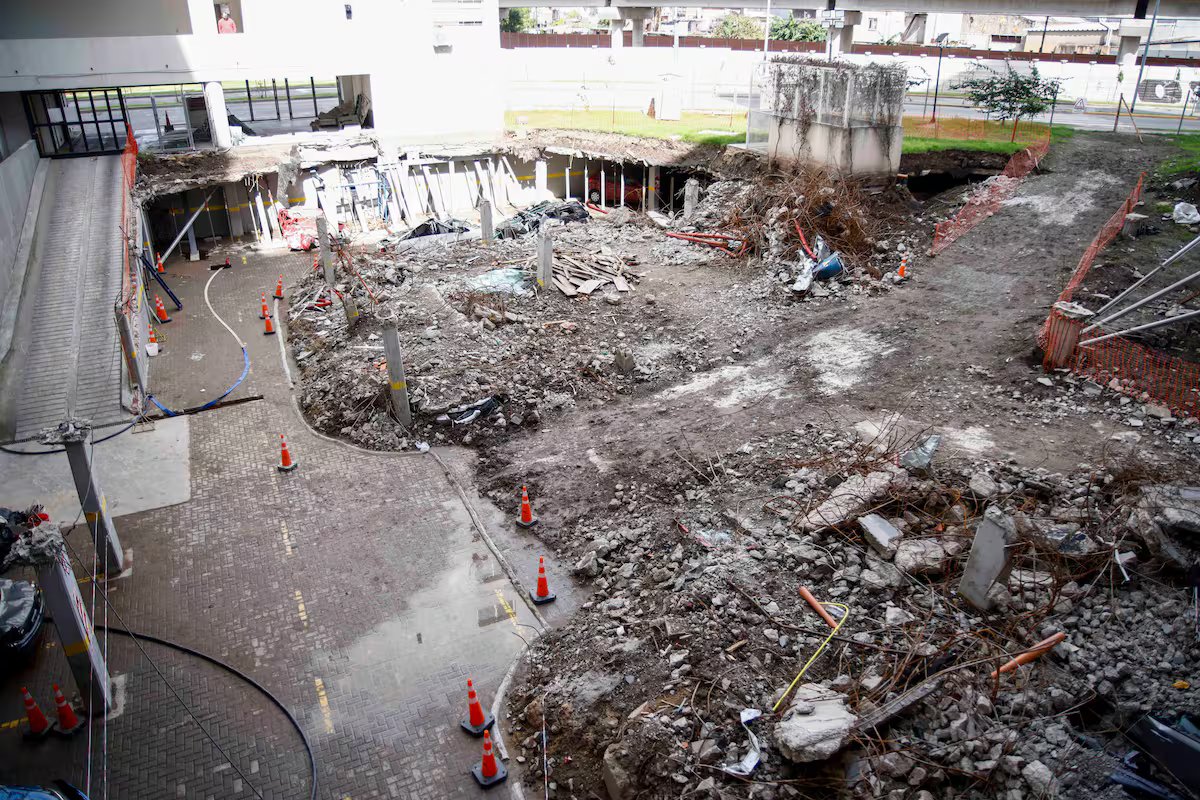
“The crater.” This is how the residents of the Mafalda Tower 907 named the void of concrete and twisted iron that is visible today when looking towards the base of the building.
The original architecture of the Buenos Aires Station complex, in Parque Patricios, developed within the framework of the Procrear Plan, proposed a design of superimposed levels that ended in disaster: on March 3, a slab of massive proportions that served as the roof for the parking lot on the ground floor and, simultaneously, as the floor for an elevated park on the first floor, where children used to play, collapse completely sinking over the garages.
Since that incident it has passed more than a month, but in the tower that borders the collapsed area, the sense of emergency has not dissipated. On the contrary, it has become a physical presence that is perceived in the “witnesses”: small marks of glue and plaster that residents have strategically placed over the cracks that run through the hallways and stairwells.
They are not fixes, but a homemade and desperate surveillance system. As the owners explain, if the material fractures, that would prove that the structure moved again.
On a tour of THE NATION Because of the building, which remains under suspicion, one thing is clear: The neighbors live on permanent alert. Many of them, especially those who live on the first three floors, say they are afraid of another collapse due to the cracks seen in the walls. On the higher floors there are fewer cracks, but other problems appear: tiles that lift, affected windows and a lot of humidity, which already existed, say the owners, but worsened in the last month.

As she opens the door to begin the tour, Norma Ramírez, a resident of the tower, reconstructs with painful clarity the trauma of the early morning of the collapse. For her, “the crater” is not just a pit of rubble, but the origin of a night of chaotic evacuation that marked her life and that of her neighbors.
“That morning the windows of the towers in sector 2 exploded simultaneously. The noise was like a bomb. The shock wave was so strong that we did not understand what was happening outside, we only felt that the building was vibrating“, says Ramírez while pointing to the window frames that still They present consequences of the structural impact.
After the incident, the families stayed in hotels contracted by Constructora Sudamericana, who built the housing complex. They also traveled through various stages preventive evacuation. Now, after ruling out the risk of collapse of the tower that was under analysis for weeks, the prosecutor’s office authorized partial re-entry. Except for the owners of a ground-floor apartment, who were not allowed to return due to serious damage to the floor of the unit, all other neighbors were allowed to return. However, several of them today say they are uneasy.
“Those of us who returned we did it because we had no other place where to be It is not that today we feel safe or that someone has given us a definitive technical guarantee; The thing is that we ran out of savings and we have no other economic alternative than to be here, sleeping on a crack”says Ramírez.
The owners – the majority continue to pay the mortgage on their apartments within the ProCreAr plan – denounce a chain of failures that have become visible since handing over the keys to their homes, back in 2021, and which, they believe, may have been the prelude to the collapse.
There is a hole in the ceiling of Leonel’s living room that exposes the innards of the construction. It gets bigger and bigger; The material comes off at the slightest contact.
“We moved on June 20, 2021 and by October We have already started with the claims. Before it was just humidity in a corner, now it is a constant flow of water every time it rains. This is the fourth time that the construction company has tried to intervene on this roof and the problem persists,” says the neighbor.
And he continues: “They tell me that they fix it, they put a patch on it, but the water falls again the following week. It’s total apathy,” he explains with the resignation typical of someone who has lost count of the emails sent. unanswered.
When observing his apartment, it is evident that the damage caused by leaks is various: the ceramic floors have been lifted from their base, forming pronounced unevenness that makes the movement of the internal doors difficult. “Just yesterday, while a team from the construction company was trying to place the door that the firefighters had had to force to enter during the emergency, the tiles jumped alone in front of them. It was as if the earth was pushing from below. They stood looking at them in silence, not knowing what to say,” he says.
The tour of the tower leads to Liz’s unit, an apartment that became in the involuntary observer of the disaster: Your balcony has a direct view of “the crater”. For her, the reconstruction of what happened is not only a story of that panicked morning, but a list of damages that, according to her complaint, the construction company tries to make invisible.
After the first eviction, Liz returned on a Friday to restore services and the window was intact; the building seemed to have resisted. However, the following Sunday, when she returned with her six-year-old daughter to look for clothes for school, the little girl warned her what the adults had not noticed: “Mom, look, the window broke.”. What he found was a bent enclosure and broken windows.
“The construction company and the Emergency Guard were here and saw how the department was; “You can’t ignore it,” says Liz.
Cosud’s official response was that the damage had no link to the collapse, but was surely due to the “strong winds” or a fault in the carpentry.
The owner does not believe it: “This enclosure has been in place for two years, storms of all kinds have passed through, including the one on December 17, 2023, and nothing happened“, he complains. Given the lack of answers and the need to protect his children from the cold that came in through the broken window, He had to pay for the repair with his own money.
Santiago Filipuzzi
The crisis, however, deepens when looking down. From his window you can see, still trapped under the concrete, the two vehicles and the family’s motorcycle. “They want to settle for a subsidy of $800,000 after everything we lost“, denounces Liz.
She says that the most difficult damage to repair is what is not seen: the trauma of her daughter, who today cannot be separated from her. When faced with any noise at night, the girl looks for her with the same question: “Is it going to collapse again?”.
For Federico González, another of the affected neighbors, the collapse of March 3 was the announced end of a “scam” which began the same day the apartment was handed over, March 3, 2021. “That day we all came to see the apartments and we already noticed broken balconies and cracks. We inform the construction company Cosud and the IVC (City Housing Institute)”, he denounces.
Federico says he lives in a legal limbo: “Since they haven’t let us write deeds for five years, we cannot form a consortium. The Mortgage Bank appoints the administrator and we are tied hand and foot.”
“The elevators We changed companies seven times and they keep breaking because they are poorly made; the water pumps do not work and leaks are constant“, adds the neighbor.
In the common hallways, due to the lack of original materials, the construction company replaced the damaged tiles with pieces of different colors, leaving a mosaic of patches.
Last Friday, the Legislature of the City of Buenos Aires unanimously approved a law that establishes tax benefits for neighbors affected by collapse. The rule contemplates a series of tax reliefs on the Real Estate Tax and the Lighting, Sweeping and Cleaning (ABL) rate. Specifically, it establishes the condonation of the debts corresponding to the installments of March and April 2026, and a total exemption from payment from May to December of this year.
In addition, the law also incorporates specific measures for damaged vehicle owners during the collapse. In these cases, the 02/2026 fee of the Patent Tax and the exemption from payment between March and June of this year are provided for.
The approved text also provides that payments already made—including the 2026 annual payment—over periods now exempt are refunded directly to taxpayers. To expedite the return of funds, they will be exempt from the usual verification requirement for outstanding tax debts.
Many neighbors are dissatisfied. Furthermore, they claim that they continue paying expenses (between $50,000 and $60,000 now).
They maintain, however, that the human cost is the most heartbreaking. “Three days after returning, An 18-year-old boy tried to kill himself and we had to rescue him from neighbors”says Federico.
Santiago Filipuzzi
Stress is also affecting pets: “Three animals have already died and Now a neighbor has to put her cat to sleep because it stopped eating since the collapse”.
The tour ends in the common areas of Mafalda 907, where the degradation of basic services is the constant that accompanies structural uncertainty. Of the four elevators installed, only two work and irregularlywhich has generated recent incidents with trapped people who had to be rescued by firefighters.
Water pumps operate below capacity, leaving apartments on the highest floors without supply for hours.
As night falls, the vast majority of departments remain darkwith its owners still sheltered in the homes of relatives or friends, afraid to return to their apartments. Only a third of them returned to the tower, the neighbors who did return estimate.
Those who returned live with manual monitoring of the cracks using plaster cores and the sound of the experts who continue digging in the craterwaiting for a definitive security signal that has not yet arrived.