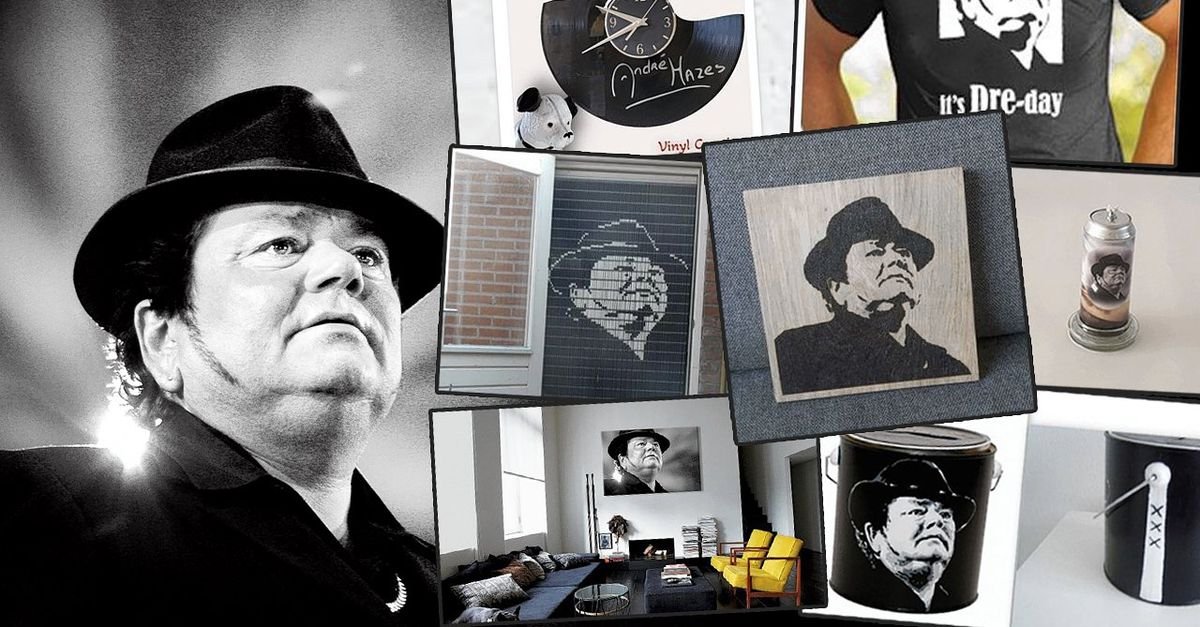
On the kitchen table of photographer Patrick Post (58) in Monnickendam is a black T-shirt with André Hazes’ face on it, as a white silhouette. It is the face as Post photographed it 24 years ago during a Hazes concert in the Olympic stadium in Amsterdam. ‘It’s Dre-day’ is written in white letters next to the head.
There is also a diamond paint set on the table, with which you can create a work of art with small diamonds. A setting sun almost disappears into the sea, at the top left the same head of Hazes rises from the waves. The set can be ordered online in different sizes from various online stores. For those who prefer painting, a paint-by-numbers set of the image is also available, which comes with canvas, pots of paint and a brush.
There is more, much more, Post shows when he has started his computer. A mirror, a clock, different T-shirts, a money box, a candle, an oil lamp, a fly curtain, paintings, coasters. All stuff with Post’s photo – without his permission, and he doesn’t get paid for it either.
Now that June 30 is approaching – Hazes would have been 75 years old – Post sees the number of copyright infringements increasing again. He shows a poster of Café De Kroeg in Purmerend, where a Hazes party will take place on that date. Post’s photo again, in color this time, and a plate of bitterballen and a large glass of beer.
Rainy concert
Back to 2002. André Hazes announces that he will perform in the Olympic stadium in August. Hazes in your own city. The 36,000 tickets were sold out within two days. Expectations are high that evening, but things turn out differently. That may be due to the rain that falls inexorably from the sky, as a review describes Fidelity how a wave is initially started with umbrellas and people sing along loudly Volare. But when Jody Bernal appears on stage, the atmosphere changes.
The audience revolts: they whistle at all the guest artists, and occasionally even the great Hazes himself. Before the end of the concert, the audience leaves the stadium en masse. “The home game of the year, ruined by the weather and the spectators,” writes the reviewer Fidelity. Patrick Post is on the road for the same newspaper. As was customary 24 years ago, he is given the opportunity to take photos during the first three songs.
Do you realize it when you witness a historical moment? The 36,000 visitors in the Olympic Stadium could not have known that the folk singer would die two years later, on September 23, 2004, and that this was one of his last major performances. Do you realize it when you take an iconic photo? Patrick Post did not at the time. But his portrait of Hazes did. The black and white color scheme, taken slightly from below, the black hat, the look with the typical Hazes tragedy, the stage light peeking over his shoulder – a heavenly squeeze on the shoulder. The image has become part of the collective memory of the folk singer. Hazes belonged to ‘all of us’. But that photo is not.
The photo is copyrighted by Post, which means only he has the right to make the photo public and reproduce it. In addition, he has personality rights, also called moral rights, which concern mentioning his name and editing a work. If you infringe those rights, you must compensate the damage. With the advent of the internet, it became easier than ever to simply copy photos from others. Just post a picture on a blog or take a photo of your idol from the internet and print it for the wall. It seems innocent, but – as in the case of Patrick Post – it can get out of hand.
“It wasn’t too bad at first,” says Post. “Then I saw that a newspaper had published the photo without paying for it, or had not mentioned my name. I then sent them a letter and they paid properly.” But about six years ago, Post received a tip from a colleague to check online to see whether his work is being used more often. Then he found the tsunami of Hazes products, as well as websites and streaming services that use his photo.
:format(webp)/s3/static.nrc.nl/wp-content/uploads/2026/06/24125720/240626CUL_2034293964_Montage-2.png)
On June 30, André Hazes would have turned 75, which means the image is used even more often, according to the photographer.
Photo Patrick Post, edited by NRC
Whether he takes action depends on the infringer. “It’s okay to paint something and hang it in your own home,” says Post. If hobbyists proudly share such a creation online, he doesn’t mind. “That’s just for private use.” Legally, this is literally called private copying, an exception included in the Copyright Act. You may reproduce a work for your own use, but not publish it (make it public); not even on your own Instagram account, blog or Facebook page. “If people start selling that work and reproducing it and making serious money from it, it will be a different story,” says Post. They receive a warning and an invoice from Post’s lawyer. In a few cases he goes to court.
Ignorance or laziness
Charlotte Meindersma, social media lawyer who specializes in copyright, immediately recognizes Post’s photo. “This photo has been used extremely much,” she says. But she says in general it is very common for people to use other people’s images. She doesn’t know if it’s due to a lack of knowledge, or if it’s just laziness. To do something about the first thing, she tries to spread information about copyright online. Because actually doing something about it is not that easy in the Netherlands.
:format(webp)/s3/static.nrc.nl/wp-content/uploads/2026/06/23141413/240626CUL_2034293964_hazes-origineel.jpg)
The original photo of André Hazes, taken by Patrick Post.
Photo Patrick Post
“The problem is that the subdistrict courts in the Netherlands decided in 2017 to add a ceiling for ‘very simple cases’. If a photographer asks less than 250 euros for the photo, a maximum of 129 euros in legal costs can be reimbursed. “The amount often even amounts to 86 euros,” says Meindersma. “You won’t find a lawyer who will draw up a whole summons, come to the hearing, do all the preparation, send letters and so on. So even if you win the case as a photographer, it will cost you money.” Post says that he often lets things go or warns people by invoicing a small amount.
Larger photo news agencies detect misuse of material and then send high claims
Sometimes photographers achieve success, such as in the Belgian case of photographer Katrijn Van Giel against the artist Luc Tuymans. Tuymans had copied a photo of Van Giel, the subdistrict court judge agreed with her. “Repainting, which also happens with Hazes’ photo, is not allowed. That is duplication,” says Meindersma. Van Giel and Tuymans reached a settlement, the amount was never announced.
Larger photo news agencies approach it differently. They detect misuse of material and then send high claims, which can amount to many hundreds of euros or even more than a thousand euros per image. People complain online about the extremely high amounts, unjustified claims and the aggressive tone of communication.
“I find it ridiculous that a party like ANP charges such high costs,” says Meindersma. “They have recently started making claims under the name ‘Fair Licensing’. But they have the same working method as Copy Right and Visual Rights Group” – legal companies that search the internet for unlawfully used images.
Using a photo for a blog normally costs between 60 and 120 euros. In case of copyright infringement, there may be an additional 50 percent for the absence of the name and a small amount for research costs. Then you arrive at an amount of around 200 euros. “If a Visual Rights Group or ANP makes a claim themselves, they are suddenly allowed to charge high research costs, while a photographer who makes a claim himself is not allowed to do so.”
Yet Meindersma understands why photographers file a claim through a company like Visual Rights Group: they do that no cure no pay. That is why more and more photographers are using them, even if they may not necessarily be happy with the way those companies claim. In any case, it won’t cost them anything. “That’s why I’m so angry with the judiciary. Because they caused this.”
Patrick Post arranges his affairs himself, through his lawyer (not Meindersma). The reactions range from immediate payment and apologies to persistent non-payment and legal proceedings. The latest claim went to Café De Kroeg in Purmerend, which is preparing to celebrate Hazes’ birthday.