BERLIN – The German government headed by Chancellor Fridrih Merc plans to introduce a new measure in the sick leave system – the so-called partial sick leave (Teilkrankschreibung).
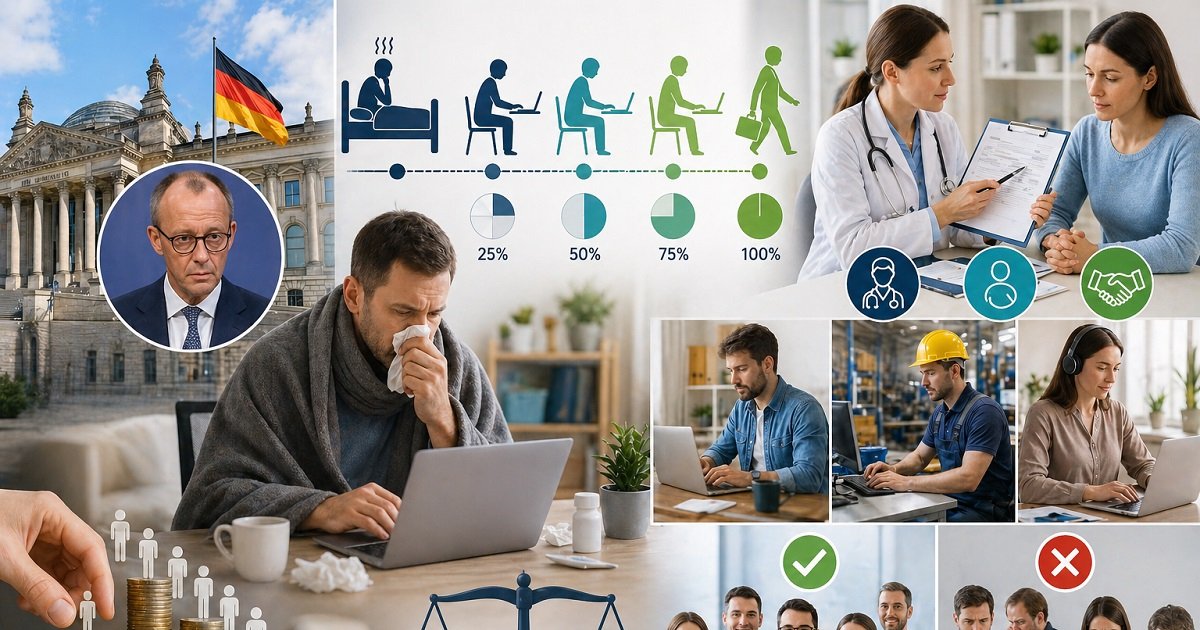
Instead of the current rule “you are either completely sick or completely healthy”, in the future, doctors could assess work ability in percentages (100%, 75%, 50% or 25%). This means that, for example, a person who normally works 40 hours a week could only work 20 hours during an illness.
What is planned and why
The reform is proposed by the Minister of Health, Nina Varken, and the goal is for employees to return to work gradually and earlier and to reduce the costs of sick leave. The reason is high absenteeism rates – an average of 19.5 days of sick leave per year per employee in Germany.
Conditions for partial sick leave
In order for someone to work on a reduced scale during illness, three conditions must be met:
– the doctor must determine partial working capacity
– the employee must feel able to work
– the employer must give consent
If the employer does not agree, it remains a classic, full sick leave.
How it would look in practice
The idea is especially intended for longer sick leave (more than four weeks).
Examples:
– someone with a mild illness can work from home instead of going to the office
– a physical worker can temporarily do administrative work
– employers could help with flexible working hours or remote work
Financial aspect
the first six weeks: the employer still pays the full salary
then:
– the employer pays for the hours worked
– health insurance covers the rest through sick pay
It is also planned to reduce sick pay from 70 to 65 percent of the gross salary, but in some cases employees could still do better financially than with full sick leave.
Arguments FOR reform
Supporters highlight several advantages:
– easier and faster return to work
– lower total number of sick days
– retention of work habits and skills
– better social inclusion, especially in the case of mental illnesses
– a more flexible transition from illness to full-time work
Experts emphasize that many people are neither completely healthy nor completely sick, but somewhere in between – so this model makes sense.
Criticisms and concerns
Unions and social organizations warn of risks:
– employees could be under pressure to work even when they are not ready
– recovery could take longer or the condition could worsen
– there is a danger that “voluntariness” will not be real in practice
Opponents point out that a premature return to work could increase the number and duration of illnesses in the long term.
The planned reform brings a more flexible approach to sick leave, but also raises questions about employee health protection. The key will be that decisions remain medically based and that employees really have a choice. Parliament still needs to decide on the bill after it has passed the government, he says.Fenix-Magazin“.
Follow us on our Facebook and
Instagram page, as well as on
X account and on
Viber channel.