A proposed school-day smartphone ban in Korea’s largest school system has reignited debate over concentration, safety, students’ rights
Many South Korean schools already limit smartphone use during class.
But a proposal to ban smartphones for the entire school day, including lunch breaks and free periods, is gaining attention.
The idea is drawing attention in Gyeonggi Province, home to the country’s largest student population, after superintendent-elect Ahn Min-seok identified it as one of his top priorities.
Similar measures have been introduced in countries such as France and the United States. The proposal has received support from many teachers, who argue that inconsistent rules between schools often lead to complaints from students and parents.
At the same time, critics warn that a blanket ban could infringe on students’ rights to communicate with the outside world, as they spend a significant portion of their day at school.
A signature pledge from superintendent-elect
The policy has been at the top of Ahn’s agenda before he takes office in July. He is reportedly considering a “phone-free school” directive as his first major administrative order.
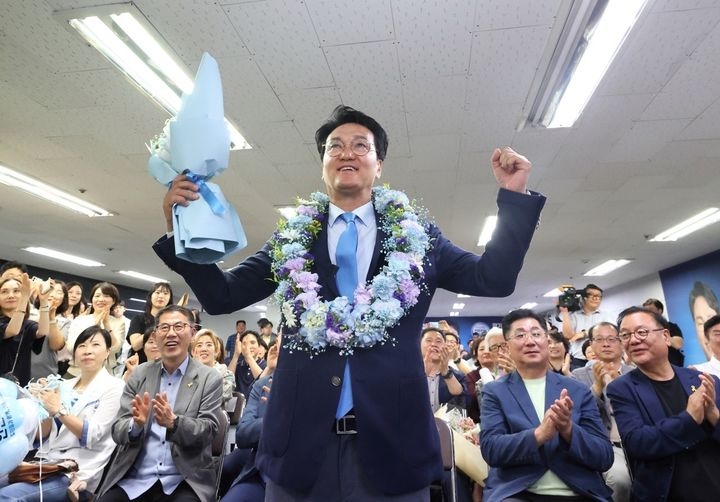
“As the first education superintendent of the artificial intelligence era, I want to address children’s dependence on smartphones,” Ahn said after exit polls projected his victory in the June 3 local elections. “We will begin with middle schools as a practical first step and consider expanding the policy to high schools after careful review.”
Citing the case of a Samsung family member who reportedly attended high school without a smartphone before entering Seoul National University, Ahn has argued that limiting smartphone access can help improve students’ concentration and creativity.
“The introduction of phone-free schools in Gyeonggi Province could encourage other provinces to follow, just as they did with free school lunches,” Ahn added.
As of 2025, Gyeonggi Province has about 1.44 million elementary, middle and high school students, accounting for roughly 28 percent of South Korea’s total student population.
Restrictions already exist, but remain uneven
Although the timing and specific implementation of the policy remain unclear, it would go beyond current restrictions, which are largely determined by individual schools. Many schools prohibit smartphone use during lessons but allow students to use their devices outside class hours.
According to a survey of 153 elementary, middle and high schools conducted by the Korean Federation of Teachers’ Associations, more than 95 percent of schools allow students to carry smartphones at school, while 56 percent permit use outside academic activities.
Teachers have long complained that enforcing smartphone restrictions is difficult when neighboring schools apply different standards, often resulting in complaints from students and parents.
The survey also found that students frequently challenge school regulations that partially restrict smartphone use. In a separate survey conducted last year, 34.1 percent of teachers reported experiencing disputes or verbal abuse related to smartphone rules, while 6.2 percent said they had suffered physical violence or injury.
However, schools have expressed concern about facing human rights complaints when attempting to impose stricter controls on smartphone use.
Korea’s National Human Rights Commission has repeatedly ruled that banning smartphone use throughout the entire school day can constitute an excessive restriction on students’ rights.
While the commission has recognized temporary collection of smartphones during class as a legitimate educational measure, it ruled in August that collecting students’ phones from 7:20 a.m. until 11:20 p.m. excessively restricted their right to possess and use personal devices.
Concerns prompt more cautious approach
Supporters of stricter controls often point to overseas examples such as France and several US states, where smartphone restrictions have been expanded in schools.
In Korea, however, concerns remain about whether limiting access to phones could leave students unable to seek help in cases of school violence or other emergencies.
Critics also argue that the debate reflects a broader tendency to view students primarily as subjects of control rather than as individuals capable of making responsible decisions.
“Regardless of political or social views, many people now take it for granted that banning smartphones is automatically good for students, even though the same logic is rarely applied to adults,” said an official from Baram, a human rights advocacy group.
“The assumption that adolescents should naturally be subject to greater control reflects a broader issue in our understanding of human rights, and that perspective can influence other issues as well.”
Facing such concerns, Ahn’s transition committee has struck a markedly more cautious tone than the superintendent-elect’s earlier remarks, which criticized what he described as a regulatory gap governing smartphone use outside class hours.
“Any phone-free school initiative will be slowly implemented only after sufficient consultation with students and education stakeholders,” a committee official told The Korea Herald by phone.
forestjs@heraldcorp.com