Union warns of second, bigger strike on June 29 as profit-linked pay demands spread among Korean firms
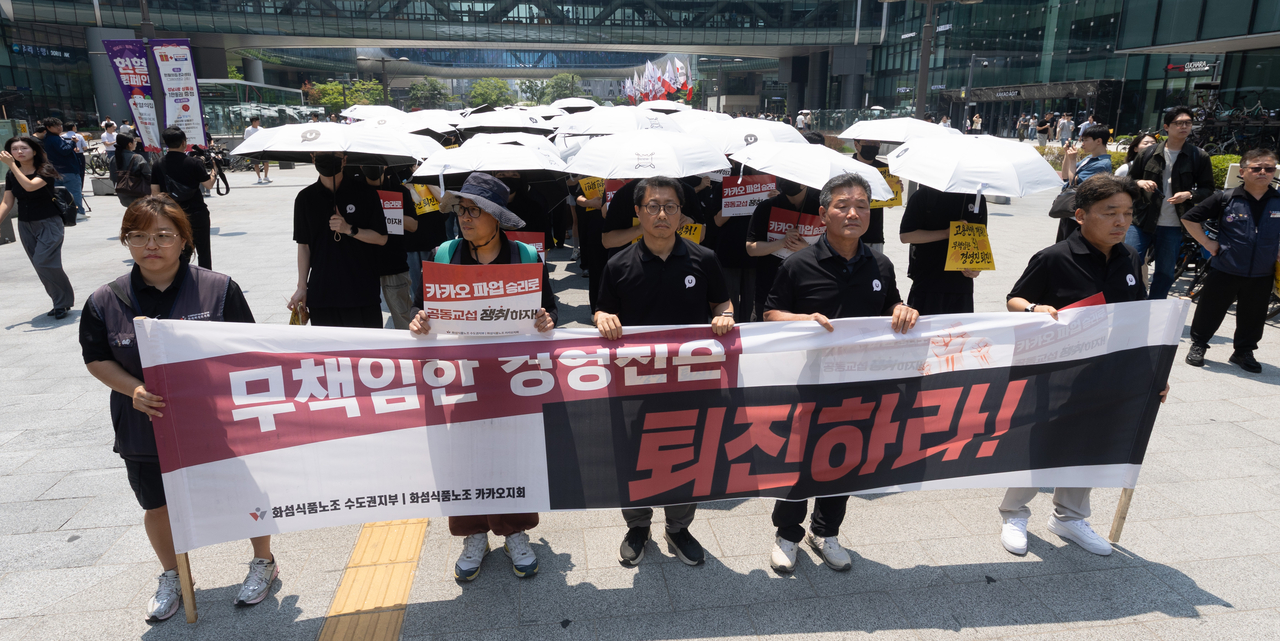
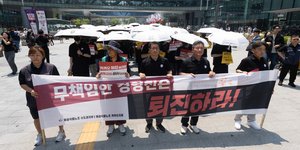
Unionized workers at Kakao walked off the job Wednesday in the first strike at the company’s headquarters since its founding, and warned of a second, larger walkout later this month, escalating a monthslong dispute over how the operator of KakaoTalk, the messaging app used by most South Koreans, divides its profits with employees.
The Crew Union, which represents Kakao staff, staged a four-hour partial strike from 10 a.m. to 3 p.m., excluding the lunch hour. By late morning, the union said more than 1,000 headquarters employees had joined, with about 1,500 taking part across the group. Four affiliates whose wage talks had also broken down joined the walkout: Kakao Pay, Kakao Enterprise, DK Techin and XL Games. With roughly 4,000 staff at headquarters, that meant about one in four took part.
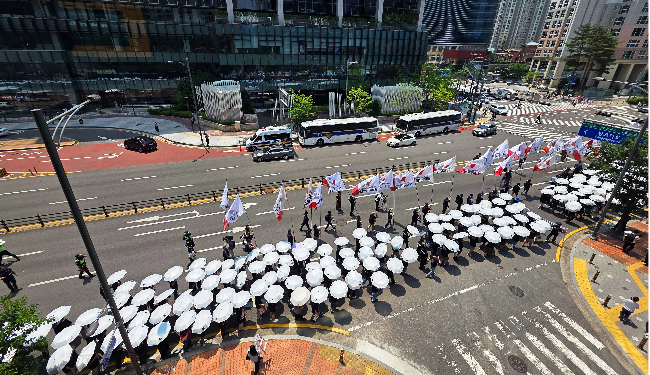
Around midday, workers rallied at the plaza outside Pangyo Station in Seongnam, Gyeonggi Province, then marched through the surrounding tech district, joined by union members from Naver, Nexon and NCsoft. Police estimated about 500 people in the march at noon, while the union put the figure at around 800.
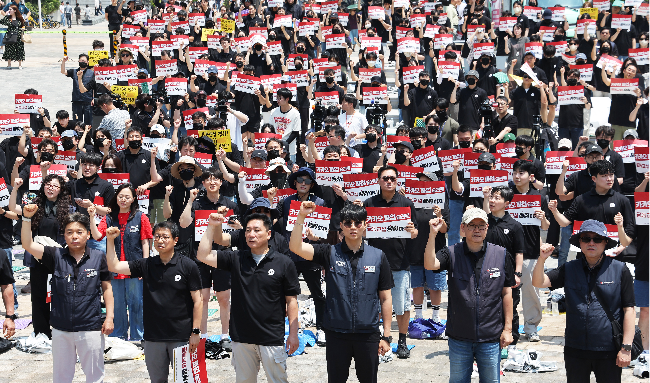
At a rally afterward, Crew Union chapter head Suh Seung-wook announced a second strike on June 29, which the union calls a “log-off day.”
Members would register leave and log out of internal work systems for the full day, rather than the four hours they downed tools on Wednesday. The union said it aimed to draw all 5,000 of its members and that more participants could raise the risk of disruption to services such as KakaoTalk and Kakao Pay.
“Kakao’s real reform has to be made by its crew, not its executives,” Suh said, using the company’s in-house term for employees.
At issue is the formula for performance-related pay. The union wants bonuses tied to a fixed share of operating profit, reportedly between 13 and 15 percent, which it says would come to roughly 10 million won ($6,560) per worker. It also wants 5 million won in restricted stock units paid separately rather than counted as part of the bonus. Kakao began granting the shares to employees with a year of tenure last year in place of stock options.
The company has offered a compensation pool that folds in the stock units, which the union calculates at about 10 percent of operating profit.
The fight reaches beyond Kakao. Through 2026, unions at major Korean firms have pushed to lock bonuses to a set percentage of profit, a demand that gained traction after Samsung Electronics and SK hynix, lifted by the memory-chip boom, faced similar pressure. The approach sets worker claims on company earnings against management’s argument that such payouts erode the flexibility to invest, a tension sharpened in a year when firms are pouring money into artificial intelligence.
Kakao posted record first-quarter results, with an operating profit of 211.4 billion won, up 65.9 percent from a year earlier, on revenue of 1.94 trillion won. The union argues that the gains have gone to executives while restructuring and spinoffs leave ordinary staff exposed. The shares closed down about 3.5 percent Wednesday at 38,150 won and have fallen roughly 13 percent over the past month.
Services like KakaoTalk and Kakao Pay ran normally through the day. Because most service operations are automated, the walkout caused no visible disruption, and the company said it had a real-time response system running. The Ministry of Science and ICT reviewed service-stability measures with Kakao before the strike. Kakao said it would keep talking with the union in pursuit of a deal.
mjh@heraldcorp.com