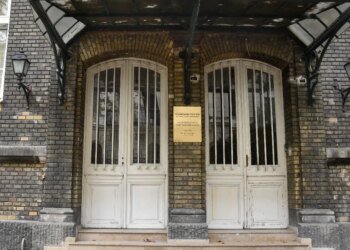

The Reformatory at 60 Szőlő Street in Budapest
Even political opponents acknowledge that the TISZA Party has a campaign strategy unlike any other: planned down to the smallest detail—likely with foreign expertise—and executed with mathematical precision, it has amplified the partly justified dissatisfaction with FIDESZ to excessive proportions. One of the most successful—and at the same time most despicable—disinformation campaigns by the TISZA spin doctors gained notoriety under the name “Uncle Zsolti Affair.”
Character assassination has always been a favorite tactic, not only of the Hungarian left, for dealing with political rivals they cannot defeat through democratic competition. Shortly before the elections, Foreign Minister Szijjártó was accused of acting as Moscow’s “Trojan horse”—a role generally attributed to patriotic politicians. The “wiretapping scandal” and the alleged passing of sensitive information to Russia turned out, in hindsight, to be intelligence manipulation. It had to be grudgingly admitted that the then-chief diplomat had acted strictly within the scope of his official duties toward his country and the EU. Nevertheless, the “revelation,” which spread exponentially, reinforced the TISZA narrative, culminating in chants of “Russians go home” by unsuspecting youths.
The “Pedo-FIDESZ” label attached to Viktor Orbán’s party served the same purpose: to discredit a political rival.
The infamous accusation of condoning or even engaging in pedophilic tendencies is by far the most serious charge against a party that has made child protection a cornerstone of its social policy. As a killer argument, it served Péter Magyar’s party well during and after the election campaign.

Protest in front of the juvenile detention center on Szőlő Street (December 2025). Photo: MTI/Zoltán Balogh
The scandal centered on a juvenile detention center on Szőlő Street in Budapest, whose director was placed in pretrial detention in May 2025 on suspicion of forced prostitution, forced labor, and abuse of official authority. Surrounding these alleged crimes, a story was fabricated with the help of a former inmate that targeted a high-ranking politician, nicknamed “Uncle Zsolti,” who was accused of abusing the young inmates in his care. Hundreds of articles in the media—which was then part of the opposition but is now pro-government—waged a smear campaign against allegedly corrupt politicians in the governing coalition, thereby paving the way for a lynch mob mentality that continues to wreak havoc to this day. The left-wing press identified Deputy Prime Minister Zsolt Semjén, the chairman of the Christian Democrats, as the prime suspect. The question “Who is Uncle Zsolti?”, repeated a thousand times, provided the soundtrack for a doomsday scenario in which not just four, but countless “horsemen of the apocalypse” proclaimed TISZA’s verdict against FIDESZ, which was portrayed as the epitome of moral depravity.
Now, the “Day of Judgment” that was supposed to spell the final demise of FIDESZ has turned out to be nothing more than an amateurish farce. The script of the pop-up party with 29 members has proven to be the Achilles’ heel of this political charade.

Interpellation by Miklós Panyi on June 22, 2026. Photo: MTI/Bodnár Boglárka
At a joint press conference with his fellow party member János Pócs, Fidesz MP Miklós Panyi stated: Over the past six days, it has become clear that the so-called “Uncle Zsolti affair” does not exist; it is a fabricated story. He claimed that the TISZA Party is “in it up to its neck” in the fabrication of the case and the formulation of the charges, since TISZA’s “in-house media platform,” “Kontroll,” and its founder, Márton Magyar—the brother of Prime Minister Péter Magyar—had paid “several million forints” to Sándor Bangó, who is described as the key witness in this case. The opposition politician emphasized that the “story of Uncle Zsolti” had surfaced nine months ago, but in his opinion, it has since become clear that the case has collapsed, since there are neither documents nor records or credible witnesses.
Meanwhile, the ruling party’s mouthpiece media remain silent. The hundreds of articles on the “Uncle Zsolti” case since the story broke are countered by a single article from Telex, which grudgingly admits that the case is collapsing like a house of cards.
What remains is an outrageous accusation, a tarnished reputation (“Where there’s smoke, there’s fire”—this malicious insinuation is often and readily used by TISZA), a poisoned social climate, and, last but not least, a psychologically fragile young person who, through the lure of vast sums of money, was led astray from the path of social integration and became a pawn in a cynical scheme. The constant talk of a “land of love” is the fig leaf of the newest generation of Hungarian “do-gooders,” an Orwellian Newspeak that not only robs language of its meaning but also sacrifices social peace on the altar of political expediency. In this perversion of language and morality, older generations—who were not granted the mercy of being born later in the former Eastern Bloc—can easily recognize the grimace of class hatred, a memory best left in the past.

Featured image: Envagyokbela/Wikimedia Commons