In Moldova in 2025, along with the growth of GDP and investment, the public debt and foreign trade deficit increased noticeably. And against the background of rising wages, the efficiency of production and exports is falling. These are the data of the report on the socio-economic situation in the country based on the results of 2025, presented by the Ministry of Economic Development and Digitalization. NM selected the main points from the report.
Macroeconomic indicators
Report on the socio-economic situation in 2025 by the Ministry of Economy published this week. The fifty-page document contains key economic indicators for the past year.
Thus, one of the main macroeconomic indicators, gross domestic product (GDP), grew by 2.4% in 2025. At the same time, the ICT sector grew by 12.5%, agriculture, against the backdrop of favorable weather conditions, by 10.7%, the construction sector by 6.6%, and industry by 5.4%.
The volume of investments increased by 17.6%, amounting to 41 billion lei. According to the report, private business, the state, and external financing played a role in this.
Trade volume increased by 5.9% and the number of people using tourism services increased by 8.7%.
Annual inflation amounted to 6.8% (while the inflation corridor established by the National Bank was 5% ± 1.5%).
Public debt increased by 9.4% – to 132.8 billion lei, of which internal debt amounts to 52 billion lei, external debt – 80.8 billion lei. “Despite the increase in public debt in 2025, it remains at a sustainable level, amounting to 37.6% of GDP,” the report notes.
The current account deficit in the balance of payments in 2025 increased by 32.7%, amounting to $4 billion (that is, the country consumes more than it produces). The Ministry of Economy explains this by an increase in the foreign trade deficit, as well as a slight increase in remittances from migrants – by only 1.3%, to $1.9 billion.
Moldova’s exports in 2025 amounted to $3.8 billion (an increase of 6.4% over the year), and imports – $10.9 billion (an increase of 20.5%). Thus, the foreign trade deficit exceeded 7 billion lei, increasing by 29.6% over the year.
Salaries, according to data from the report, also increased: in real terms (taking into account inflation) – by 1.9%, the average salary reached 15.5 thousand lei. The average pension in real terms increased even more – by 3.5%, to 4.4 thousand lei.
Production efficiency
In addition to macroeconomic indicators, the report also provides other data indicating the situation in the economy. In particular, the export efficiency index (an economic indicator used to assess the ability of an economy to supply goods and services to foreign markets, as well as the competitiveness of national products). It is defined as the ratio of export growth to import growth of Moldova’s main trading partners over the same period.
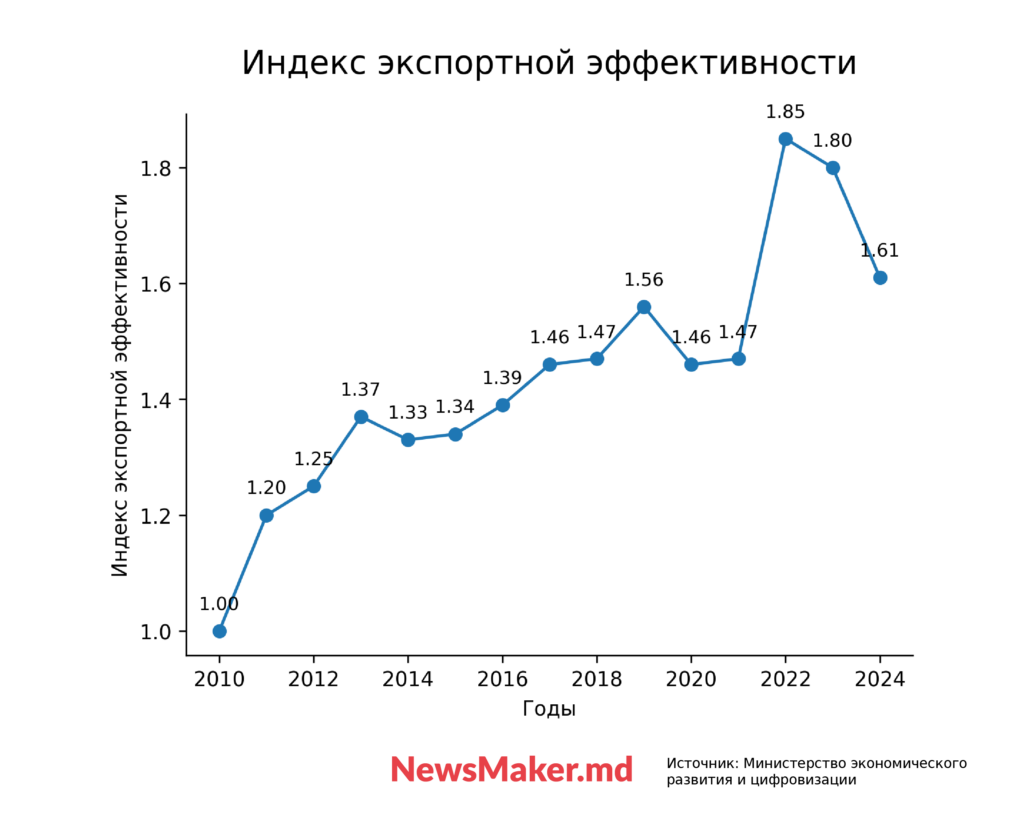
Index data is given since 2010. Then it was 1, then rose to 1.85, but in 2023 it decreased to 1.8, and in 2024 to 1.61.
“The decline over the past two years indicates a loss of share in foreign markets, although demand from major trading partners has remained relatively stable, reflecting predominantly domestic factors. The decline in 2024 is mainly explained by a decrease in agricultural production, affected by drought, as well as a reduction in fuel re-exports to Ukraine,” the Ministry of Economy explained.
Also, according to the ministry, this indicator was negatively impacted by an increase in domestic energy costs and logistical disruptions associated with the war in Ukraine.
Another indicator is unit labor costs (that is, labor costs per unit of output – a key indicator of production efficiency). In 2025, unit costs increased by 9.6%, and since 2015 – by 2.5 times, while labor productivity increased by only 2.8%.
“The economy was relatively balanced between 2016 and 2018, with labor productivity growing faster than labor costs, supporting stable economic growth and low inflation pressures. Beginning in 2019, this trend reversed: labor costs increased significantly while productivity stagnated,” the report’s authors noted.
The reasons for this trend, according to the Ministry of Economy, were the labor shortage, as well as the increase in wages after 2021 against the backdrop of inflation.
“In 2024, unit labor cost growth thus exceeded the rate of economic growth, indicating that wages are rising faster than productivity,” the report said.
Subscribe to our Telegram channel @newsmakerlive. Everything that is important to know right now about Moldova and the region quickly appears there.
Want to support what we do?
You can contribute to quality journalism by supporting us one-time through the E-commerce system from maib bank or by taking out a monthly subscription to Patreon! This way you will become part of changing Moldova for the better. Thanks to your support, we will be able to implement even more new and important projects and remain independent. No matter how you support us, you will receive a small gift. Follow the link to become our partner. It’s not difficult and even pleasant.