Who can please do compulsory labor for Corpus Christi? In many clever companies – of which the “press” is certainly one – emails with this question have been rampant in the last few days. Their effect is based on the fact that the Lord (Middle High German: “fro”), for whom one may have to work on the holiday, is different from the one whose body and blood are the focus of this festival.
And not just symbolically, this is where the theological explosiveness begins: This festival, established by Pope Urban in 1264, celebrates transubstantiation, the true transformation of bread and wine into the body and blood of Christ. The fact that wafers and sacramental wine at Holy Communion do not taste or look any different than usual explains this catholic church in that their accidents (e.g. their taste and their color) have remained the same, but not their substance.
It was a motive of the Reformation that the Protestants saw things differently. Luther spoke of real presence: Jesus Christ was really present with his body and blood “in, with and under” the bread and wine. The difference may seem subtle today, but it fueled the religious wars, probably also because it concerns the role of the priest, who brings about the change, at least as a middleman.

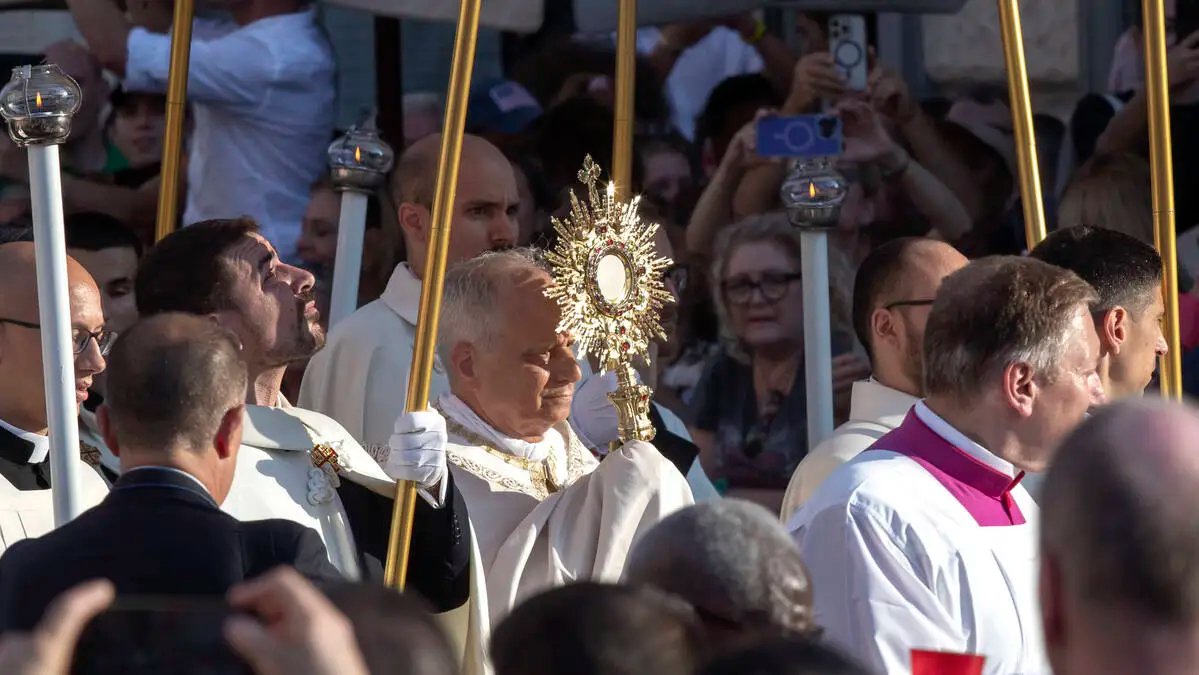
Monstrance under a yellow sky: Corpus Christi procession in Traunkirchen am Traunsee. Imago/Rudi Gigler
Corpus Christi – which is closely related to Maundy Thursday, which cannot be celebrated so opulently due to the Passion – became a showcase and parade festival for the Counter-Reformation and thus for the Catholic Church (and in our case for the Habsburg state). Both are to be understood literally. The magnificently decorated monstrance, which contains an already transformed (“consecrated”) host, is presented in parades that, using the same basic word (“monstrare” = to show), could certainly be described as demonstrations.
The impressive processions were sometimes perceived as such, especially in regions where Catholics and Protestants lived side by side. “Our farmers used to demonstratively mess up on Corpus Christi,” wrote a Protestant church newspaper in Franconia recently, “so that the Catholic altars would be properly fogged up. Not out of malice – more out of tradition.”
Could one identify an influence of the Corpus Christi processions in today’s demo culture? In times when Austria was still dominated by Catholics, the external connection to social democratic marches was obvious. “As a boy, I once said to my red grandfather that I would like to go to Corpus Christi one day,” says historian Wolfgang Maderthaner, who grew up in Waidhofen an der Ybbs. “He replied briefly: You go to May Day. That’s enough.”
A passage in HC Artmann’s “Looking for Yesterday” shows how present Corpus Christi was in the suburbs of Vienna. “To Corpus Christi (capitalized by Artmann!) they have (meaning: the girls) “All in white clothes and burnt hair,” writes the poet from Breitensee: “But when it rains, the children get completely wet. But they are still not allowed to leave the line, because that would be a sin, and the girls’ burnt hair begins to hang down. They look like bad mice, the poor bastards… say the social democrats and free thinkers.”
The portable roof with the beautiful name Carrying Heaven ensures that the holy of holies, i.e. the monstrance, does not get wet. It is also called canopy, which comes from the place where the gold brocade for it was once produced: Baldach, today Baghdad. At least verbally, a piece of the Orient is included in a Corpus Christi procession.