There was the sound of an explosion, then smoke rose in the near distance – a controlled demolition, one journalist suggested. Another pointed out an Israeli flag. A second explosion sounded and black smoke rose. This was the view from the village of Majdal Zoun in southern Lebanon this week: a final stop before the Israeli military’s newly declared “yellow line”, which journalists visited at the invitation of Hizbullah.
Lebanese citizens risk death if they attempt to go beyond this line – an area that includes at least 55 towns and villages. From a distance instead, they watch as their homes and all the history that goes with them are deliberately destroyed.
Despite the fragile ceasefire, the Israeli military has continued occupying and demolishing areas of south Lebanon. It says it aims to create a buffer zone to prevent Hizbullah attacks and ensure safety for its citizens in the north of Israel.

“The Nakba of South Lebanon,” read the front page of Lebanese French-language newspaper L’Orient-Le Jour this week.
Nakba, “catastrophe” in Arabic, was previously used to refer to the 1948 displacement of hundreds of thousands of Palestinians around the creation of the state of Israel.
The new Israeli-occupied area runs between five and 10km deep into Lebanese territory, covering more than 500 sq km.
Hostilities between Hizbullah and Israel reignited on March 2nd, when the Lebanese group opened fire in support of Iran. More than 2,400 people have been killed in Lebanon since Israel launched an offensive in response to the attack.

Over three days reporting in south Lebanon since a ceasefire came into force on April 17th, The Irish Times witnessed widespread destruction and fear, with many expecting fighting to restart soon or saying it has not really stopped.
Israeli surveillance drones are regularly audible, while GPS often does not work because of what locals say is jamming. Outside the occupied area, citizens are still frightened to return home, and shocked by the devastation when they do.
In Gaza, where there is also a “yellow line” – agreed in a US-brokered truce last October – the Israeli military has continued to expand its control, with new areas coming under attack. Hundreds of people, including more than 100 children, have been shot near the line since the ceasefire, according to UN data.
In Lebanon, the fragile 10-day ceasefire was due to expire on Sunday, although US president Donald Trump said on Thursday that it would be extended by three weeks.
What happens next is unclear. Hizbullah has said it has the “right to resist” if Israeli occupation continues, “and this matter will be determined based on how developments unfold”.
On Thursday a Unifil spokesman said peacekeepers continued to observe Israel Defense Forces ground activities in southern Lebanon “including demolitions”, and had recorded “a handful of Israeli drone strikes”. They also recorded more than 450 launches from Israeli-controlled territory in the first six days of the ceasefire, including mortar and artillery shells, and four projectiles fired into Israel from Lebanese territory. Hizbullah says it fired rockets and drones as a reaction to Israeli violations.
Lebanon’s National Council for Scientific Research (CNRS) says more than 62,000 housing units were completely or partially destroyed over around 45 days of all-out war. Destruction continued after the ceasefire, with the organisation estimating that 428 housing units were destroyed and 50 damaged during the first three days, according to Dr Chadi Abdallah, CNRS secretary general.
Last year Amnesty International called for Israel’s “extensive and deliberate destruction of civilian property and agricultural land across southern Lebanon” to be “investigated as war crimes”, with a report documenting how Israeli forces “manually laid explosives and bulldozers to devastate civilian structures, including homes, mosques, cemeteries, roads, parks and soccer pitches, across 24 municipalities.”

As the Lebanese assess the latest damage, they also grieve. A series of mass funerals took place this week, as those kept in temporary graves were finally brought back to their hometowns for a proper burial.
In the village of Mansouri, a cemetery is littered with debris, gravestones in it smashed. A man is preparing for funerals – there are 21 local “martyrs”, he says.
Another local, Hussein Hayda (56), says that before 2024 the village was “normal; we were happy”. He tried to return to the village recently, thinking a ceasefire had come into force, but says he came under attack. They were “shooting fire on us”, he said, and his neighbour was killed. He survived by hiding under a building, he says.
[ Israeli strikes kill a journalist and injures another in LebanonOpens in new window ]
Last Sunday the Israeli military invited Israeli journalists to visit the border village Ayta al-Shaab. A Jerusalem Post reporter claimed there was no occupation there because “it has been depopulated and largely reduced to rubble”. In November 2025 The Irish Times visited the same village with its Lebanese residents. “You feel like you’re walking in Gaza, not Lebanon,” said a local woman – one of about 16,000 residents who are now displaced.
In mid-April, UN experts said the deliberate destruction of homes in Lebanon was “a weapon of war and a form of collective punishment, particularly in Shia areas in the rural south of the country. It also points to ethnic cleansing.” They added that forced displacement of a civilian population “constitutes crimes against humanity and is a war crime under international law”.
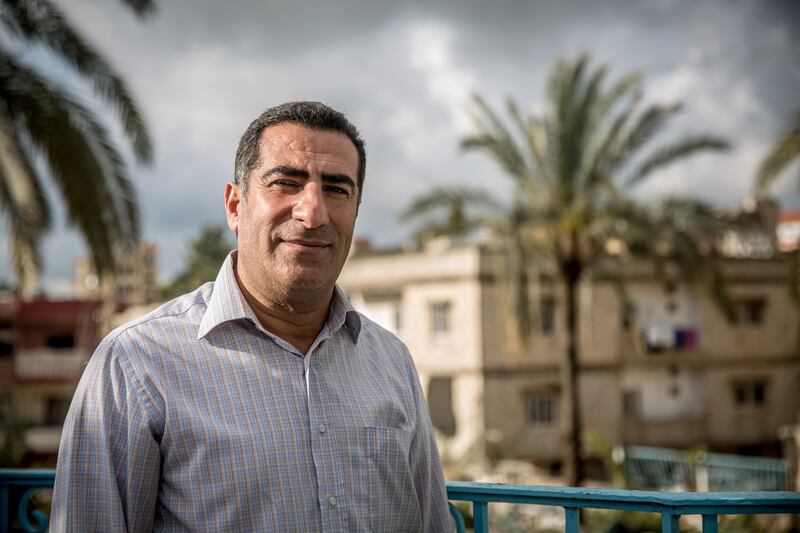
Hussein Fahas, the mayor of the village of Jibchit in Nabatieh district, and a physics professor, says the Israeli-occupied area starts about 7km in one direction and 15km in another.
During the war, 100 buildings were destroyed in the village, making up about 300 units. The civil defence centre, three generators that supplied electricity to the village and the mosque were destroyed. The water supply was damaged. According to Fahas, an estimated $20 million of damage took place in central Jibchit alone. This included $120,000 for each of the generators.
About 70 locals were killed, including about 15 fighters. Another 50 were killed during the 2024 war, and at least 12 during the 15-month ceasefire, during which Israel continued to carry out near-daily attacks on Lebanon.
Fahas says the Israeli military has targeted “any movement” during the war, regardless of whether the people are civilians or not. This is a tactic to empty the area, he suggests. One of the 18 municipality members is among the dead.
“When the war stopped the municipality started cleaning,” Fahas says. About 50 per cent of the population, of about 17,000, has returned. About 1,200 lived there during the war, he says.
He says it is now US president Donald Trump’s decision as to whether war will start again. “We hope that the war will stop totally, not partially,” he says. “For every action there’s a reaction. The occupation is the action. If the Lebanese army could defend us there’s no need for resistance. We have confidence in the resistance. We have confidence in the Lebanese army but they don’t have proper weapons to defend us, not since 1948.”
He says Israelis have “no mercy for the children, for the people and for the buildings”.

In the same village on Monday, three children – Narges (8), Mohammed (11) and Zainab (15) – and their mother, Khadija, were laid to rest. Their father was a Hizbullah member, attendees whispered, but his family were alone – displaced a 26km drive away in Ghaziyah – when they were killed by an Israeli air strike. Their bodies were covered in Hizbullah flags because of his position.
Khadija’s child nephew – whose father was also a Hizbullah “martyr” – lay on top of one of the coffins, wearing a khaki uniform as it approached the cemetery.

In the village of Qlaileh, Tyre district, 15 Hizbullah fighters were buried on Tuesday. Mourners prayed, cried and chanted “death to Israel” and “death to America.”
Hizbullah media officer Salman Harb says they want journalists to “see the faces of those who defended the land.” He perceives Hizbullah fighters as “those who took the place of the Lebanese army … We’re proud of them. Our community supports us.”
Regarding the ceasefire, he says “Israel and the peace are opposite directions. They’re working not in parallel … Look at what happened in Gaza.”
He says Hizbullah does not agree to direct talks with Israel and if there is dialogue with them, through Lebanese officials, “we’ll punish them later”.
Nearby is a widow holding a picture of her husband, Abed Asad Hawila (43). He is in a temporary grave in the city of Tyre, she says, awaiting a funeral. Beside her are three teenage daughters. They all agree that they are proud of their father. “All the world loves him,” one says.

Sitting back from the crowd is 82-year-old Heian Hassan, the mother of one of the men being buried. She grips his picture, saying her son became involved with Hizbullah when he was still a teenager, after seeing his older brother killed. When he died, he was 47 with a “sweet wife” he married in Africa, and three children, including a three-month-old girl.
“All the people know him,” she says. “He was very strong, Israel was afraid of him.” She says Israeli forces discovered her son and a friend planting bombs, but he survived after hiding for days. Mehdi was killed a day before the latest ceasefire, she says. Three of his brothers are still fighters, and another died earlier in the war.
Yet Hassan says, “If you go to sacrifice you will be in paradise. I encourage all my sons to be in Hizbullah, I want them to all be martyrs like their brother. We are proud of this thing.” She says she would even encourage her grandchildren to join.
Back in Majdal Zoun, the village on the new frontline, a group of men – using shovels and bricks – are “widening” the cemetery, one explains. “We are preparing for the last battle.” Soon, they will bury nine Hizbullah fighters and two civilians but “we are ready for 20 more. Don’t worry about that.”
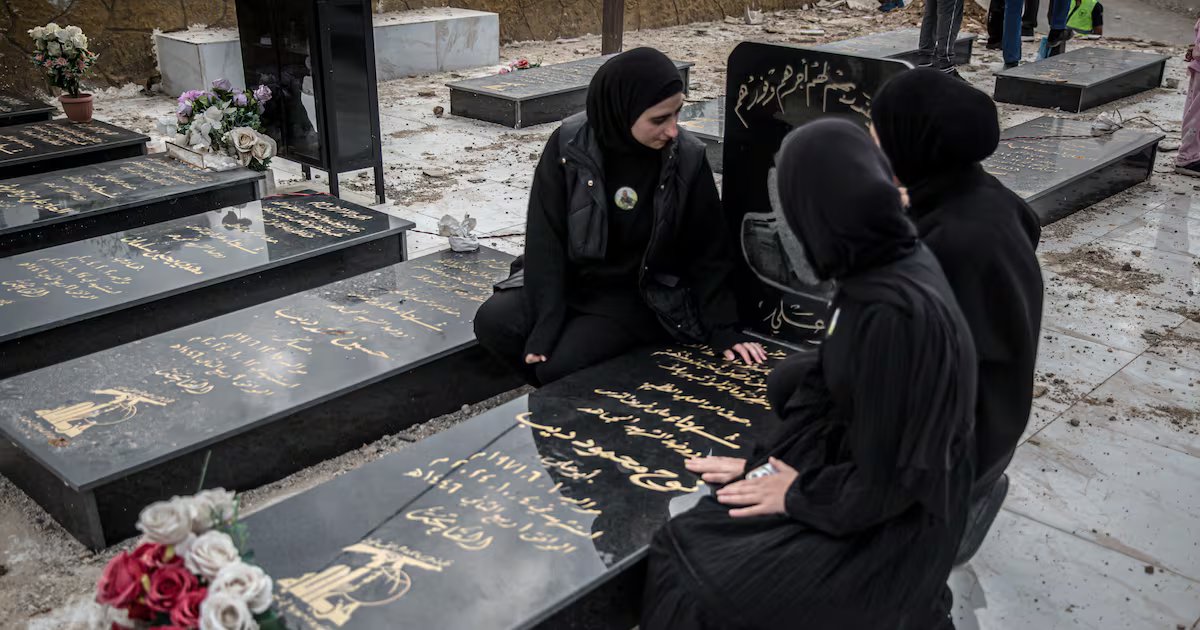
Nearby, a group of young women, one with a baby in her arms, sits at the grave of their father. They are some of seven sisters, and their father was a civil defence member killed by Israel in 2024. They come to the village each day and sleep elsewhere at night – their home has no windows and doors.
Whether they will lose access to their father’s grave in the future is far from clear, but they seem definite in this moment. “The most important thing is we will not leave our land,” one says, the others nodding in agreement.