Opinion
In this series, My Happy Place, our writers reflect on the holiday destinations in Australia and around the world that they cherish the most.
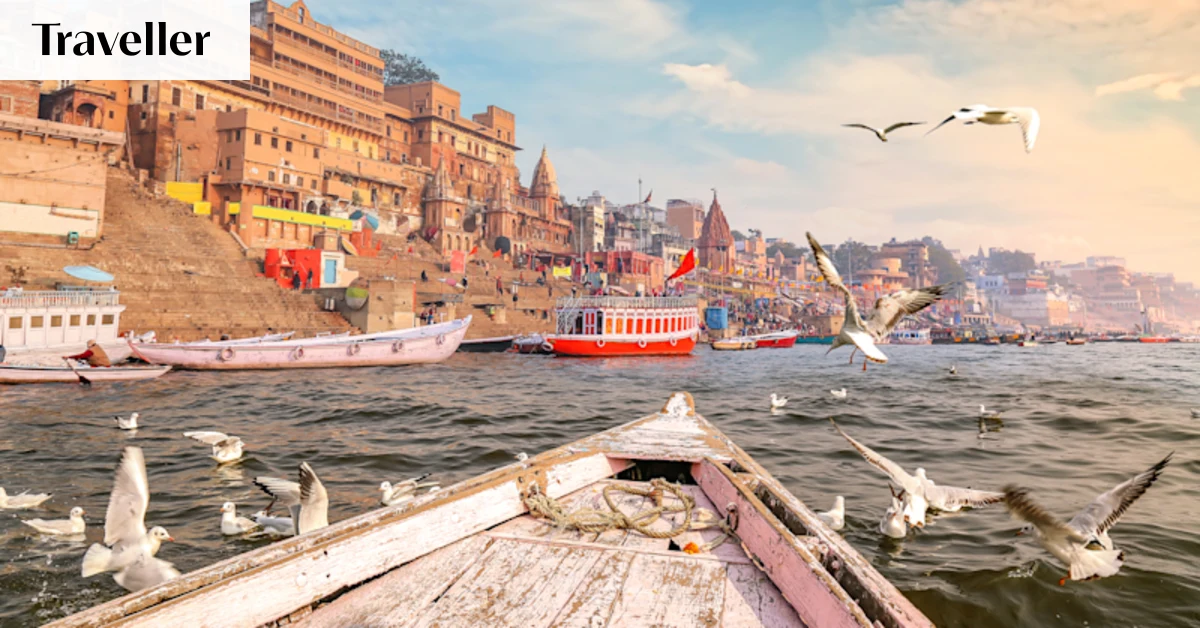
Beauty is in the eye of the beholder and perhaps so too is happiness, particularly when it involves a most ancient of ancient cities, a place mired in pyres from which the resultant pall coils itself around the adjacent sacred river below like a python around its prey.
I was by no means devoid of trepidation when I ventured to Varanasi, a stop on a 1451-kilometre cross sub-continental rail journey between Kolkata and Delhi. It was a stop easily bypassed by the faint-hearted.
Varanasi, also known as Banaras, is regarded as the spiritual pulse of India, a city where the reality of mortality is on display for each one of the living to see. But it’s not long before you’re overcome with the realisation that this place is, despite its reputation and function, an overwhelmingly living city.
True, when a secular foreign visitor such as myself arrives in Varanasi, they invariably encounter a challenging place: a seemingly grisly Disney-for-the-departed, where the half-naked, ganja-affected sadhu, or holy men, are omnipresent.
They are among the human tide of devout Hindu pilgrims from all over the country who visit Varanasi each day. Many of them come bearing the bodies of deceased loved ones, bound tightly in woven shrouds awaiting cremation here by the Ganges, the river which runs through the city.
Sign up for the Traveller Deals newsletter
Get exclusive travel deals delivered straight to your inbox. Sign up now.
The ordinary Hindu pilgrims come not only to perform antyesti, or funeral rites, that facilitate the soul’s transition from the body through cremation – usually within 24 hours – but to bathe in the paradoxically putrid-yet-sacred waters of Mother Ganga.
Overtourism has existed here for centuries, or even longer, well before the modern-day term was coined and worried over. Indeed, in 2025, a record 147 million or so people, mostly Indians, visited what is one of the oldest continuously inhabited cities in the world.
“Few ancient cities survive today and those that do, such as Athens and Cairo, cannot claim their ancient culture is still intact,” wrote the late Mark Tully, the distinguished BBC correspondent who became known as “the voice of India”. “The holy city of Varanasi is the only exception to that rule that I know. Its ancient culture is still alive.″
As weird as it may seem, during my brief sojourn to this more than 3000-year-old Indian city of the dead, I never felt more alive, or for that matter, happier, to have not just experienced this unique city, but to have confronted it.
There’s so much more to Varanasi than meets the inevitably sooty eye. It’s also a city renowned for the production of fine muslin and silk, something confirmed by the sounds of rhythmically clanking wooden looms as you pass through narrow laneways flanked by buildings full of anonymous weavers.
Of course, it didn’t hurt that my visit, and, yes, my nervous system, both to and in Varanasi were soothed by the fact that I was enjoying the considerable guest comforts of the Taj Nadesar Palace, one of the most divine five-star Raj-era hotels in all of India.
A refuge from Varanasi’s oft grim realities, one of the establishment’s key experiences are its holistic offerings, in which I partake to escape the heat of the day. As the hotel management states: “The holy waters of the Ganges are the wellspring of life in Varanasi. Fittingly, wellness treatments in the ancient city touch an unmatched level of holistic elevation.”
Fortunately, the water used by the wellness therapists is not drawn from the ghastly contents of the Ganges, a river which naturally lures foreign visitors to its steep heroic banks, rather than into – heaven forbid – its depths.
Here on these banks during the warmth of the day, Technicolor saris are unfurled to dry, providing a burst of vibrancy in this ancient, weathered place.
The star attraction is the Ganga Aarti Ceremony, a truly mesmerising Hindu religious ritual held each night at dusk on the river banks. Free-of-charge to attend but with donations welcome, anywhere else in the world this ceremony, to honour the river as a sacred and life-giving entity, would have been fully commercialised.
You can witness the ceremony, a frenzy of fire, chants and dance, aboard a row boat on the river where you’re invited to release a lotus flower candle onto the Ganges. But to experience it properly, it’s best to find a seat on the precipitous ghat overlooking the Ganga-side stage or do, as I did, both.
From here you can experience the pulsating nature of the Ganga Aarti, which built into an almost hypnotic crescendo on the enervating summer evening of my attendance.
At its conclusion I staggered back in a near trance-like state to the cool refuge of the Nadesar Palace, my head spinning among the departing throng so large it felt like a ten-fold emptying of the Gee.
Happily, as intense as it can be, there are whimsical moments to be had in Varanasi. When it was time to depart the city for the next leg of our journey to Delhi, my travelling companion and I headed to the railway station where each piece of our luggage was summarily snatched by a towering turbaned stranger.
Before we knew it, this incredible Indian hulk had balanced each one of our suitcases atop his head and was trudging down the stairs to the platform, hastening us to follow. He turned out to be the gentlest of giants and one of many who earn a meagre living as station porters. We reward him generously, as much for his porterage, as his display of strength and poise.
Early for the train, we killed time by watching from a bench as a sacred cow walked up and down the platform, taking bets as to whether it would actually board with us. When the train finally arrived, the bovine stood before an open door of a carriage, as if to enter it, but, alas, sensibly decided against the trip.
After having arrived in Varanasi with the stoniest of faces, it’s a relief and a pleasure to leave it with a smile as wide as Mother Ganga herself.
 Anthony Dennis is the editor of Traveller at The Sydney Morning Herald and The Age.