By mid-morning in Griffith, the espresso machines are humming and the bakeries along Banna Avenue are full. But beneath the familiar rhythms of this irrigation city sits a deep political bitterness. The talk is no longer just about crops, water allocations or wine exports, but who sold the region out.
For decades, this part of the Riverina has voted as it always has – reliably and loyally – for the Coalition.
The seat of Farrer has been conservative since its creation in 1949, a political constant compared to neighbouring seats prone to swings and shocks. Labor barely registers here and isn’t even contesting Saturday’s byelection.
And yet, in the dust and distance of what was once one of Australia’s safest seats, something volatile is building – coalescing around Pauline Hanson and her One Nation, in a way that would have seemed unthinkable here not long ago.
Inside his family furniture business, Caesar’s, Paul Pierotti doesn’t bother with political euphemisms. He has spent decades in local business leadership, including nearly 30 years at the helm of the Griffith business chamber. What he describes is not drift, it is rupture.

He recalls a meeting about water years ago with Sussan Ley, the deposed Liberal leader whose retirement triggered this byelection, in which she “banged the table and said, the lower lakes are off the table, and we’re never to discuss them again if you ever want to speak to me again”.
The message, as he tells it, was blunt: the political sway of South Australia outweighed the economic survival of irrigation communities upstream.
For Pierotti and many like him, that moment crystallised something more fundamental – a sense that decisions about water, the lifeblood of the region, were being made elsewhere for someone else.
The fallout, he argues, has been profound. “In 2013, we went from building 250 homes a year in Griffith down to something like 60 or 80 now,” he says. “So we invented the housing crisis, and we invented the workforce crisis back in 2013.”
Population growth has stalled. Businesses that rely on a steady workforce now advertise year-round without a single applicant. Skilled migration, once a lifeline, has become tangled in cost and bureaucracy.
“We have jobs listed all year round. We never get an applicant,” he says.
Long-running disputes over the Murray-Darling Basin Plan have become a central fault line.
Winemaker Darren De Bortoli, whose family name is synonymous with the region, traces the discontent back more than a decade. “There’s a lot of hurt,” he says. “It comes back to flawed water policy.”

That is now colliding with a political moment that is anything but ordinary.
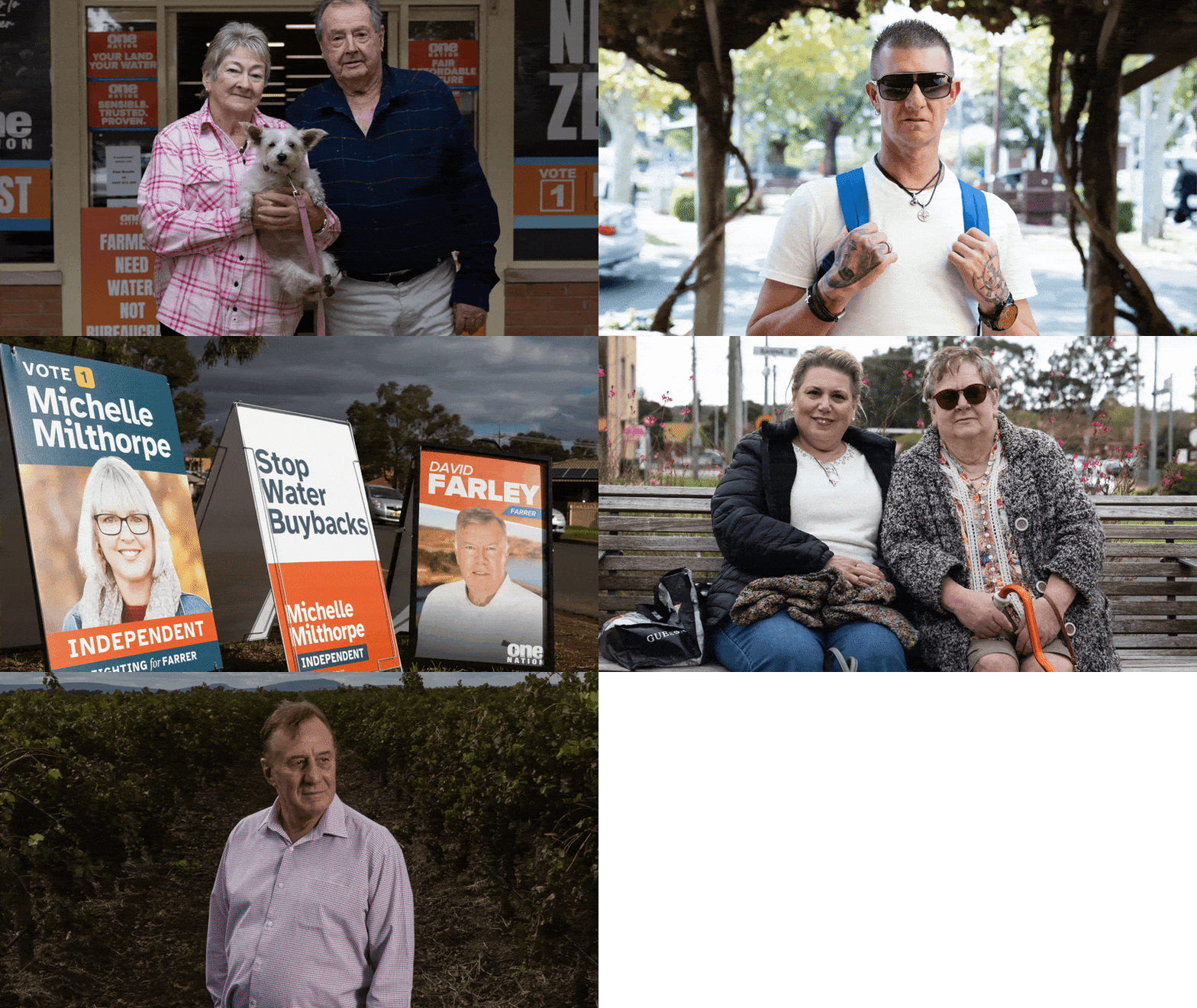
Outside Bertoldo’s Pasticceria, a Griffith institution heavy with cannoli and espresso, Judy and Wally Currie have stopped for lunch. They’ve driven in from Merriwagga, about 70 kilometres away, and like many here, they are not wavering.
“I’m voting for Pauline,” Judy says. “I’m not sure about my husband, but my son has gone Pauline too.”
She pauses, then adds what has become a refrain across the electorate.
“I think people have just had enough around here. We don’t have any good politicians, so people are just saying ‘f’ the lot of youse, I think.”

Wally, halfway through a sausage roll, leans in. He’s made up his mind, too.
“She says what she thinks,” he says. “I think that’s why so many people will vote for her.”
On a nearby bench, Karen Roberts and Lucy Cian are initially reluctant to talk politics. Then, almost sheepishly, they admit they’ve both done the same thing – voted for One Nation.
“She says it how it is,” they say, almost in unison, grateful for being asked.
Lucy, a second-generation Italian-Australian, says it is the first time she has backed Hanson’s party.
“I’m sick of all the jargon, sick at all the rubbish, all the lies, just sick of it. I think Australia’s just going down,” she says.

Her frustration is layered with personal history and her mother’s journey to the region decades ago.
“She was never given a pension. She was never given anything, not even housing, right? She worked, she worked, but she allowed us to stay and become Australian.”
Karen has been voting for Hanson far longer.
“They don’t like what she says because it’s true,” she says. “That’s how I feel anyway.”
“This idiot [Prime Minister Anthony Albanese] keeps handing all their money out to everyone from overseas. I’m not saying they shouldn’t be here. They’re quite welcome to come, but they’ve got to pay their own way.”
In Griffith and beyond, nuance is in short supply. What remains is a pervasive sense of loss. The language is raw and often contradictory. But the through-line is unmistakable: a belief that the system no longer speaks for them.
Daniel Ball, a delivery driver who moved from Sydney to Griffith a few years ago, puts it more quietly.

“Coming here from Sydney, I think I understand why people would vote for Hanson,” he says. “Lots of people don’t feel listened to. Things are sort of forgotten here. The world has really changed the past few years.”
Further east, outside the Leeton pre-poll centre, Daryl Conroy is making a break from habit. He has voted Liberal all his life. Not this time.
“If they weren’t constantly fighting with one another I might have voted for them again,” he says. “But people have simply had enough. I know Pauline doesn’t have a lot of policies, but she says what everyone else is too scared to say.”
In a town that relies on food growing and processing, Kerry Maguire, a nurse and lifelong Coalition voter, tells a similar story.
“I voted One Nation because I want to send the major parties a message,” she says. “Labor and Liberal, there doesn’t seem to be too much direction, you know. Labor are just wasting our money, spending money on campaigns like, get your roof racks off, because that’s going to save petrol.”
Just over 12 months ago, when Ley won with 40 per cent primary vote, only 6.60 per cent of Farrer voted One Nation. In hamlets like Oaklands, it was up to 13 per cent, with booths in Goolgowi, Wentworth, Blighty, Deniliquin and Walla Walla around 10 per cent.
Now, if the polls are correct, One Nation’s primary vote is more than 30 per cent across an electorate the size of South Korea. That’s enough, with preferences from the Coalition, to be a red-hot favourite. While independent Michelle Milthorpe, a candidate taking funding from Climate 200 even as she backs away from their environmental platform, might carry the 60,000-strong city of Albury, the western part of the electorate is in another mood altogether.

One Nation’s 69-year-old candidate, David Farley, is an unlikely vessel for that fight.
In his hometown of Narrandera, an hour and a bit from Griffith, his wife Janice is handing out how-to-vote cards and his 98-year-old mum, Patsy, is voting when this reporter arrives. She smiles before declaring she hasn’t voted for her son. “I’ve got a pimple on my tongue,” she says, giving a cheeky wink.
The presence of the national media over the past few weeks has been welcomed by many, but within One Nation there’s been strict instructions to be wary. Several volunteers have offered a “no comment” as if they’re starring in a new TV police procedural drama.
Farley’s campaign has been littered with controversy, from revelations he tried to run for Labor four years ago, to the endorsement of his independent rival last year, to his contradictory statements on One Nation policy. He’s avoided cameras in recent days, cancelled events and apologised for a volunteer engaging in biffo with an elected politician. He likes to chat and is prone to waffle.
But nobody on the ground really seems to care. A farm sector identity of nearly 40 years, Farley’s career spans from Riverina jackaroo to senior roles at Colly Cotton and the Australian Agricultural Company. Few who have worked with him expected he would align with Hanson’s brand.
But those who know him do not doubt his drive. For some supporters, the distinction matters. They are backing Farley much more than they are backing One Nation.
Even so, the paradox is clear. In a region that depends on migration and prides itself on multicultural cohesion, Hanson’s party is gaining traction. Supporters navigate that tension by focusing on local concerns – water, hospitals and the sense of being ignored.
“There needs to be two different policies,” Pierotti argues, suggesting Farley could influence that. “There needs to be how do we produce housing and workforce in regional areas immediately, then something else for the cities.”
But even among those sympathetic to the revolt, there is caution.
De Bortoli, who has known Farley for years, is careful in how he draws the distinction.
“David’s heart’s always been in the right place,” he says. “He’s got the intellect, he’s got the intelligence, he’s got the tenacity.”
It is an endorsement of the man, but not an unqualified embrace of the vehicle carrying him.
“There’s a bit of baggage there. I will give him my vote, but haven’t given them any money,” De Bortoli says.
That ambivalence runs through the electorate. Voters are prepared to take a risk, but they are not blind to it.
Nobody gives either the Liberals or the Nationals much chance of finishing in the top two. And if the Coalition cannot hold here, questions about its path back to government become unavoidable. If One Nation can win its first-ever seat in the House of Representatives in a seat like Farrer, it would confirm a structural shift on the right of Australian politics.
The Coalition’s strongest redoubts are no longer immovable. Loyalty, once assumed, is now conditional. And in places like Griffith, where politics was once a settled question, it is being asked again – with an edge.
Barnaby Joyce, the high-profile defector to One Nation, describes this election as a catalyst for Australia.
“It’s a sense of the great divide between those inner-city luvvies and those out in regional areas,” he says.
If the orange wave crests here, it will not be because Pauline Hanson suddenly became palatable. It will be because the ground beneath the Coalition has moved.
This is how a protest coalesces – not around a single issue, but around a shared exhaustion.
Cut through the noise of federal politics with news, views and expert analysis. Subscribers can sign up to our weekly Inside Politics newsletter.