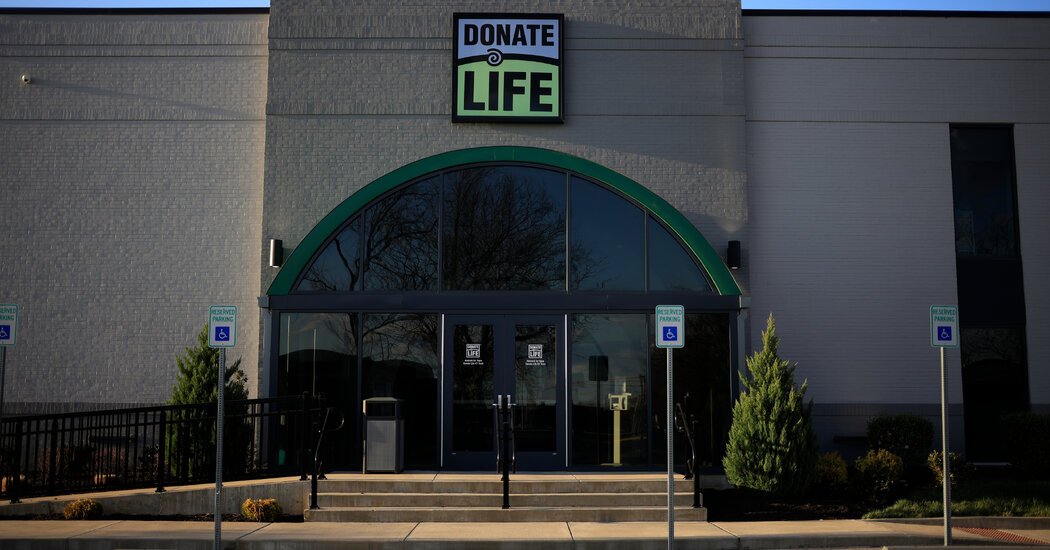
The federal government is firing the nonprofit group that coordinates organ donations in Kentucky after finding that it tried to pursue organs from critically ill people who were recovering from their injuries.
The decision, announced on Wednesday, will effectively shut down the organization, called Network for Hope. It is part of a monthslong effort to address unsafe and unfair practices in the United States organ transplant system.
Health Secretary Robert F. Kennedy Jr., whose department oversees the transplant system, cut ties with a similar nonprofit in South Florida last year. Before that, the roughly 55 groups that have federal contracts to manage donations in the country had never faced closure.
“Today we are restoring integrity,” Mr. Kennedy said at an event in Lexington, Ky. “We will not tolerate organizations that compromise patient safety or betray the trust of donors or their families.”
He said that Network for Hope had endangered patients and failed to fix safety lapses despite numerous opportunities to improve.
Network for Hope is planning to appeal the decision. The organization said in a statement that it had complied with all federal policies and enacted patient safeguards, and that “more than 3,000 people waiting for a lifesaving organ transplant will be negatively impacted by the decision announced today.”
In addition to Kentucky, the group also coordinates donations in more than a dozen counties in neighboring Indiana, Ohio and West Virginia. All its responsibilities will be awarded to another nonprofit.
-
An Improved System: A crackdown on problems with fairness and safety is achieving results, including a big drop in the number of sick patients being passed over for transplants.
-
Skipped Over in Line: The sickest patients are supposed to get priority for lifesaving transplants. But more and more, they are being skipped.
-
Bungled Organ Retrievals: Potential donors endured rushed or premature attempts to remove their organs. Some were gasping, crying or showing other signs of life.
-
Courting Overseas Patients: Despite an organ shortage, some U.S. hospitals seek out international patients, who pay as much as $2 million for a transplant. In recent years, patients from abroad have typically received organs faster than U.S. patients.
-
Pig Organ Transplants: The U.S. Food and Drug Administration has given the green light to two biotechnology companies for clinical trials that will transplant organs from genetically modified pigs into people with kidney failure.
The government’s attempts to improve the transplant system were prompted in part by a series of articles in The New York Times that detailed widespread problems, including with an increasingly common practice called donation after circulatory death.
Unlike most donors, who are brain-dead, the patients in these cases have some brain activity. But they are on life support, often in a coma, and their doctors do not expect them to recover. If donation is authorized, doctors withdraw support, wait for the patient’s heart to stop and then remove the organs. Strict rules are supposed to ensure that no retrieval begins before death or causes it.
In Kentucky, scrutiny began when a congressional committee heard testimony about the case of Anthony Thomas Hoover II, who had an overdose in 2021. After family members were told that he would not recover, they authorized donation.
As coordinators arranged for the surgery, Mr. Hoover began to stir, at one point “thrashing on the bed,” according to records reviewed by The Times. Still, Network for Hope, then called Kentucky Organ Donor Affiliates, tried to move forward. Finally, on the way to the operation, Mr. Hoover cried, pulled his knees to his head and shook his head, and a hospital doctor refused to withdraw life support.
Mr. Hoover eventually recovered, although he has lingering neurological injuries.
Network for Hope initially avoided punishment. But a federal investigation last year determined that the group had similarly ignored signs of growing alertness in more than 70 other patients. Although the organ removals were eventually canceled, the investigation said multiple patients exhibited pain or distress as they were being readied for surgery.
Overall, more than 100 cases had “concerning features,” the investigators said, noting that the majority of transplants arranged by the Kentucky group were from circulatory-death patients.
Last summer, leaders of the organization testified in Congress and agreed to make changes, including increased training and regular neurology tests on potential donors. But regulators ultimately decided the group had not improved enough, leading to this week’s announcement.
Mr. Hoover attended the announcement on Wednesday with his sister and legal guardian, Donna Rhorer. “We are talking about real lives and real families like mine,” she said, adding, “If we don’t act, this will happen again.”
In all, The Times found patients who had endured premature or bungled attempts to retrieve their organs in nine states. In some instances, hospitals, which are responsible for caring for patients before death, mistakenly concluded they would not recover. And although donation organizations are not supposed to have any role in treatment of potential donors, some groups, including the one in Kentucky, improperly pressured doctors and families while ignoring signs of recovery.
In one case in Alabama, surgeons cut into a woman’s chest before discovering she was alive. Doctors sewed her back up, and she was declared dead again 12 minutes later.
The Association of Organ Procurement Organizations, a national trade group, has emphasized that errors are rare and that donations save thousands of lives every year.
A regulatory board that runs the transplant system has been working for more than a year on a set of safety policies. The rules are expected to require potential circulatory-death donors to undergo frequent neurological testing to ensure they are not regaining awareness. The policies would also empower health workers and family members to pause the process.
Mr. Kennedy ordered all organ donation groups to hire patient safety officers after The Times’s reporting last year.
Besides addressing safety problems, government officials are working to improve fairness in the system.
After The Times reported last year that organ donation groups were regularly ignoring federal allocation rules — skipping patients at the top of waiting lists and sending organs to people who weren’t as sick and hadn’t waited as long — officials cracked down on the practice. The latest federal data shows that patients on the list were skipped about 9 percent of the time in the last quarter, down from nearly 20 percent in 2024.
And regulators recently promised renewed focus on another issue reported by The Times: how, despite America’s organ shortage, some hospitals have catered to overseas patients who pay more for transplants.
Congress has started a separate investigation into transplants for international patients. Representative Brett Guthrie, Republican of Kentucky, who chairs the committee that oversees the transplant system, applauded the government action this week.
“The American people deserve to have an organ procurement and transplantation system that they can trust,” Mr. Guthrie said. “This action takes a step forward in restoring integrity back to that system.”