Of Andrea Monda
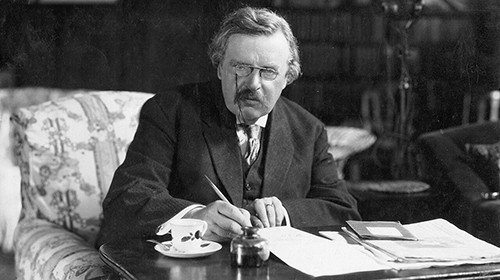
It is no coincidence, also because the case does not exist, that Jorge Luis Borges and Gilbert Keith Chesterton both died on the same day, June 14, but fifty years apart from each other. It is no coincidence because the two writers have many things in common, beyond appearance. On one side one, the Argentine poet, a bit of a dandy, with an encyclopaedic culture, with refined conversation, fascinated by the figure of Christ but who always showed off a melancholy skepticism towards the faith, and on the other the gigantic English novelist and polemicist, a Thomist in the Franciscan habit, champion of the Catholic faith to the point of being defined defender fidei by Pius XI. Nothing in common therefore, or very little… But if you dig a little beyond appearances you will always find some surprises.
Let’s start with Borges who in his literary essays and conversations continually cites some authors as true points of reference: Wilde, Poe, Kafka, Emerson and, above all, Whitman, Homer and Virgil, Dante and Cervantes but, above all the others, Chesterton.
The fundamental point of this reflection of mine is biographical: I owe the knowledge of the older Englishman to the younger of the two, the Argentinian. Hence my immense gratitude towards Borges.
So let’s talk about this poet who is also a sublime literary critic and narrator. In fact, the poet from Buenos Aires soon developed a narrative streak, entirely in favor of the short story compared to the novel which he would never find congenial because it was “too artificial” (he told Alberto Arbasino in an interview in 1977): “Stories on the other hand are always true stories, and men have always loved telling and listening to stories: this is why I love Kipling so much (…) and Stevenson (…). The novel is always a construction, I know that I cannot do it; I can only tell stories. And then, since I’m not a reader of novels, why should I write about them? I don’t read them, except Conrad, which I like a lot.” This observation against the artificiality of the novel is singular as Borges himself would later be the architect of sophisticated stories that became famous for their complexity. It is no coincidence that the two, Jorge Luis and Gilbert Keith dabbled in the mystery genre, the most “artificial”, sophisticated and cerebral of literary genres. And in fictional stories.
As is known, in 1938 the writer had an accident which forced him into immobility for a long time, after an attack of septicemia which seriously threatened his life. During the years of his illness, the Argentine writer conceived some of his masterpieces: the collection of short stories Fictions (1944) and later The Aleph (1949) with which Borges moves on to the fantasy genre, which for him is the main one in literature. The 1940s, in which blindness becomes increasingly threatening, are the years in which the Argentine poet is consecrated as a great author of fiction thanks also to the creation of a true literary mythology composed of some symbolic elements that will accompany Borgesian poetics until the end: the library, the labyrinth, sleep and dreams, chess, the sword, the tiger, the sand, the mirror.
In 1955 Borges was now blind when he was appointed director of the National Library, what he had always dreamed of doing. The writer comments on the nomination thus: «It is a sublime divine irony that has endowed me with eight hundred thousand books and, at the same time, with darkness». And in 1980, in the American Conversationshe will add that «since 1955 my sight no longer allows me to read, and then I have no longer read anything contemporary. I don’t think I’ve ever read a newspaper in my life. We can know the past, but the present is a mystery to us.”
Borges was a great priest of the cult of books, going so far as to affirm that man is what he reads, not what he writes. This statement reveals a true mystique of reading which manifests itself in the belief that “a dialogue, a form of relationship”, “a collaboration and almost a complicity” is established between authors and readers, in a word, that reading is a creative act.
Borges is a writer who loves to surround himself with friends with whom he first and foremost discusses everything, thus resulting in a vast and varied production of volumes of conversations where perhaps Borges, a man-librarian, gives the best of himself. But with his friends Borges not only converses, but also writes: in collaboration with Adolfo Bioy Casares writes in 1942 Six problems for Don Isidro Parodi and with Margarita Guerrero the Manual of fantastic zoology (1957).
On the one hand, therefore, the poet and the lucid and refined narrator, on the other the essayist and the passionate conversationalist: obviously the two souls are one and feed each other.
Borges loved history (he wrote several history books, Universal history of infamy, History of eternity…) but he doesn’t like dates, for example one of his favorite books is The eternal man by Chesterton, an essay in universal history without even a date. And here is Chesterton again. Precisely on this topic, let’s try to compare two statements by the two writers; Borges writes: «I don’t believe in schools. I don’t believe in chronology. I don’t believe in dating works. I think poetry should be anonymous (…). What do we know about the names of those men who wrote that wonderful dream that is The Arabian Nights? Nothing, and we don’t care. (…) I believe that for an author the best thing is to be part of a tradition, to be part of a language, because the language evolves while books can be forgotten.” Concepts very close to what Chesterton states in Orthodoxy: «The legend is generally made by the healthy majority of the inhabitants of a village; the book is written, generally by the one among the villagers who is mad.”
Another theme, perhaps the main one, that unites the two writers is the theme of wonder. It is difficult to find a page of a story or novel or a poem by Chesterton in which this dimension of amazement is not present. Something more precise we can cite from Borges who observes a common origin of poetry and philosophy which, as Plato and Aristotle recalled, is born precisely from wonder. In 1976 in a meeting at Indiana University, Borges stated: «… without a doubt, our existence is a curious fact. (…) being amazed at life can be the essence of poetry. Poetry consists in feeling things as strange (…). The only difference is that in the case of philosophy the answer is given in a logical manner, while for poetry metaphor is used.”
It’s a short step from wonder to mystery. The “stuff” of which reality is made for Borges seems to be the mystery that surrounds every act and moment of human existence. «Every poem is mysterious» states the Argentine, «no one knows entirely what he was allowed to write». Another phrase that Borges often quotes is actually Chesterton’s and reminds us that “everything will pass, only the amazement and amazement at everyday things will remain.” It is precisely there, in everyday things, that wonder lurks, for both poets, because: “There is not a day, not even in prison or hospital, that does not bring a surprise, that is not, against the light, a network of minimal surprises” (from the story The wait by Borges), or because «He who embraces a woman is Adam. The woman is Eve. / Everything happens for the first time” (from the poem There happiness). Borges’ amazement is primordial, it is the wonder linked to the origin, the amazement for the good, that good which is existence itself. In poetry The sea he asks himself: «But who is the sea?» and notes that «Whoever looks at it sees it for the first time, always. / With the amazement / that elementary things leave, the beautiful / afternoons, the moon, the fire of a bonfire”. Elementary things, this is a central node in Borges’ life and work.
In conversation with Osvaldo Ferrari, Borges observes that: «It is so difficult to define things. Precisely the most obvious are those that are impossible to define, since to define is to express something with other words, but these can express less than what needs to be defined. What is elementary, for example, cannot be defined; How can we define the taste of coffee or the grateful sadness that overtakes us at dusk, or the feeling of expectation, of hope, naturally illusory, that we can feel upon waking up? None of this can be defined. Yes, abstract things can be defined; an abstract definition of a polygon or a congress can be given. But I doubt it can be defined as toothache.”
Borges and even more so Chesterton often express the feelings that arise from wonder, first of all gratitude, but also the disorientation and bewilderment that arise from feeling things strange, from feeling foreign. This is a feeling that Borges and Chesterton have in common who said, again quoted by Borges, that: «Reality is stranger than fiction. And Chesterton comments on it acutely and rightly, I think, when he says, “… fiction is created by us, while reality is much stranger because it is created by someone else, the Other, God”».
In the essay already cited The eternal manChesterton states that «The simplest truth about man is that he is a truly strange being: strange almost in the sense that he is a stranger to this earth (…) alone, among all the animals, is he shaken by the beneficial madness of laughter; as if he had grasped some secret of a truer form of the universe and wanted to hide it from the universe itself.”
The two, as well as poets and writers, are extraordinary literary critics. In particular, getting to know Borges is equivalent to getting to know a man-librarian, a traveling library who, with sweetness and humourwelcomes you into its labyrinthine meanders without disorientating you and guiding you by the hand to discover the thousand treasures it contains. It was in that library that I met Chesterton.
Borges literary but also cinematographic critic. His essays on film criticism are formidable, especially if we consider that his was a race against time, as progressive myopia increased. Narrator, poet and critic, Borges was, however, first and foremost a great conversationalist, like Wilde, who was also much loved by Borges, and just like his “master” Chesterton. The two had an almost childlike curiosity about practically everything. And they talked about everything. In the three volumes edited by Osvaldo Ferrari (not the only ones dedicated to Borges’ conversations) we really talk about every aspect of human knowledge: from humour to dreams, from Shakespeare’s poetry to Nordic mythology, to the “flavor of the epic”, from cinema western to memory, from politics to dialogues, from love to Socrates, from prefaces to Melville, from the sea to Thoreau up to the beloved Chesterton who continually returns. Here, for example, is a portrait of him, passionate and very lucid: «There are marked pictorial traces in his writing. His characters enter the stage like actors and his vividly sketched landscapes stick to the memory. Chesterton lived throughout the years steeped in melancholy which he refers to with the definition fin de siecle. From this unavoidable tedium he was saved by Whitman and Stevenson. Yet something remained attached to him, traceable in his taste for the horrid. The most famous of his novels The man who was Thursday, has as a subtitle A nightmare. It could have been Poe or maybe a Kafka; he however preferred, and we are grateful for the choice, to be Chesterton and courageously opted for happiness or pretended to have found it. From the Anglican faith he moved to the Catholic one, which, according to him, is based on common sense. He argued that the strangeness of such belief fits the strangeness of the universe, as the strange shape of a key fits perfectly the strange shape of a lock. In England, Chesterton’s Catholicism has damaged his reputation, as people persist in reducing him to a mere Catholic propagandist. Undeniably he was, but he was also a man of genius, a great prose writer and a great poet… Literature is one of the forms of happiness; perhaps no writer has given me as many happy hours as Chesterton.”
I can say the last statement too, and I say it by addressing, with gratitude, precisely Borges.