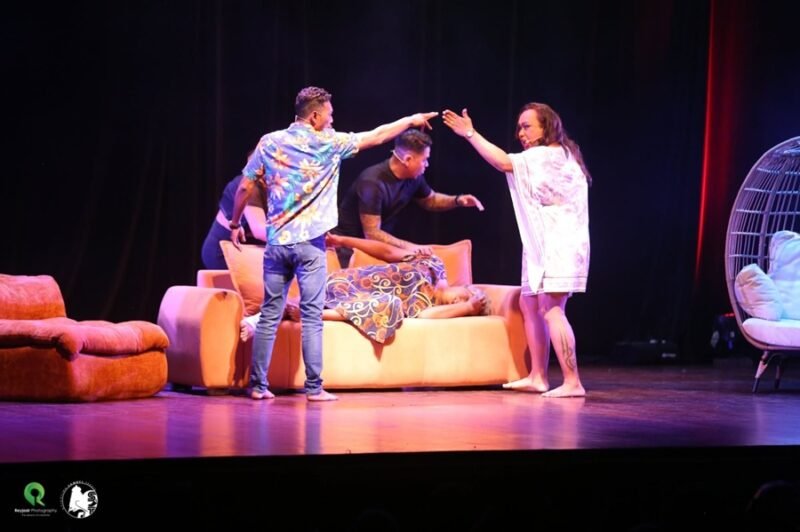
It’s quiet for a moment. Gaffie Marno and Sally Karto have welcomed the audience and leave the stage. Then the lights go out. It is completely dark when an exciting, almost eerie melody sounds from the speakers. The music stops abruptly, after which the familiar soundtrack by Sambel Trasie sounds. The lights turn on, the curtains slide open and there is Tristan and Jamille’s bedroom. “Good morning, we are going to school, to school on time,” the radio sounds. Grandma Djoemienten wakes up her grandchildren. A seemingly ordinary morning, but it is the beginning of a story about family, greed, loss and ultimately reconciliation.
Text Shanavon Arsomedjo
Image Rey Jasir Photography
With ‘A second chance’, Sambel Trasie presented her twentieth theater piece in Theater Thalia this month. The series came to an end on Sunday with two performances. The two-hour afternoon performance was a catch-up show. During the first performance on September 3, the power went out, giving the audience another chance to ‘see’ the story. The hall was full.
“The audience sometimes doesn’t know what is going to happen and neither do the actors. That creates a spontaneity that is difficult to play”
Legacy
At first glance, the story revolves around a family in which relationships have been under strain for some time. Sally, the mother of Tristan and Jamille, lives in the Netherlands and her children live with their grandmother Djoemienten.
When Sally returns to Suriname, reunion with her family seems obvious. But before there is really room for warm conversations, a special topic comes up: family shares and her father’s legacy. But her mother prefers not to talk about it.
When Sally brings up the issue again another time, an argument ensues with her brother. Djoemienten, who is already not strong due to her poor health, can hardly handle the tension. During a heated argument between her children, she collapses on the couch. The argument dies down. Djoemienten has passed away.
But that’s not the end of it. Even on the day of her funeral, emotions still seem to be running high. Then the notary assistant appears with the will. And that’s exactly where the story takes its unexpected turn. Not Sally and her brother, but Tristan and Jamille appear to be the heirs of everything their grandmother leaves behind.
The message hits home hard. Not only because it concerns possessions that the children automatically expected, but because the will confronts the family with a painful truth: Djoemienten had a much closer bond with her grandchildren than with her own children.
It is precisely that blow that causes something to change. What threatened to fall apart due to greed is given another chance. Sally realizes that this is an opportunity to repair the relationship with her children and with her brother and sister-in-law.
Here the family opts for ‘A second chance’. The play is about material things, but ultimately mainly about what people lose when possessions become more important than family.
Audience favorite
Yet the performance is anything but heavy from start to finish. Anyone who knows Sambel Trasie’s previous productions will notice that the group has made a lot of room for humor this time. The laughs come not only from the dialogue, but also from the way the actors portray their characters.
One of the biggest audience favorites is ‘Pa Chally’, played by Siris Doelbakir. He appears at unexpected moments and sometimes even seems to surprise his fellow players. During a visit to his grandson at work, a dialogue arises that is so unexpected that even the actors have difficulty containing their laughter.
But the absolute ‘highlight’ comes during Djoemienten’s funeral. ‘Pa Chally’ appears there in a strikingly tight bodysuit. The crowd erupts. Meanwhile, on stage, the other actors try to keep a straight face. Not everyone can do that equally well.
The laughs are real, the surprise is real, but all the while the players remain true to their roles in every scene. It is precisely such moments that make the theater lively. Sometimes the audience doesn’t know what’s going to happen and neither do the actors. That creates a spontaneity that is difficult to play.
Musical closing of the theater year
In between the humor, the performance maintains its core message: ‘don’t build your happiness on shares or earthly goods’. Make sure you take care of your own affairs while you still have the opportunity, because no one knows what tomorrow brings.
And perhaps even more importantly: ‘don’t wait too long to make things right with the people who are important to you’. When Rocheteau Tirtamenawi sings ‘Wan nyun libi’ at the end, that message gets a musical conclusion.
A new chance, a new life and trying to do better together. The characters have not been able to undo their loss, but they can choose what to do with the time they have left. Sally, together with the rest of the group, has once again proven that strong theater can be created from difficult subjects.
“What threatened to fall apart due to greed is given another chance”
Sambel Trasie closes the 2026 theater year with ‘A second chance’. At the same time, a new face was introduced to the group: Denise Kertowidjojo, who played the role of Sally’s sister-in-law.
The group will return to the stage together in 2028. What happens in the meantime remains a surprise. Perhaps that is also appropriate. Because just like in the play, no one knows exactly what tomorrow brings.