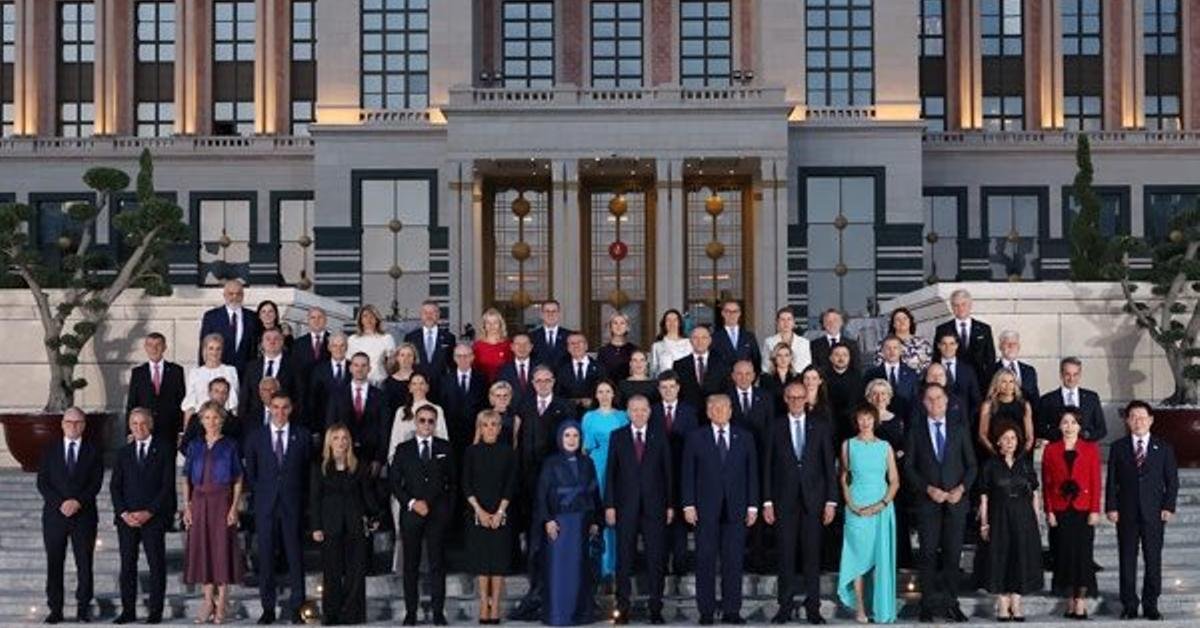
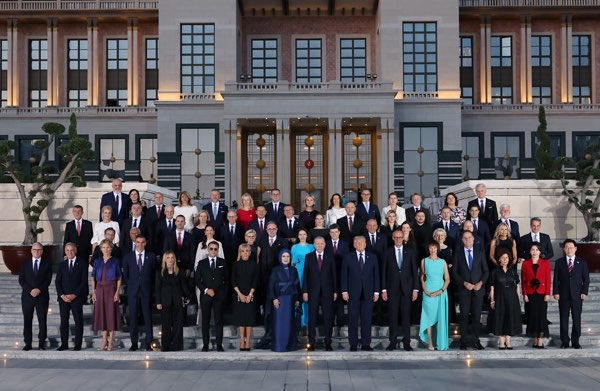
Ankara/NATO leaders began this Wednesday the only work session planned at the Ankara summit, marked by the confrontation of the president of the United States, Donald Trump, with allies such as the United Kingdom, Spain and Denmark for their role in the war in Iran and for control of Greenland.
The North Atlantic Council began its meeting at the Bestepe presidential complex focused on defense spending, the promotion of the military industry and support for Ukraine under the tension introduced by the American president.
In a meeting with the Secretary General of the Alliance, Mark Rutte, Trump attacked different allies for not having provided him with the support he considered necessary in his campaign against Iran, a country with which he ended the ceasefire after the latest cross attacks.
Specifically, he had harsh words against the United Kingdom, Italy or Spain, which he considered a “lost cause” and with which he asked to cut “all trade”, even though it is impossible because it requires it to be suspended with the entire European Union as a bloc.
Specifically, he had harsh words against the United Kingdom, Italy or Spain, which he considered a “lost cause” and with which he asked to cut “all trade”, even though it is impossible
Rutte tried to calm the situation by referring to the efforts of these countries to increase their military investment since last year. “You mentioned Spain; even you managed to get Spain to pay 2% (of its GDP in military spending), they took a huge step last year. There are some issues that we have to resolve, but Spain reached 2%,” he said.
The former Dutch prime minister insisted that there were only “isolated cases” among the allies regarding the refusal to support the US and Israel operation in Iran, and that up to 5,000 planes took off from European airports to support ‘Epic Fury’.
“That makes Europe a great platform for projecting the power of the United States helping with ‘Epic Fury’, including countries that you have mentioned, such as Germany, from day one, or France and many others,” Rutte summarized.
Regarding the United Kingdom, Rutte reminded him of his “very strong relationship” with the country and its authorities. Outgoing Prime Minister Keir Starmer has pledged to invest another $20 billion in defense.
Trump also criticized Denmark and considered that Greenland, its associated autonomous territory, would be better managed by the United States, which assured that it needs the island not only to protect itself as a country but for “the protection of the world.” During the session with the allies, he added, he will explain that “Greenland is a big problem for us.”
Previously, the Prime Minister of Denmark, Mette Frederiksen, had stated upon arrival at the summit that Greenland “is not for sale” and warned that Copenhagen will defend “every inch of its territory.” The leaders of other countries such as the Netherlands, Iceland and Latvia also closed ranks around Denmark in the face of Trump’s new onslaught.
From Brussels, Trump’s comments also had a response. The European Commission recalled that decisions on the future of Greenland “are the responsibility of the Greenlanders and the Danes” and maintained that the EU “shows full solidarity” with Denmark.
The European Commission recalled that decisions on the future of Greenland “are the responsibility of the Greenlanders and the Danes” and maintained that the EU “shows full solidarity” with Denmark
“Greenland is an autonomous territory of the Kingdom of Denmark. Decisions about the future of Greenland correspond to the Greenlanders and the Danes,” said the Community Executive’s Trade Spokesperson, Olof Gill, at the institution’s daily press conference.
Territorial integrity, national sovereignty and the inviolability of borders, he stressed, are fundamental principles of international law: “They are essential not only for the EU, but for nations around the world.”
Regarding the allusions to Spain, Gill asked Washington to respect the trade pact it has signed with the European Union, by which it has committed to applying a 15% tax to most European products, in exchange for its industrial goods reaching the community bloc free of tariffs.
“We will continue to champion stable, predictable and mutually beneficial transatlantic trade,” the spokesperson continued, stating that “safeguarding this relationship is more important than ever in times of geopolitical disruption.”
The host of the summit, Recep Tayyip Erdogan, underlined in his initial speech to the leaders Turkey’s commitment to raising defense spending to 5% of GDP as early as 2030, but insisted that “restrictions between allies in the defense industry must be removed.”
“Excluding countries that are not members of the EU would be wasting resources and creating an artificial division in Europe that no one wants,” he said, referring to the SAFE community credits, created to finance the acquisition of weapons produced by European Union countries.
“The United States has been NATO’s greatest ally for 80 years. That is not going to change simply because an (American) president criticizes the organization”
Additionally, Erdogan promised to maintain aid to Ukraine while employing “channels of communication with Russia to facilitate a peaceful solution,” and applauded Trump’s “firm stance to stay the course toward a solution to the Iran crisis despite attempts at sabotage,” in a speech read just moments after Trump called off negotiations with Tehran.
Belgian Prime Minister Bart De Wever had predicted upon his arrival that they would listen to what Trump had to say, but he ruled out that he was going to “question the very existence” of NATO. “The United States has been NATO’s greatest ally for 80 years. That is not going to change simply because an (American) president criticizes the organization,” he stressed.
The summit officially began on Tuesday with an industrial forum that raised at least $50 billion in new defense material contracts, and a reception with Ukrainian President Volodymyr Zelensky, who was however absent from today’s plenary session.
A NATO-Ukraine Council at the level of foreign ministers also took place the day before. In the final declaration of today’s summit, allies are expected to support a financial commitment to support kyiv militarily that could amount to €140 billion over two years.